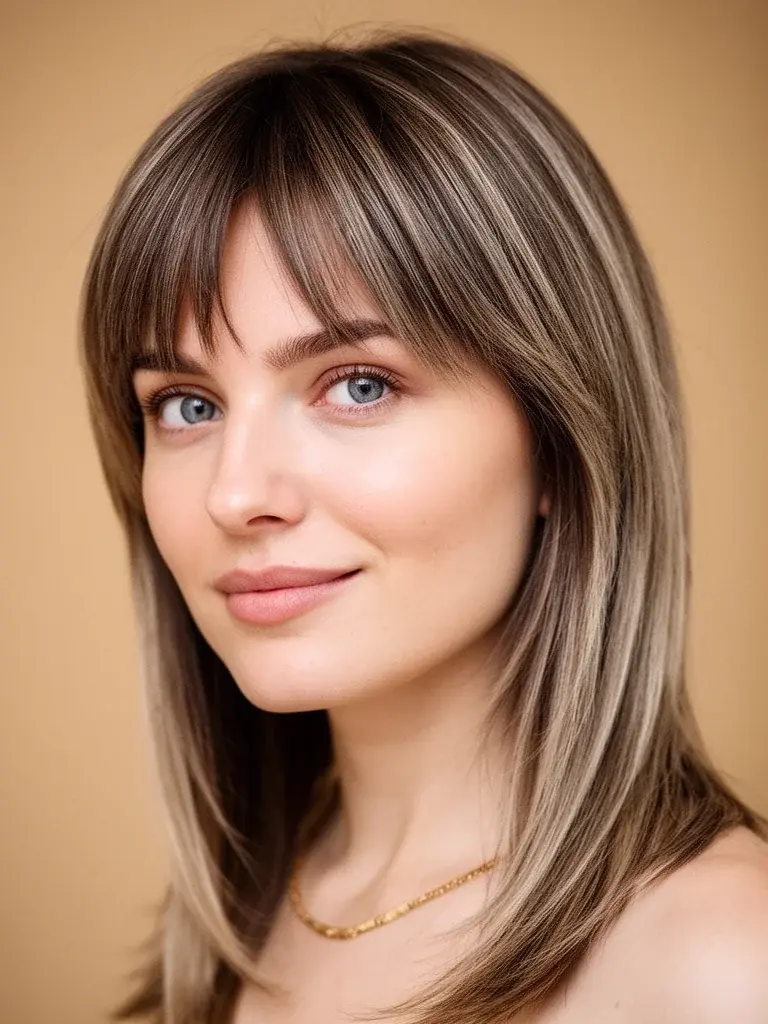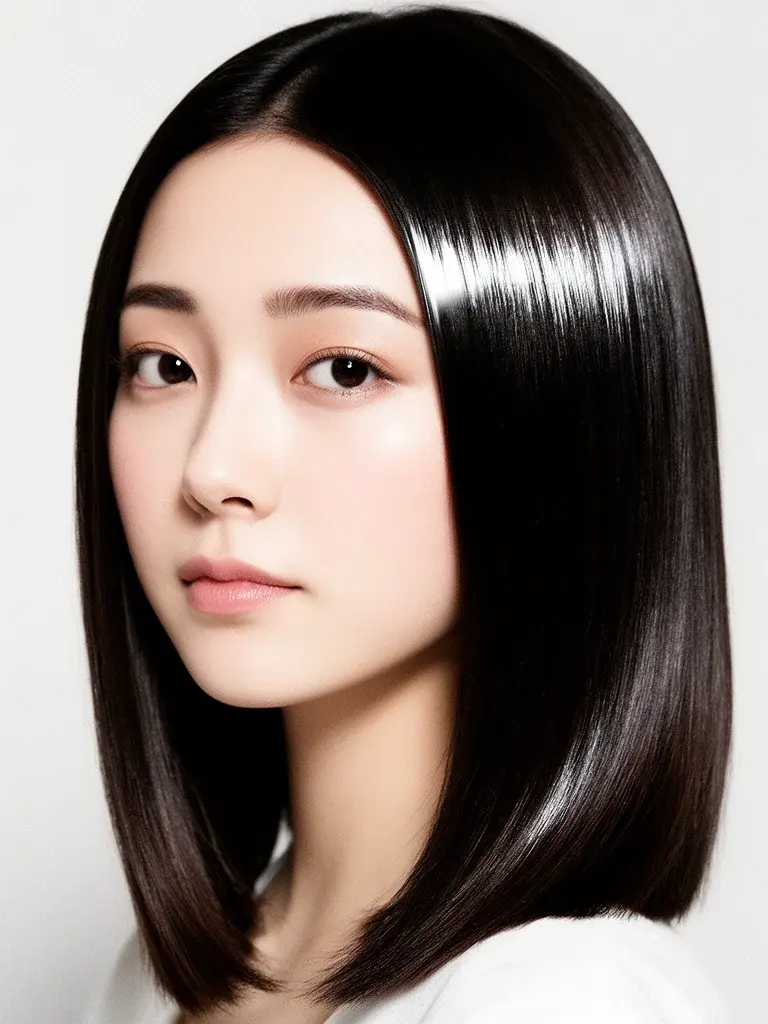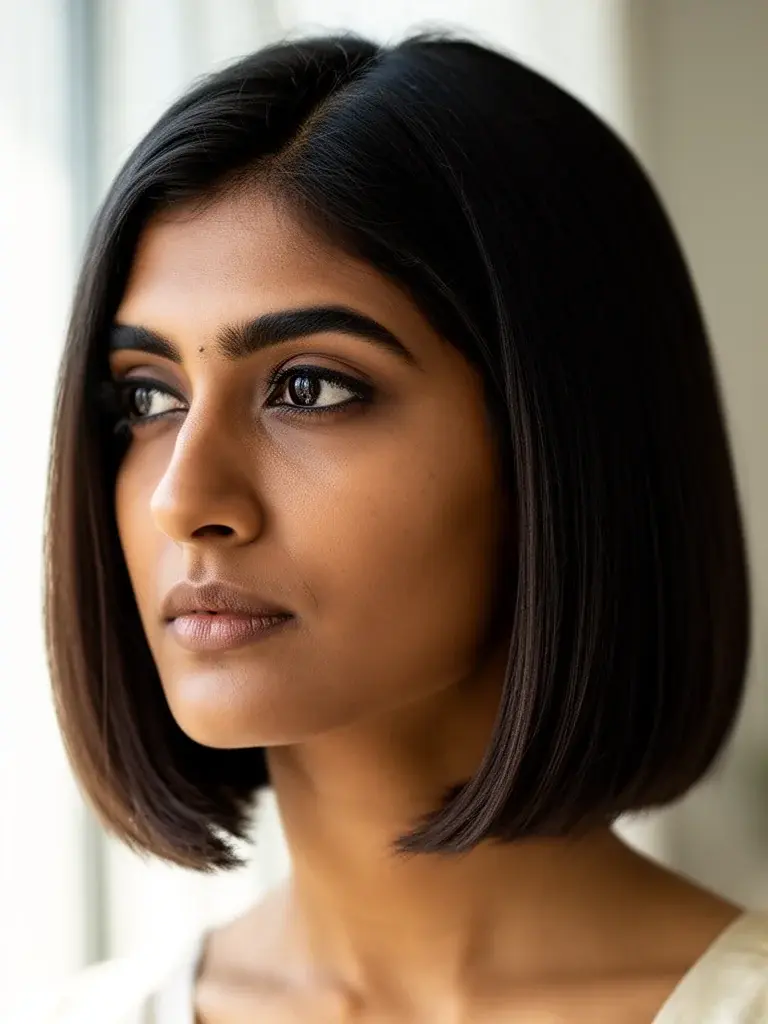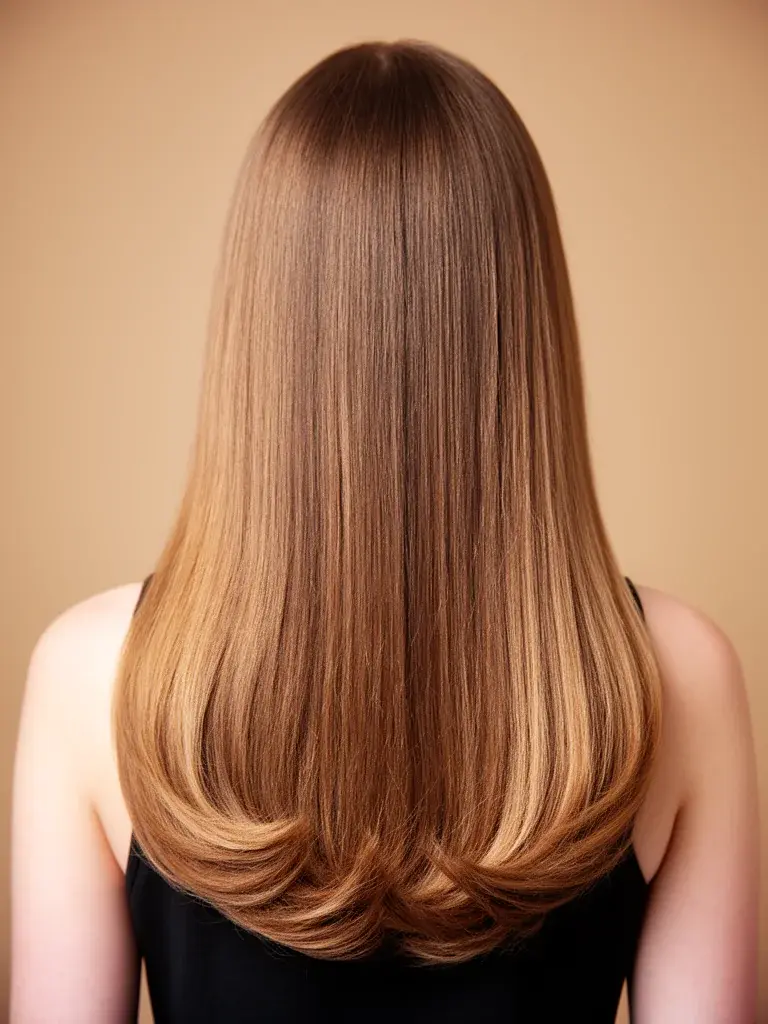
TL;DR
- Best for: Straight or thick hair wanting maximum density, clean lines, and the glass-hair aesthetic
- Avoid if: You have naturally curly hair and won't flat-iron regularly, or you want visible movement and texture
- Ask your stylist: "One length, no layers, sharp horizontal line. I want maximum density at the ends. If my hair is too thick underneath, use internal texturizing — don't add visible layers."
- Maintenance: Trim every 8-10 weeks for the sharp line; glass-hair styling takes 15-20 minutes daily
Who Does It Suit?
Blunt long hair is the anti-trend. While everyone else chases wolf cuts and butterfly layers, this is the deliberate choice to reject complexity. One length. One line. Maximum impact through minimum interference.
Ideal for:
- Straight hair types where the cut's geometry shows — the flatter the natural texture, the more dramatic the blunt line
- Thick hair that wants density celebrated rather than thinned out — blunt cuts let thick hair be thick
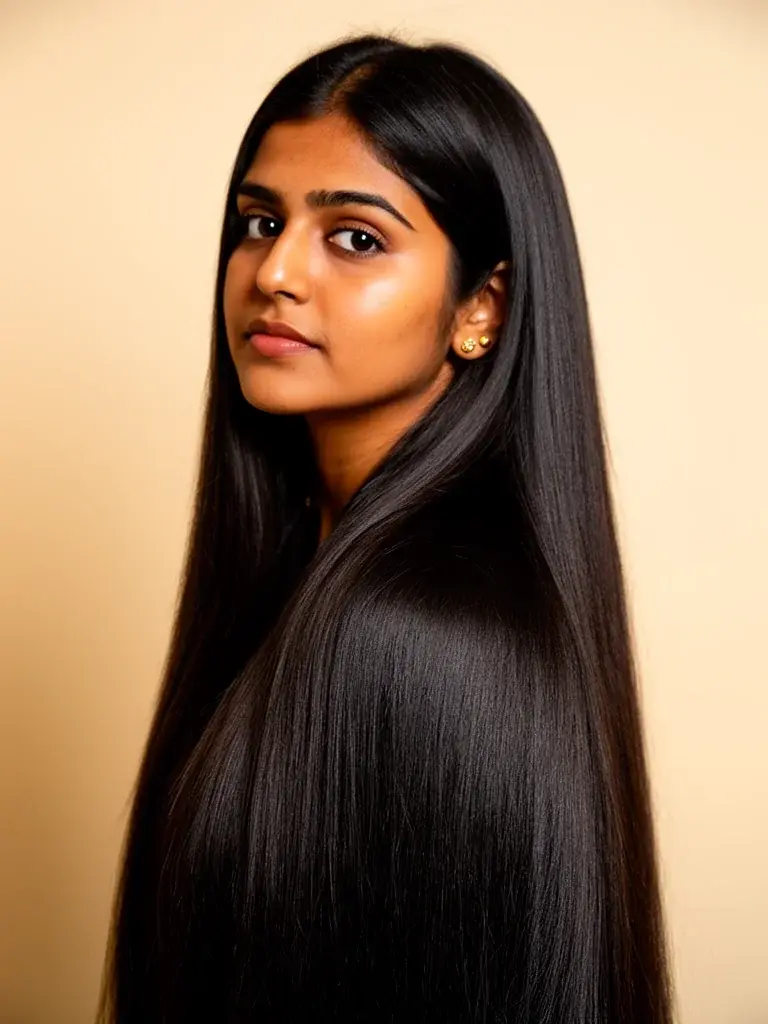
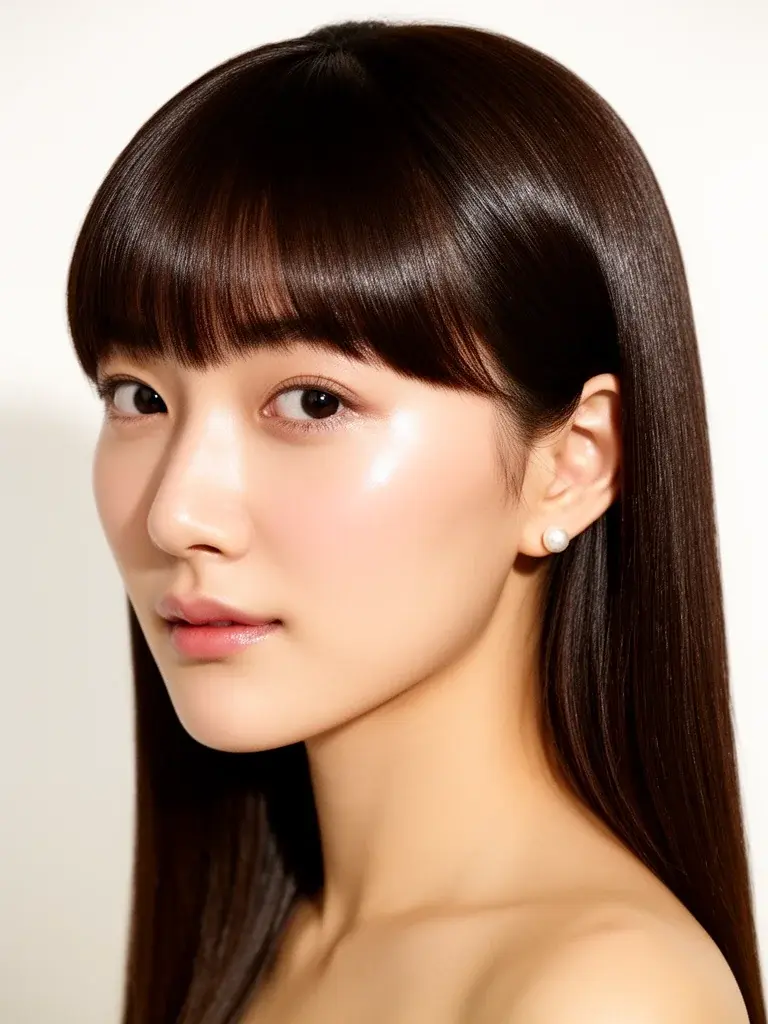
- Women chasing the "Glass Hair 2.0" trend of 2026 — blunt one-length hair extended to waist with mirror-like finish
- Oval, square, and oblong face shapes where the strong horizontal line creates visual anchoring
- Anyone tired of being told they "need layers" — you don't, and this cut proves it
Hair types:
- Straight: The ideal candidate — the cut's geometry shows cleanly and the glass-hair finish is achievable without fighting natural texture
- Thick: Excellent — maximum density, maximum visual weight. Internal texturizing handles the bulk without changing the outside shape
- Fine: Surprisingly good — the blunt cut preserves every strand of density that layers would remove, making fine hair look thicker than it is
Avoid If...
- Your hair is naturally curly or coily → a blunt cut on curly hair doesn't look blunt when styled naturally. Each curl's shrinkage creates an uneven hemline. If you want the glass-hair look, you'll flat-iron daily — which is a heat commitment and a texture fight. Beach waves or spiral curls work with your texture instead
- You want visible movement and texture → blunt long hair is intentionally uniform. The beauty is in the stillness, the weight, the sheet-like quality. If you want bouncy movement, v-cut-layers or shoulder-length-layers are better bets
- You skip trims regularly → blunt cuts are the least forgiving of split ends and uneven growth. A layered cut masks a missed trim. A blunt cut broadcasts it. If you won't commit to 8-10 week trims, the clean line degrades into a messy hem
- You want face framing → this cut has no face-framing layers, no curtain-bangs integration, no graduated front pieces. Your face frame is your face. If you want hair that frames, consider adding face-framing layers as a hybrid, or accept that this is a different aesthetic
- You live in high humidity → glass hair requires smooth, sealed cuticles. Humidity forces cuticles open, creating frizz that breaks the mirror effect. A humidity-resistant serum helps but won't fully counteract consistently humid climates
What is Blunt Long Hair?
Blunt long hair is one-length hair with no layers, no graduation, and a sharp horizontal cut line at the bottom. Every strand terminates at the same point. The result is maximum density at the ends, maximum weight through the body, and a geometric precision that layered cuts deliberately avoid.
The "blunt" in blunt long hair refers to the cutting technique: shears cut straight across, creating a single clean line. No point-cutting, no razor, no texturizing. The ends are thick, uniform, and deliberate. In a world of "lived-in" texture and "effortless" layers, blunt long hair is the opposite — it is obvious effort, obvious intention, obvious precision.
The glass-hair trend of 2024-2026 is built entirely on blunt long hair. The mirror-like shine that defines glass hair requires a flat, unbroken surface for light to reflect uniformly off of. Layers break the surface. Texturizing disrupts the plane. Only a one-length cut creates the continuous sheet that catches and reflects light like water.
Blunt Long Hair vs V-Cut Layers vs U-Cut Ends
| Blunt Long Hair | V-Cut Layers | U-Cut Ends | |
|---|---|---|---|
| Back shape | Straight horizontal line | Sharp V-point at center back | Soft U-curve |
| Layer visibility | None — one length | Visible tapered layers | Subtle graduated ends |
| Weight distribution | Maximum, uniform across the line | Lightest at sides, heaviest at center | Medium, gradual transition |
| Braid-friendliness | Best — all ends are even | Layers poke out of braids | Good — smooth curve |
| Grow-out ease | Easiest — stays clean longest | V softens to U naturally | Stays U-shaped |
| Best for | Straight, thick, fine | Thick, wants movement | Any, wants softness |
| Glass-hair potential | Maximum | Low — layers break the surface | Medium — slight curve |
Bottom line: Blunt = maximum density and simplicity. V-cut = shape without sacrifice. U-cut = the soft middle ground. If you want the glass-hair mirror finish, only blunt delivers.
Cut Specifications
Blunt long hair is the simplest cut conceptually and one of the most demanding in execution. A perfectly straight horizontal line on hair that grows at different rates across the head requires genuine precision.
- Cutting technique: Scissors only, cutting straight across. No razor (creates feathered, uneven ends). No point-cutting (thins the end line). The stylist should section the hair flat against the back and cut in one continuous motion per section, checking the line from multiple angles.
- Internal texturizing: For thick hair only — the stylist lifts the top 2-3 inches of hair, thins the interior sections underneath using controlled point-cutting or thinning shears, then drops the top layer back. The outside remains one-length and dense; the interior is lighter and more manageable. This is different from visible thinning — nobody sees it.
- Length: Below the collarbone to work as a visual statement. The sweet spot is mid-chest to waist — long enough for the sheet-like quality to read, short enough to maintain easily. Above the collarbone, one-length hair reads as a lob rather than blunt long hair.
- End precision: The horizontal line must be genuinely horizontal, not slightly curved. Have your stylist check from behind with your head level — not tilted forward, not to the side. A 1-degree angle becomes visible over the width of the hair.
- Trim cycle: Every 8-10 weeks, strictly. The blunt line is the entire aesthetic — once ends become uneven from natural breakage and growth-rate variation, the cut looks abandoned rather than intentional.
Color Pairing
- Single-process glossy brunette: The glass-hair default. Rich espresso, chocolate, or dark mahogany as a uniform color creates the most light-reflective surface. Variation in color breaks the mirror — monotone amplifies it. Add a clear gloss treatment for maximum shine.
- Platinum or silver-toned: Platinum blonde on blunt long hair creates a runway-editorial effect — the monotone lightness combined with the sharp line looks intentional and polished rather than casual. Requires significant maintenance (toner every 4-6 weeks) and protection from warmth pulling through.
- Ombre (subtle): A 2-shade gradient from roots to ends works on blunt long hair because the color transition follows the length without interruption. The horizontal cut line shows where the ombre ends — a deliberate frame. Avoid ombre with more than 2-shade difference, which can look like outgrown highlights.
- Avoid heavy balayage: Balayage is designed to create dimension and movement — it fights the glass-hair aesthetic that blunt long hair exists for. If you want a dimensional color, consider v-cut-layers or shoulder-length-layers where the layered structure works with the color technique.
Face Shape Tweaks
- Oval: Blunt long hair at any length — the balanced proportions handle the strong horizontal line without adjustment. Center part or side part both work
- Square: The horizontal cut line mirrors the strong jawline — this can either emphasize or soften depending on styling. A slight side part and the hair falling forward past the shoulders softens the geometric echo. Avoid center parts that create symmetry with a square face
- Heart: Blunt long hair adds visual weight below the chin, balancing a wider forehead. The density of the cut at the ends creates the counterweight that heart faces need. Keep the length at mid-chest or longer for maximum balancing effect
- Oblong: The horizontal line creates a visual stop point that shortens the face. Blunt long hair is one of the best cuts for oblong faces — the strong horizontal line acts as an architectural element. Keep the length at collarbone to chest to maximize the shortening effect
- Round: Proceed with caution — blunt long hair can add visual width. If you have a round face, keep the length below the chest so the hair falls past the widest point of the face. Add a deep side part to break the symmetry
Hair Type Tweaks
- Straight: Your natural texture is the ideal canvas. The flat surface shows the blunt line most cleanly and achieves the glass-hair finish most easily. Minimal styling required — blow dry and smooth.
- Thick: The cut celebrates your density rather than fighting it. If the bulk becomes unmanageable, ask for internal texturizing (thinning underneath) rather than adding layers that break the blunt line. The outside stays dense; the interior breathes.
- Fine: This is your density hack. The blunt cut keeps all your hair at one length, so every strand contributes to the end line. Fine hair with a blunt cut looks thicker than fine hair with layers, because the layered version spreads the already-sparse ends across multiple length levels. The trade-off is flatness — add root lift during styling.
- Wavy: You can have a blunt cut on wavy hair, but the glass-hair finish requires blow-drying straight. If you're willing to straighten regularly, the blunt line works. If you want to wear your waves, the one-length cut creates a beautiful natural curtain — just don't expect the glass-hair mirror effect.
Getting the Glass Hair Finish
This is the technique that makes blunt long hair a statement rather than just long hair that hasn't been cut in a while.
- Start clean: Wash with a smoothing shampoo, not a volumizing one. Volumizing products lift the cuticle for body; glass hair needs the cuticle sealed flat. Follow with a silicone-based conditioner that coats and smooths.
- Smoothing serum first: On damp hair, apply a silicone-based smoothing serum (not oil — serum dries down, oil stays wet) evenly from mid-length to ends. This creates the slip layer that allows the cuticle to lie flat.
- Blow dry with a paddle brush: Section hair into 4-6 horizontal layers. Using a paddle brush (not round — round adds curve), blow dry each section by pulling the brush straight downward from root to end. Keep the nozzle pointed DOWN the hair shaft — blowing against the cuticle direction creates frizz. This step does 60% of the glass-hair work.
- Flat iron in single passes: Temperature: 300-350°F for fine/normal hair, 380°F for thick. Slow, single passes only — multiple passes over the same section damages without benefit. Start each pass 2 inches from the root and glide to the end in one motion. The flat iron seals what the blow dry started.
- Cold air blast: After flat ironing, hit the entire length with cold air from your dryer. Cold contracts the cuticle, locking in the smooth surface. This step is why professional glass hair looks better than DIY — most people skip it.
- Finish with serum, not spray: A final microscopic amount of serum (pea-sized for all hair) smoothed over the surface with your palms. Hairspray creates texture; serum creates mirror. The glass-hair finish is touchable, not helmet-like.
What to Tell Your Stylist
"I want one-length, no layers, with a perfectly straight horizontal line at [reference point]. No point-cutting, no razor. I want maximum density at the ends — if it's too thick underneath, use internal texturizing but keep the outside shape one-length. Please check the line from behind when my head is level."
Reference photo tips:
- Bring a BACK VIEW photo — the blunt line is the cut's defining feature, and it's invisible from the front. The back view is what your stylist needs to match
- Specify the finish you want: "glass hair" vs "natural one-length" — they require different approaches to the end texture
- If your hair is thick, mention that you want internal texturizing rather than visible layers — many stylists default to adding layers for thick hair, which breaks the blunt aesthetic
- Show the exact point on your body where you want the line: "bottom of my shoulder blades" is clearer than "long"
- Ask the stylist to check the line while you're standing (not sitting) with your head level and facing forward
How to Style
Daily (15 minutes):
- Apply smoothing serum to damp hair, mid-length to ends
- Blow dry in sections with a paddle brush, nozzle pointed downward
- Once dry, check the surface for any flyaways or sections that aren't lying flat
- Run a flat iron through only the sections that need it — don't flat iron the whole head unless going for full glass-hair finish
- Finish with a cold-air blast and a tiny amount of serum on the surface
Polished / Glass Hair (25 minutes):
- Smoothing shampoo + conditioner in the shower
- Damp hair: apply smoothing serum evenly from mid-length to ends
- Section into 4-6 horizontal layers and blow dry each section with paddle brush, pulling straight down
- Flat iron the entire length in slow, single passes — 300-380°F depending on thickness
- Cold-air blast from roots to ends
- Pea-sized serum smoothed over the surface with palms
- No spray, no powder, no texture — the finish should be mirror-smooth and touchable
No-Heat Alternative:
- Apply smoothing serum and a light styling cream to damp hair
- Wrap hair around your head in a "hair wrap" technique — brush hair flat around your skull, securing with clips every few inches
- Allow to air dry completely (requires several hours or overnight)
- Remove clips — hair falls straight and smooth with minimal frizz
- Finish with serum on the surface
- Note: this won't achieve full glass-hair level shine, but it gives a smooth, polished one-length look without heat
Maintenance Schedule
- Week 1-2: The line is razor-sharp, the ends are fresh, and the glass-hair finish takes minimal effort. Everything about the cut is working at peak precision.
- Week 3-4: Still looking sharp. Individual hairs grow at different rates, but the density of the blunt cut masks minor variations. Glass-hair finish is still achievable with the normal routine.
- Week 5-6: Some unevenness is starting to show at the ends, especially visible in natural light from behind. The line is still functional but no longer mathematically perfect. Split ends may begin appearing on the most exposed outer layer.
- Week 7-8: The line is softening. If you've been heat-styling regularly, the ends need attention — dryness and splits are breaking the smooth surface. Time to book a trim.
- Week 8-10: Trim. The stylist re-establishes the sharp horizontal line, removes split ends, and the cut is back to peak condition. A good stylist can maintain length while restoring precision — you shouldn't lose more than half an inch.
If you color your hair:
- Glossing treatment: every 6-8 weeks for brunettes, every 4-6 weeks for blondes. The gloss adds the shine layer that makes glass hair work — it's part of the style, not a luxury add-on.
- Full color: every 6-8 weeks. Blunt long hair shows root grow-out more clearly than layered hair because there's nothing to break up the color line.
- Deep conditioning: every 2 weeks if heat-styling regularly. The flat iron and blow dry routine strips moisture that the smoothing serum only masks — the deep mask actually repairs.
Pro tip: Invest in a boar-bristle paddle brush specifically for blow-drying. Nylon bristles snag; boar bristles smooth. The brush quality affects the glass-hair finish more than the flat iron quality.
Common Mistakes
-
Adding "just a few layers" for movement Fix: A few layers is no longer a blunt cut. The entire aesthetic depends on one length. If your stylist suggests layers, say no. If you want movement, add it through styling (round brush curving at the ends) rather than cutting. Movement from layers is permanent; movement from styling is reversible.
-
Skipping trims and hoping it won't show Fix: It shows. Blunt long hair has zero margin for uneven ends. A layered cut at week 12 looks like a layered cut that's growing nicely. A blunt cut at week 12 looks like neglected hair. The trim schedule IS the style. If you won't maintain it, consider v-cut-layers which degrades more gracefully.
-
Using volumizing products Fix: Volumizing shampoos, root powders, and texturizing sprays all work by lifting the cuticle or adding grip. The glass-hair aesthetic requires the exact opposite — flat cuticle, zero grip, maximum slip. Every volumizing product in your routine is fighting the cut's intention. Switch to smoothing products across the board.
-
Blow-drying with a round brush Fix: A round brush adds curve and body to the ends — which is the opposite of the blunt-line aesthetic. Use a flat paddle brush and pull straight down. The goal is to make each section fall perfectly flat, following gravity rather than curving against it.
-
Multiple flat-iron passes over the same section Fix: One slow pass at the right temperature does the work. Multiple fast passes at high temperature damage the hair without additional smoothing benefit. Each unnecessary pass degrades the cuticle surface that you need intact for the mirror finish. Slow down, get it right in one pass, move on.