TL;DR
- Best for: Every face shape — round faces gain slimming angles, long faces gain width, square faces gain softness
- Avoid if: Very tight curls (they shrink too much) or you refuse to own a round brush
- Ask your stylist: "Curtain bangs starting at cheekbone length in the center, blending to chin length at the sides — feathered, not blunt"
- Maintenance: Trim bangs every 5–6 weeks; base haircut on its own schedule
Who Does It Suit?
Curtain bangs are the most universally flattering bang style. The center part and outward sweep create diagonal lines that work with nearly every face geometry.
Ideal for:
- Round faces that need slimming angles (the diagonal sweep narrows visually)
- Square or angular jawlines that need softening around the forehead
- Heart-shaped faces where the forehead is wider than the chin
- Women who want a visible change without altering their base haircut
- Anyone who's been "thinking about bangs" for months but hasn't committed
Hair types:
- Straight: Clean, polished curtain effect — the easiest type to style and maintain
- Wavy: Natural wave creates effortless bend away from the face; often looks better than straight curtain bangs
- Thick: Works well but needs thinning — heavy curtain bangs fall flat instead of sweeping
- Fine: Surprisingly good — curtain bangs add the illusion of density around the face
Avoid If...
- Very tight curls (type 3C–4C) → curls shrink 30–50% and won't hold the curtain shape; consider face-framing layers cut into your natural curl pattern instead
- You won't touch a round brush or blow dryer → curtain bangs need 2 minutes of directional drying when new; once trained (after 2 weeks), some hair types can air-dry them, but not all
- Cowlick right at the center part → a strong cowlick pushes bangs in the wrong direction; side-swept bangs work better with cowlick patterns
- Your base haircut is shorter than chin-length → curtain bangs need length to blend into; on very short cuts, they become a disconnected fringe rather than a curtain
- You want full forehead coverage → curtain bangs part in the center, so your forehead shows between them; for full coverage, get blunt bangs or a French Crop
What is Curtain Bangs?
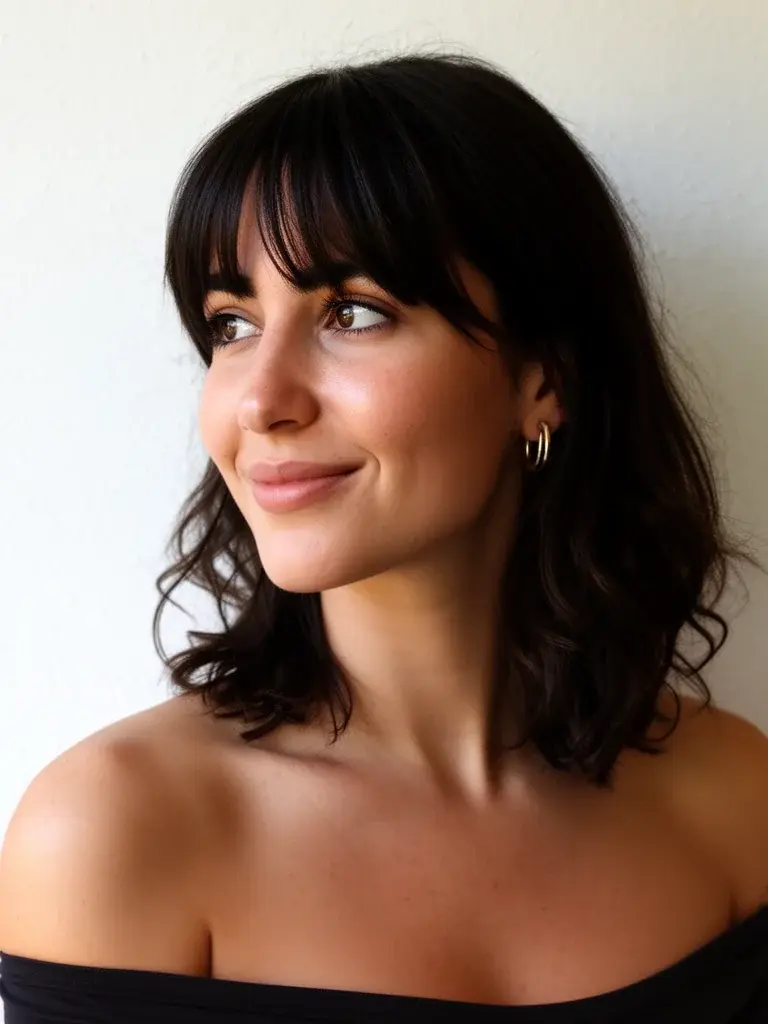
Curtain bangs are center-parted bangs that start shortest at the middle of the forehead and gradually lengthen toward the temples, sweeping outward along the cheekbones like an open curtain. The center portion typically falls between the eyebrows and the bridge of the nose, while the longest pieces reach the cheekbone or jawline.
What makes them different from other bangs is the blend. Blunt bangs create a hard line across the forehead. Side-swept bangs commit to one direction. Curtain bangs do neither — they frame both sides of the face symmetrically and transition seamlessly into the rest of your hair. This is why they work as a modifier on top of almost any base haircut: bobs, lobs, long layers, Beach Waves, shags. The bangs are a separate element that layers onto your existing style.
Curtain Bangs vs Blunt Bangs vs Side-Swept Bangs
| Curtain Bangs | Blunt Bangs | Side-Swept Bangs | |
|---|---|---|---|
| Parting | Center part, sweeps both sides | No part, straight across | Side part, sweeps one direction |
| Length | Eyebrow (center) to cheekbone (sides) | Eyebrow to mid-forehead, uniform | Eyebrow to chin, one-sided gradient |
| Face shapes | All — the most universal bang | Best for oval and oblong | Best for round and heart |
| Grow-out | Blends invisibly into layers | Grows into eyes, needs constant trims | Blends to one side, moderate grow-out |
| Maintenance | Trim every 5–6 weeks | Trim every 3–4 weeks | Trim every 5–6 weeks |
| Forehead coverage | Partial — center forehead shows | Full coverage | Partial — one side covered |
Bottom line: Curtain bangs = lowest risk, easiest grow-out, suits everyone. Blunt bangs = most dramatic, highest maintenance. Side-swept bangs = good middle ground if you prefer asymmetry.
If you want to go all-in on the short fringe as the centerpiece of your look — rather than adding bangs to a longer style — see Pixie Short Bangs: an above-the-eyebrow blunt fringe built into a full pixie cut.
Cut Specifications
Curtain bangs are a modifier — they add onto your existing base haircut. When asking for them, you'll communicate two things: the bang specifications and your base style (separately).
- Bangs center length: The shortest point at the center of the forehead. Typically between the eyebrows and the bridge of the nose — about 3–4 inches from the root when cut on straight hair. Shorter reads more retro (Brigitte Bardot); longer reads more modern.
- Bangs side length: The longest pieces at the outer edges. Should reach the cheekbone (for a short frame) or the jawline (for a longer frame). The gradient from center to side is what creates the "curtain" shape.
- Layering within the bangs: The bangs themselves should be point-cut or razor-cut for softness — never blunt. Internal layering (slide-cutting or texturizing) removes weight so the bangs sweep rather than fall flat.
- Starting point: The bangs should begin about 2–3 inches back from the hairline at the center part. Starting too far forward creates too much density; starting too far back removes too much from the sides.
- Base style communication: Tell your stylist the bangs and base cut separately — for example, "curtain bangs with my existing long layers" or "curtain bangs on a new chin-length bob." This avoids confusion about overall length.
- Trim cycle: Bangs every 5–6 weeks. Your base haircut follows its own schedule (8–12 weeks for most styles). You can trim bangs between full appointments — some stylists offer bang-only trims for a reduced price.
Color Pairing
- Face-framing babylights: 8–12 ultra-fine highlights concentrated in the curtain bang area and the first inch of hair around the face. Creates a natural sun-kissed frame that brightens your face without a full highlight session. Best on brunettes and dark blondes.
- Money pieces (face-framing color): Two bold, chunky highlights at the front — one on each side of the part, running through the curtain bangs. Creates a high-contrast frame that makes the bangs a focal point. Works on every base color, from black to blonde.
- Balayage that starts at the bangs: Instead of starting balayage at the mid-lengths (which skips the face entirely), ask your colorist to paint the curtain bangs as the highest point. This creates a graduated lightening effect that starts at your face and melts down. Most flattering on medium-to-long base haircuts.
- Single-process rich brunette or red: Curtain bangs in a deep, uniform color look striking — the frame effect comes from the cut alone, and the solid color keeps it sleek. Best if your bangs are on the longer side (cheekbone to jaw).
Face Shape Tweaks
- Oval: Standard curtain bangs at any length — this face shape has no proportional issues to correct, so choose based on personal taste
- Round: Keep the center short (right at the eyebrows) and the sides long (past the cheekbones) — the steep diagonal creates maximum slimming effect
- Square: Cut the center slightly longer (bridge of nose) and add extra texturizing — soft, wispy bangs counteract a strong jaw
- Heart: Focus length at the cheekbone to add width at the narrow lower half of the face; keep the center airy so the forehead doesn't look wider
- Oblong: Cut bangs slightly shorter with a wider, denser center section — the horizontal line shortens a long face visually
- Diamond: Keep cheekbone-length sides to soften the widest point of the face; center length at the brow or just below
Hair Type Tweaks
- Straight: Cut dry for precision. Straight curtain bangs need internal texturizing (slide-cutting) to create movement — without it, they just hang flat against the face.
- Wavy: Cut 0.5 inches longer than target length to account for wave shrinkage. Natural wave creates the outward sweep automatically — you may not even need a round brush after the training period.
- Thick: Request heavy internal layering and point-cutting throughout the bangs. Thick curtain bangs that aren't thinned will fall forward like a curtain that's stuck closed.
- Fine: Ask for slightly more hair to be cut into the bang section (start further back on the head) to compensate for low density. Avoid over-texturizing — fine bangs can go from "wispy" to "see-through" in one cut.
- Curly (2A–3B): Cut dry, at least 1.5 inches longer than target length. Expect a different silhouette — curly curtain bangs frame the face in a rounder, softer way. They won't achieve the sharp diagonal of straight bangs, and that's fine.
Training New Curtain Bangs
Fresh curtain bangs don't know which way to go. They've been part of your longer hair for years, and now they're suddenly expected to sweep sideways. The first 2 weeks are a training period — you're teaching the hair to bend.
- Days 1–3 — blow dry every time: After washing, use a round brush to roll the bangs away from your face while blow drying on medium heat. Dry each side separately, rolling outward. This is non-negotiable for the first few days — air-drying new bangs trains them to fall flat.
- Days 4–7 — introduce velcro rollers: After blow drying, roll each side of the bangs outward in a large velcro roller (1.5–2 inch diameter). Leave them in for 10 minutes while you do your makeup or get dressed. Remove and shake out. This sets the outward curve as muscle memory.
- Days 8–14 — start testing air-dry: After a week of training, try letting your bangs air-dry with just a center part and your fingers directing the hair outward. If they fall into the curtain shape on their own, the training is working. If they fall forward into your face, go back to the round brush for another week.
- Week 3+ — maintenance mode: Most hair types will hold the curtain shape with minimal effort by week three. Wavy hair often trains fastest. Straight, heavy hair takes longest. Once trained, you can air-dry or use a 30-second blast with a round brush.
- The overnight trick: Before bed, twist each side of the bangs outward and pin with a small clip or bobby pin. Sleep on it. Remove in the morning and the bend holds all day without heat.
What to Tell Your Stylist
"I want curtain bangs — shortest at the center, about eyebrow length, graduating to cheekbone length at the sides. Point-cut them so they're feathery, not blunt. I want them to blend into my layers, not look separate. My base style is [describe your current or desired cut]."
Reference photo tips:
- Bring photos of curtain bangs on hair similar to your texture — straight-hair examples won't translate to wavy or curly hair
- Point out the center length specifically — "I want the shortest part here" (gesture at your face)
- Show where you want the longest pieces to end — cheekbone, jawline, or chin
- Ask your stylist to cut conservatively the first time — you can always go shorter at a follow-up, but you can't add length back
- If this is your first time with bangs, say so — a good stylist will cut the initial set slightly longer and schedule a free follow-up trim in 2 weeks to adjust
How to Style
Daily (2 minutes):
- Start with damp bangs (spritz with water if they dried overnight)
- Part at center with a fine-tooth comb
- Use a round brush to blow dry each side outward — roll the brush under, aim the dryer down the hair shaft
- Let the rest of your hair air-dry or style as normal
Polished (5 minutes):
- Blow dry bangs with a round brush as above
- Set each side in a velcro roller (1.5-inch) for 5 minutes while styling the rest of your hair
- Remove rollers, shake bangs loose
- Apply a tiny amount of light-hold hairspray from 12 inches away to lock the shape
- Finish the rest of your style (flat iron, waves, or air-dry)
No-Heat Alternative:
- Dampen bangs with water or leave-in conditioner spray
- Part at center and smooth each side outward with fingers
- Pin each side against your cheekbone with a bobby pin or small clip
- Let air dry fully (15–20 minutes)
- Remove pins — the hair will hold the outward curve for most of the day
Maintenance Schedule
- Week 1–2: Bangs are at their ideal length. The curtain shape is crisp. Training period if this is a new cut.
- Week 3–4: Bangs are still flattering. Center section starting to reach the nose. You may need to adjust your styling slightly — a longer round brush sweep.
- Week 5–6: Time to trim the bangs. Center pieces are past the nose, sides are at the jaw or beyond. The curtain shape is turning into general face-framing layers. Book a bang trim.
- Week 7–8+: Bangs have officially blended into your layers. If you want to keep them, you're overdue. If you're growing them out intentionally, congratulations — this is as painless as bang grow-out gets.
If you color your hair:
- Babylights or money pieces in the bang area: refresh every 8–10 weeks (bang trims won't remove enough length to cut out the color)
- Full highlights or balayage: follow your regular 10–12 week schedule; the bangs will be trimmed between color appointments
- Single process: roots show faster in bangs because they're right at your face — consider a root smudge technique for softer grow-out between appointments
Pro tip: Many salons offer bang-only trims for $10–15, no full appointment needed. Ask yours. Keeping bangs maintained is the difference between "intentional face frame" and "hair in your eyes."
Common Mistakes
-
Cutting the center too short on the first try Fix: Start with the center at nose-bridge length — you can always go shorter at a 2-week follow-up, but too-short curtain bangs lose the "curtain" and become blunt bangs. Tell your stylist "err on the side of too long" for the first cut. You'll know within a week if you want them shorter.
-
Not texturizing enough for thick hair Fix: Thick curtain bangs need internal layering (slide-cutting or point-cutting) to sweep outward. Without it, they just hang forward like a stage curtain that won't open. If your bangs feel heavy and won't hold their sweep, book a quick follow-up and ask specifically for thinning through the bang section.
-
Skipping the training period Fix: New bangs need a solid 2 weeks of directional blow-drying to learn their shape. Skipping this means bangs that fall flat against your forehead instead of sweeping sideways along your cheekbones. Yes, it takes 2 extra minutes per wash. It's temporary — after training, most hair types hold the shape without heat.
-
Using heavy products on the bangs Fix: Bangs are the oiliest section of your hair because they rest against your forehead all day. Oil, serum, cream, and leave-in conditioner all make this worse. Use only light-hold spray or dry texture spray on the bangs — never anything that adds moisture or weight. If your bangs look greasy by midday, a spritz of dry shampoo at the roots fixes it instantly.
-
Washing your bangs on the same schedule as the rest of your hair Fix: Bangs get greasy faster than the rest of your hair because of constant forehead contact and face oil transfer. If you wash your hair every 3 days, your bangs will look flat and oily by day 2. Quick fix: lean over the sink, wet just the bangs, apply a tiny drop of shampoo, rinse, and blow dry with a round brush. Takes 90 seconds and resets the bangs without washing your whole head.