TL;DR
- Best for: Long hair that needs shape without losing length — especially thick hair drowning in its own weight
- Avoid if: Your hair is above shoulder-length, you braid daily (uneven ends escape), or you want uniformly thick ends
- Ask your stylist: "V-cut layers, steep angle, longest point at [your current back length]. I want the sides at [desired front length]. Point-cut the ends."
- Maintenance: Trim every 10–12 weeks; the V-point softens gradually and still looks good
Who Does It Suit?
The V-cut is the architectural solution for long hair that needs structure. It works by subtraction at the sides rather than addition at the center.
Ideal for:
- Long hair that feels heavy and shapeless — the V removes side weight while preserving center length
- Thick hair that creates a "wall" effect when worn down — the angle breaks the wall into layers
- Women who want visible dimension from behind — the V-point is a back-view statement
- Anyone who wants layers but is scared of losing length — the center stays untouched
- Round faces that benefit from longer, narrower front layers — the V naturally creates face-framing
Hair types:
- Straight: The sharpest, most geometric V-cut result — the angle reads clearly and dramatically
- Wavy: Waves add softness to the V-angle, creating a romantic, flowing taper rather than a hard geometric shape
- Thick: The ideal candidate — the V removes the most weight from thick hair without shortening the center
- Fine: Can work with a subtle V (less steep angle) — too dramatic a V on fine hair creates thin, wispy side ends
Avoid If...
- Your hair is shorter than shoulder-length → the V-point needs length to display; on short hair it crowds together and looks unintentional
- You braid your hair daily → graduated layers from the V-cut create pieces that escape braids at different lengths; a blunt cut or U-cut keeps ends even for braiding
- You want uniformly thick ends → the V tapers ends thinner at the sides by design; if you want blunt, heavy ends, that's a different cut
- Your hair is very fine and you want it to look thicker → the V removes mass from the sides, making fine hair look thinner at the edges; a blunt lob maximizes fine-hair density
- You want a major change → a V-cut on long hair is subtle from the front; most people won't notice unless they see the back. For visible transformation, consider a butterfly cut or wolf cut
What are V-Cut Layers?
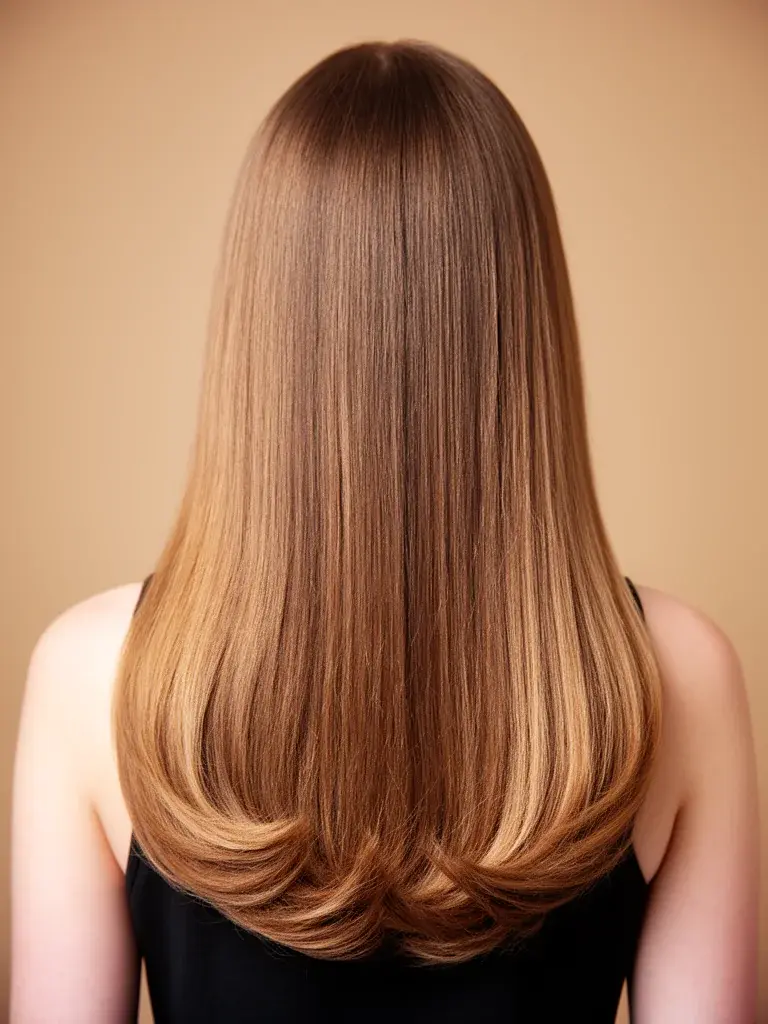
V-cut layers are a layering technique where the back of the hair is cut to form a V-shape — shortest at the sides, longest at the center back, with a sharp angled line connecting the two. The "V" describes the shape you see when looking at the hair from behind.
What makes V-cut layers different from standard long layers is the geometry. Standard layers remove length throughout the hair at varying heights. A V-cut focuses the layering at the perimeter — the bottom edge of the hair is angled rather than straight across. The interior length can remain mostly untouched. This means maximum length preservation at the center while creating visible shape at the sides and back.
The V-cut is the opposite of a blunt cut. Where a blunt cut creates one straight line across the back (maximum end thickness, minimum shape), the V creates maximum shape at the expense of end thickness at the sides. The U-cut sits between them — rounded rather than straight or pointed.
V-Cut vs U-Cut vs Blunt Cut
| V-Cut | U-Cut | Blunt Cut | |
|---|---|---|---|
| Back shape | Sharp V-point at center | Soft U-curve at center | Straight line across |
| Layer visibility | High — dramatic angle shows layers clearly | Medium — gentle curve, subtle layers | None — one-length, no visible layering |
| Bulk removal | Most — steep angle removes maximum side weight | Moderate — rounded shape removes some | Least — all weight retained |
| Braid-friendliness | Low — uneven layer ends escape braids | Medium — some unevenness but manageable | High — even ends stay in braids |
| Grow-out pattern | V softens into a vague taper over 10–12 weeks | U flattens into a soft curve | Stays straight, just gets longer |
| Best for | Thick hair, back-view drama, weight reduction | Balanced shape, versatile styling | Maximum thickness, braids, minimalists |
Bottom line: V-cut = most dramatic angle, most weight removal, best for thick hair. U-cut = softer compromise, good for everyone. Blunt = no layers at all, maximum end density. If you can't decide between V and U, ask for a "soft V" — a less steep angle that splits the difference.
Cut Specifications
V-cut layers are defined by the angle at the back. The steeper the angle, the more dramatic the cut.
- Angle steepness: Subtle V (15–20° angle from horizontal) — barely visible, gentle taper. Moderate V (30–40° angle) — clearly visible V-point, noticeable weight reduction. Dramatic V (45–60° angle) — very sharp point, maximum weight removal, front pieces significantly shorter than back. For a first V-cut, start moderate.
- Center back length: This stays at your current length (or desired maximum length). The V-cut doesn't shorten the center — it shortens the sides relative to the center.
- Side length: Determined by the angle. A moderate V on waist-length hair might create side pieces at rib-cage length. A dramatic V might create side pieces at collarbone length. Discuss the front/side length explicitly — the angle determines it, but you should approve the side result specifically.
- Internal layers (optional): The V-cut describes the perimeter shape. You can add internal layers on top of the V for more movement throughout the length, or keep the interior one-length and let the V-perimeter do all the work. Internal layers add movement; one-length interior keeps weight.
- End treatment: Point-cut the ends for softness and movement. Blunt ends on a V-cut look harsh — the geometric shape needs soft terminations to avoid a costume-wig effect.
- Trim cycle: Every 10–12 weeks to maintain the angle. The V softens as it grows because the sides and center grow at the same rate — by week 12, it's more of a vague taper than a sharp V.
Color Pairing
- Balayage that follows the V-angle: Ask your colorist to start the balayage higher on the side pieces and lower at the center back, mirroring the V-cut's shape. This creates a diagonal gradient of color that mirrors the diagonal gradient of length — visually amplifying the V-cut's architecture.
- Face-framing highlights: The V-cut's shorter side pieces naturally frame the face. Adding babylights or money pieces to these shorter front sections draws attention to the frame. Best on brunettes and dark blondes where the contrast is visible.
- Ombré with the V as the transition line: Use the V-cut's angle as the color transition point — darker above the angle, lighter below. This creates a striking geometric effect that's only visible from behind.
- Single-process rich color: A solid, deep color (espresso, mahogany, black cherry) on a V-cut lets the geometric shape be the statement. The uniform color makes the angle read more sharply because there's no color distraction.
Face Shape Tweaks
- Oval: Standard V-cut at any angle — no adjustments needed; this face shape works with all layering approaches
- Round: Use a moderate-to-steep V — the shorter side pieces create diagonal lines along the face that slim and elongate. Keep the front pieces at or below the collarbone
- Heart: The V-cut's shorter sides balance a wider forehead by adding visual weight at the lower face. Aim for side pieces at chin-to-collarbone length for maximum balancing effect
- Square: A soft V (not too steep) with point-cut ends softens angular jawlines. Avoid a dramatic V where the side pieces end exactly at the jawline — this echoes the square shape
- Oblong: Be careful — a dramatic V can elongate a long face further by creating strong vertical lines. Keep the V moderate and add face-framing layers at cheekbone height to break the vertical
Hair Type Tweaks
- Straight: The V-cut reads most sharply on straight hair — every angle is visible. Use a flat iron on the ends for maximum geometric effect. The downside: straight hair also shows any unevenness in the cut more clearly.
- Wavy: Waves soften the V into a romantic, flowing taper. The angle is visible but gentler. This is many people's favorite combination because it balances structure with softness.
- Thick: The dream scenario. A steep V on thick hair removes the most weight from the sides while the center retains full thickness. The contrast between heavy center and lighter sides creates movement that thick hair rarely has with a blunt cut.
- Fine: Go subtle — a gentle V (15–20° angle). A steep V on fine hair makes the side pieces look stringy and thin. The goal is shape, not weight removal — fine hair doesn't have excess weight to remove. Keep internal layers minimal to preserve end density.
Making the V-Cut Work for You
The V-cut is simple in concept but requires a few decisions that dramatically change the result.
- The angle conversation: The single most important moment in your salon visit. Bring a visual reference showing the angle you want, or have your stylist show you with their hands where the shortest and longest points will fall. A "V-cut" can range from barely noticeable to dramatically pointed — specify which.
- Wet vs. dry styling difference: Wet V-cut hair hangs straighter and the V-point is sharper. Dry or styled hair with waves or curls softens the V. If your stylist shows you the V on wet hair, expect it to read softer once you style it. This is fine — the shape does its work even when softened.
- The ponytail benefit: V-cut hair in a ponytail creates a naturally tapered tail — thicker at the elastic, thinner at the ends. This looks more polished than a blunt-cut ponytail that ends in a thick, abrupt line. One of the best secondary benefits of a V-cut.
- Growing it out: As the V grows out, it naturally softens toward a U-shape, then eventually toward a blunt line. The grow-out is graceful — at no point does it look awkward. You just gradually lose the dramatic angle. Most people can go 12–14 weeks between trims without the cut looking "off."
- Combining with other cuts: A V-cut is the perimeter shape. You can layer a butterfly cut on top of a V-cut perimeter, or add face-framing layers to the front pieces. The V describes what happens at the bottom edge; what happens internally is a separate decision.
What to Tell Your Stylist
"I want V-cut layers — moderate angle, longest point staying at my current length. Point-cut the ends for softness. I want the sides to land at about [collarbone/shoulder/rib] level. No internal thinning — just the perimeter V-shape."
Reference photo tips:
- Bring back-view photos specifically — front-view photos don't communicate V-cut angle effectively
- Show the angle steepness you want — point to the longest and shortest points in the reference photo
- Tell your stylist where you want the shortest pieces to fall on your body (collarbone, shoulder, etc.) — this matters more than describing the angle in degrees
- If you have thick hair and want weight removal, say "steep V" explicitly. If you have fine hair and want shape, say "subtle V." The word "V-cut" alone is too ambiguous
- Ask your stylist to check the V-angle from behind with a hand mirror before they cut the last section — adjustments at this stage are simple
How to Style
Daily (3 minutes):
- Blow dry or air dry as normal for your hair type
- The V-cut shapes itself — the layers fall at different lengths and create natural movement
- If you want to emphasize the V, flip your head over and blow dry from underneath — the shorter side pieces will fall forward and frame your face
- No specific products needed beyond your normal routine
Polished (5 minutes):
- Blow dry with a round brush, section by section, curling ends under
- Use a flat iron on the last 2 inches of each layer — slight bend inward at the ends
- The V-cut's different layer lengths create a cascading effect when each layer has a slight curl
- Finish with a light shine spray for a glossy, editorial back view
No-Heat Alternative:
- Apply leave-in conditioner and a light styling cream to damp hair
- Part hair at center, bring both sides to the front
- Twist each side loosely and pin at the shoulder with a large clip
- Air dry (1–2 hours) — the twist creates gentle waves that emphasize the V-cut layers
- Remove clips and shake out — the layers separate at their natural lengths
Maintenance Schedule
- Week 1–4: V-cut is at its sharpest. The angle is defined, layers fall cleanly, weight difference between sides and center is most noticeable.
- Week 5–8: V-point is softening as the sides grow. The angle is still visible but less dramatic. This is the most wearable phase for most people — the shape is there but not sharp.
- Week 9–12: The V has become a vague taper — closer to a soft U-shape. Time for a trim if you want to maintain the defined V-point. If you're happy with the softer shape, you can push to 14 weeks.
- Week 12+: The V has grown out into a natural, unstructured taper. Not bad-looking — just not a V-cut anymore. Trim to reset or commit to growing it out entirely.
If you color your hair:
- Balayage that follows the V: refresh every 10–14 weeks, timed with your V-cut trim. The colorist and stylist can align the color gradient to the fresh angle each time.
- Face-framing highlights: the shorter V-cut side pieces grow out slightly between trims, but the highlights remain in the face-framing zone. Follow your normal highlight schedule.
- Single process: no special considerations. The V-cut has no impact on root growth or color maintenance timing.
Pro tip: Take a photo of your fresh V-cut from behind at each salon visit. Over time, you'll dial in the exact angle and side length you prefer. Show this photo to your stylist instead of a Pinterest reference — it's your hair, your head shape, your ideal.
Common Mistakes
-
Asking for a V-cut on too-short hair Fix: V-cuts need at least shoulder-length hair to show the angle. On shorter hair, the V-point crowds against the nape and looks like a poorly executed mullet rather than an intentional taper. If your hair is above the shoulders, a lob or shoulder-length layers gives you shape without the V.
-
Getting a dramatic V on fine hair Fix: A steep V-angle on fine hair makes the side pieces look stringy and thin because there's not enough hair mass to sustain the taper. Fine hair needs a subtle V (15–20°) that adds shape without removing too much end density. If you want dramatic layers on fine hair, a butterfly cut adds volume up top without thinning the ends.
-
Not specifying the angle steepness Fix: "V-cut" means different things to different stylists. Without specifying, you might get a barely-there taper when you wanted dramatic, or vice versa. Always bring a back-view reference photo and discuss where the shortest pieces should land on your body. The angle is the entire cut — it's the one thing you must communicate clearly.
-
Expecting a visible change from the front Fix: V-cuts are primarily a back-view cut. From the front, you might notice slightly shorter side pieces, but the dramatic effect is behind you. If you want a visible front-view transformation, add face-framing layers or combine the V-cut with a curtain bangs modification.
-
Thinning the ends with thinning shears Fix: Thinning shears on V-cut ends — especially on the already-tapered side pieces — creates wispy, transparent endpoints that look damaged rather than intentional. Point-cutting (cutting into the ends with regular shears at an angle) creates softness without transparency. Tell your stylist: "point-cut, not thinning shears."