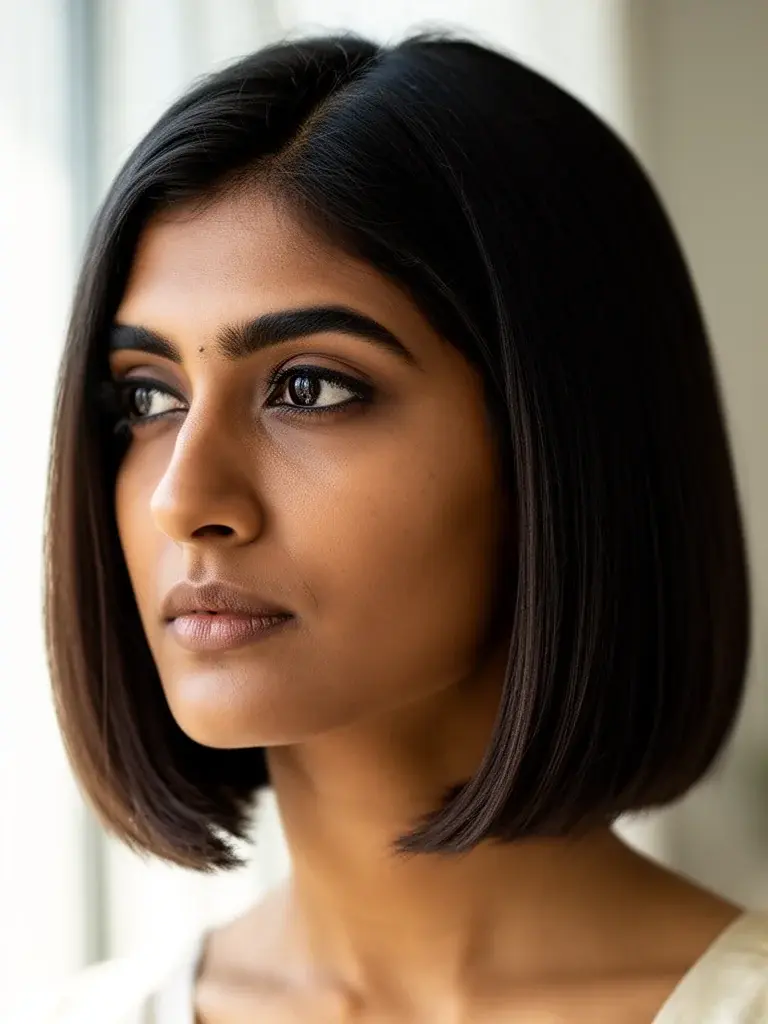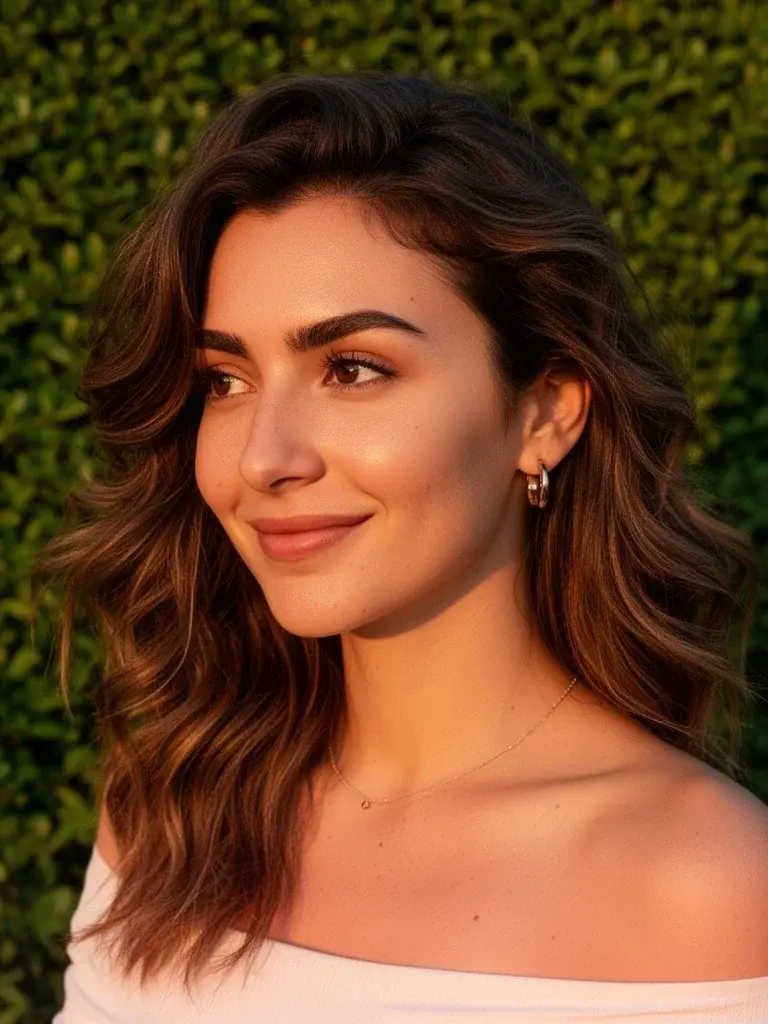

TL;DR
- Best for: Every face shape — shoulder-length layers have no meaningful face-shape restriction
- Avoid if: You specifically want one-length hair or you're growing toward a specific longer style
- Ask your stylist: "Shoulder-length layers — face-framing around the hairline, interior layers to remove bulk through the back, and graduated ends. Point-cut throughout."
- Maintenance: Trim every 8–10 weeks; 5–15 minutes daily depending on hair type
Who Does It Suit?
Shoulder-length layers are unique among haircuts in having essentially no face-shape restrictions. The length is universally flattering, and the layer type can be adjusted for any face shape.
By face shape:
- Oval: Any layer configuration works. Go for maximum movement — all three layer types (face-framing, interior, graduated)
- Round: Face-framing layers are most valuable here — they create vertical lines around the face that elongate it. Avoid any layer configuration that adds width at the sides
- Square: Soft face-framing layers through the jaw area soften the angle. Use point-cut ends to prevent bluntness that mirrors the jawline
- Heart: Face-framing layers at medium length (hitting between cheekbone and chin) draw attention downward, balancing a wider forehead. Avoid very short face-framing layers that stay at temple level
- Oblong: Interior layers add width. Add some volume through the mid-length. A slight A-line graduation (longer at the front) can help
- Diamond: Face-framing layers at chin level add width where the face is narrowest. Combined with interior layers for volume, this is a strong pairing
Hair types:
- Straight: Layers add movement that straight one-length hair can never achieve. The structure is visible and clean — particularly good for a sleek look with face-framing layers
- Wavy: Layers enhance what the waves are already doing. Less product needed; natural wave pattern creates the layer separation without help
- Curly: Layers reduce bulk and define curl sections rather than letting them merge into a single mass. Ask for dry-cutting specifically
- Thick: Interior layers are the primary solution for thick shoulder-length hair. They change the behavior of the whole cut without altering the outside shape
- Fine: Avoid too many layers — they can remove mass that fine hair doesn't have to spare. Face-framing layers only, with minimal interior work
Avoid If...
- You want one-length hair → layers by definition change the interior distribution; if you want one-length, ask for a blunt cut instead
- You're growing hair very long → layers mean different lengths throughout the hair; if your goal is uniform long hair, get only a trim
- Your hair is fine and already lacks volume → heavy layering on fine shoulder-length hair can make it look thin and stringy; stick to light face-framing layers only
- You've just had a bad layer experience → discuss specifically what went wrong with your stylist before repeating. "Too many layers" and "wrong layer placement" are the most common issues, both fixable with clear communication
What is a Shoulder-Length Layered Haircut?
A shoulder-length layered haircut is hair that ends at or near the shoulder, cut with internal graduation that distributes length and removes weight through the interior. The "layers" refer to different lengths of hair sitting underneath each other — when the hair moves, these different lengths become visible as depth and texture.
One-length shoulder hair has all ends at the same point — creating a flat, heavy bottom edge with no internal movement. Layered shoulder hair has ends distributed throughout the lower half of the cut — lighter ends through the mid-section, fuller ends at the bottom of the outer layer. The difference in motion and fall is significant.
There are three technical types of layers: face-framing (shorter pieces around the hairline), interior (hidden cuts through the underside), and graduated (the outer shape cut at an angle). Most good shoulder-length layered cuts use a combination of all three.
Shoulder Layers vs Lob vs Internal Layers Only
| Shoulder-Length Layers | Lob | Internal Layers Only | |
|---|---|---|---|
| Length | Sits on shoulder | Collarbone (1–3" below chin) | Shoulder or any length |
| Outside shape | Graduated/layered | Clean weight line | Same as base cut |
| Movement | High | Medium | Medium-high |
| Visible change | Obvious | Obvious | Subtle |
| Best for | Movement + versatility | Clean modern silhouette | Bulk removal (thick hair) |
| Styling versatility | Highest | High | Unchanged from base |
Bottom line: Shoulder layers = movement and shape. Lob = clean length statement. Internal layers = solve thick hair without changing the look.
Cut Specifications
- Length: Hair rests on or just past the shoulder; longest pieces at shoulder to 1 inch below
- Face-framing layers: Shortest pieces between cheekbone and chin; should frame the face but not hang in it
- Interior layers: Hidden; cut from the underside starting mid-length; most important for thick hair
- Graduation: Back sections slightly shorter than front; creates forward movement and stops the hair looking like it falls straight down
- Ends: Point-cut throughout — blunt ends at this length create a heavy, dated look
- Trim cycle: Every 8–10 weeks; face-framing layers need the most frequent refresh
Color Pairing
- All-over color with glossy finish: Shoulder-length layered hair shows color depth well — the layer structure creates multiple planes that reflect light differently. A single-process color with a gloss treatment shows off the cut's dimensionality without added complexity
- Curtain bang highlights: If combining shoulder layers with curtain bangs, lightening the bang sections 2–3 shades draws attention to the face-framing — the most impactful area of this cut
- Soft balayage through the ends: Starting the color at mid-length (approximately where the interior layers begin) and fading to lighter ends follows the natural layer structure. The lighter, shorter interior layers become the most visible color and the effect looks tailored to the cut
Face Shape Tweaks
- Oval: Maximum layers throughout — face-framing, interior, and graduated. No restriction
- Round: Emphasize face-framing layers. Request they sit closer to the chin (not the temples) to draw attention downward. Avoid wide layers at the sides that add horizontal mass
- Square: Soft point-cut face-framing layers through the jaw level. Request the graduation to slope from shorter-at-the-back to longer-at-the-front (creates forward movement away from the jaw)
- Heart: Medium face-framing layers (hitting between cheekbone and chin). Avoid very short layers that stay at the temple area — they emphasize the widest forehead point
- Oblong: Add interior volume through the mid-section. Ask for layers that "kick out" slightly at the sides rather than falling straight down
- Diamond: Face-framing layers at chin level add visual width at the face's narrowest point. Combined with interior layers for body
Hair Type Tweaks
- Straight: Full layer package (face-framing + interior + graduated) — straight hair shows every layer placement clearly, so precision matters. Use a light texturizer or sea salt spray to get the layers moving on day-2 hair
- Wavy: Prioritize face-framing and graduated layers; reduce interior layering. The wave pattern naturally separates layers without the structural support straight hair needs. Ask the stylist to check the wave pattern before cutting
- Curly: Dry-cutting is strongly recommended — wet layers on curly hair shrink unevenly. Interior layers are the priority: they let curl sections breathe instead of merging. Face-framing layers add definition at the front
- Thick: Interior layers are mandatory. Request specifically: "I need interior layers removed from the underside — not just surface layers." Surface layering on thick hair creates the triangle shape; interior layering prevents it
- Fine: Face-framing layers only. Minimal interior work. Avoid heavy graduation — every layer you remove is weight that fine hair needs to look full
How to Style
Sleek/straight (15 minutes):
- Blow-dry with a medium round brush, lifting at the roots and smoothing through mid-lengths
- Flat iron through the layers with a 1.25-inch iron in one smooth pass per section
- Apply shine serum to ends — the layered ends are where the style is most visible
Wavy/textured (10 minutes):
- Apply sea salt spray or light mousse to towel-dried hair
- Scrunch ends upward and diffuse, or let air-dry completely
- Separate layers with fingers once dry — no brush
Curly (natural method):
- Apply curl defining cream from roots to ends while soaking wet
- Scrunch sections upward toward the scalp
- Diffuse on low heat or air-dry completely without disturbing
- Layers will be visible through curl separation
Low-effort:
- Air-dry is genuinely sufficient for wavy and curly hair
- For straight hair, a 5-minute blowout on the crown section only gives the appearance of effort with minimal time
Maintenance Schedule
- Week 1–4: Layers are defined, movement is visible, face-framing pieces sit exactly where intended
- Week 5–6: Face-framing layers have grown slightly — heading toward the jaw rather than the cheekbone. Still looks good, especially with any wave or curl
- Week 7–8: Interior bulk that was removed has partially grown back; thick-hair people will notice this most. Face-framing layers are below the jaw — still functional, now just longer
- Week 9–10: Trim time. The graduation has softened, the face-framing pieces need a reset, and the interior weight has returned enough to matter
- Long-term: At each trim, you have the option to maintain the same length or go slightly shorter. The most common evolution is to a Lob — take two inches off the shoulder length and it falls naturally into lob territory
Common Mistakes
-
Asking for "a few layers" without specifying type Fix: Tell your stylist which layer type you need: face-framing (for movement around the face), interior (for bulk removal in thick hair), or graduated (for overall shape). Unspecified "layers" usually means the stylist defaults to whatever they prefer — which may not be what you need.
-
Requesting too many layers on fine hair Fix: Fine hair needs fewer, more widely spaced layers. Ask specifically for "light face-framing layers only" and discuss interior layering separately. Over-layering fine shoulder hair creates a stringy, gapped look that's worse than the original flat look.
-
Not asking for point-cut ends Fix: Blunt ends at shoulder length look heavy and dated in a way they don't at bob length. Point-cut (also called "razor ends" or "feathered ends" depending on the tool) gives the tips movement. Mention this specifically — not all stylists default to it.
-
Getting layers cut too short when transitioning from longer hair Fix: The first shoulder-length layered cut after long hair should be conservative. Ask for layers to start no higher than the chin. Aggressive layers on freshly cut shoulder hair can result in short pieces that stick out. Next appointment you can adjust.
-
Expecting layers to fix flat roots Fix: Layers don't add root volume — they add end movement. For flat roots, you need a different fix: volumizing shampoo + blowdry technique + dry shampoo at the roots. Layers and root volume are separate problems.