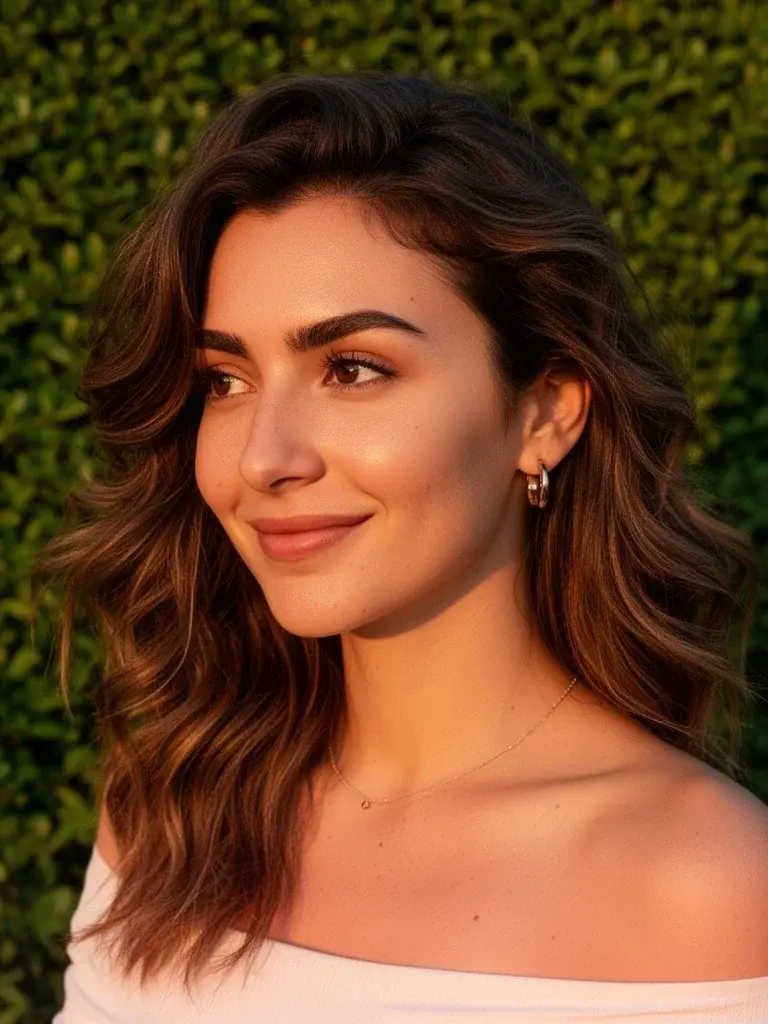

TL;DR
- Best for: Oval, round, and heart-shaped faces who want visible bounce and lift without a sharp or edgy result
- Avoid if: You want zero daily styling or your hair is currently shorter than collarbone length
- Ask your stylist: "Butterfly cut — U-shaped layers, shorter at the center back and longer through the sides, with volume lift at the crown"
- Maintenance: Trim every 6–8 weeks; 5–10 minutes of styling daily
Who Does It Suit?
The butterfly cut is built for softness. Its layer structure is curved rather than angular, which means it adds bounce and femininity without the sharpness of a wolf cut or the structure of a bob.
Ideal for:
- Oval: Every element of the butterfly cut flatters an oval face — the lifted crown creates proportion, the face-framing pieces define the cheekbones, and the longer side sections complement natural symmetry
- Round: The crown lift adds vertical emphasis that elongates a round face. The butterfly cut's top volume draws attention upward — exactly what round faces benefit from
- Square: Curved, soft layers around the jawline soften the angular edges. The butterfly cut's rounded layer structure is a natural counterpoint to a square jaw
- Heart: The longer side sections add visual weight at chin level, balancing a wider forehead. Keep the crown volume moderate rather than maximized
Hair types:
- Thick: The ideal match. The U-curved layers remove interior bulk while the crown maintains fullness — thick hair holds the butterfly shape longer and with less product
- Wavy: Second-best match. Wave pattern enhances the outward curl of the wing sections naturally. Diffuse-dry for maximum effect
- Straight: Works but requires more effort. Without natural wave, the wing sections need encouragement — a diffuser with mousse, or a 1-inch wand for loose bends at the ends
- Fine: Possible but requires a modified approach — fewer, more widely spaced layers to preserve density. A heavily layered butterfly cut on fine hair removes too much mass
Avoid If...
- You want zero daily effort → try a Boy Cut or French Crop
- Your hair is shorter than collarbone length → there's not enough length for the two-section structure; a Wolf Cut works better at shorter lengths
- You have fine hair and won't use any product → the wing sections need something to encourage outward movement; without it they fall straight
- You want a sharp, modern edge → the Wolf Cut delivers contrast; the butterfly cut is intentionally soft
- You're growing out a pixie → you need at least collarbone length for this cut to work as intended
What is a Butterfly Cut?
The butterfly cut is a layered haircut defined by a U-shaped layer structure. Unlike the wolf cut (which layers heavily from the top down) or standard long layers (which are relatively uniform), the butterfly cut creates two visually distinct sections: a shorter, heavily layered crown and upper mid-length, and a longer, lighter lower section.
When the hair falls naturally, these two sections separate. The upper section lifts and frames the face with visible layer movement; the lower section hangs with a gentle outward curve at the ends. From behind, the shape looks like butterfly wings — shorter at the center, longer and curving outward at the sides.
The name comes from both this wing silhouette and the movement: when the wearer moves, the two sections flutter independently, creating the visual impression of wings in motion.
Butterfly Cut vs Wolf Cut vs Shoulder Layers
| Butterfly Cut | Wolf Cut | Shoulder Layers | |
|---|---|---|---|
| Layer structure | U-shaped, curved outward | Top-heavy, directional | Uniform, graduated |
| Overall feel | Soft, feminine, bouncy | Edgy, modern, undone | Versatile, natural |
| Best hair type | Thick, wavy | Wavy, curly | All types |
| Face framing | Soft layers, optional bangs | Curtain bangs or layers | Optional |
| Styling effort | 5–10 min | 5–10 min | 5–15 min |
| Length required | Collarbone+ | Shoulder+ | Shoulder |
Bottom line: Butterfly cut = soft lift and wings. Wolf cut = contrast and edge. Shoulder layers = flexibility without a specific silhouette.
Cut Specifications
- Layers: U-shaped distribution — shorter layers through the crown and center back, progressively longer through the side sections
- Face framing: Soft layers or curtain bangs — pieces that curve outward from the face rather than cutting straight across
- Back structure: Center back is shortest; sides are longer — this creates the wing silhouette. The difference between center and sides is typically 3–5 inches
- Ends: Point-cut or feathered — blunt ends prevent the outward wing movement that defines this style
- Length: Works best from collarbone to mid-back. Longer hair produces a more dramatic wing effect
- Trim cycle: Every 6–8 weeks — the curved layer structure needs maintenance to prevent the U-shape from flattening into a standard layered cut
Color Pairing
- Dimensional brunette: Ribbon highlights through the mid-length layers add depth that makes the two-section structure more visible. As the wings lift and separate, color variation between layers catches the light from different angles
- Soft blonde fade: Starting darker at the roots and lightening progressively through the butterfly sections follows the natural structure of the cut — the sections that move the most are the lightest and most visible
- Copper or auburn: The wing movement shows off warm tones particularly well. As the sections flutter, copper hair catches light from multiple angles — the effect is much stronger on this cut than on a one-length style
Face Shape Tweaks
- Oval: Standard butterfly cut with the full crown lift. No adjustment needed
- Round: Maximize crown volume (request the shortest layers to be kept at the crown rather than the temples) to create vertical emphasis. Avoid adding volume at the sides
- Square: Request that the layers through the jawline area be curved — not straight. The soft angle of the butterfly cut's layering is what softens the jaw. Ask for slightly longer face-framing pieces
- Heart: Moderate the crown volume and request slightly more length through the lower sections to add visual weight at the chin. Face-framing layers rather than curtain bangs
Hair Type Tweaks
- Straight: Request shorter layers in the crown (2–3 inches shorter than the ends) to create enough internal structure for the wing sections to form. Without heat or product, straight hair butterfly cuts are flat. Plan to use a diffuser
- Wavy: Standard butterfly cut structure works well. Ask for the layers to be cut with the hair in its natural wave state — not pulled straight
- Thick: Request interior thinning within the lower section as well as the standard layer structure — this prevents the bottom section from overwhelming the lighter upper layers
- Fine: Reduce the number of layers (wider spacing between them). The standard butterfly cut can be too aggressive for fine hair. Ask for a "softer butterfly cut with fewer layers" — the shape will be there but subtler
How to Style
For full butterfly effect (10 minutes):
- Apply curl cream or mousse to towel-dried hair from mid-length to ends
- Flip hair upside-down and diffuse on medium heat, scrunching sections upward toward the scalp
- Flip back up without touching — let the sections fall naturally
- Once fully dry, use fingertips only to gently separate wing sections at the back
Straight and smooth (15 minutes):
- Blow-dry with a medium round brush, lifting at the roots
- Use a 1-inch flat iron or wand through mid-lengths and ends for slight bend
- Finish with a shine spray — keeps the feathered ends smooth and prevents flyaways
No-Heat:
- Finger-comb curl cream through damp hair
- Create 3–4 loose braids overnight
- Undo in the morning and use fingertips to separate — the butterfly sections will be more defined with the braid-created waves
Maintenance Schedule
- Week 1–2: Full butterfly effect. The U-shape is crisp, the wing sections separate cleanly, crown lift is maximum
- Week 3–4: Crown layers are growing down and starting to blend with the mid-section. The butterfly effect is still visible but slightly less dramatic
- Week 5–6: Layer structure starts reading as "layered haircut" rather than butterfly cut. Styling effort increases slightly as the wing separation needs more encouragement
- Week 7–8: Time to trim. The U-shape has flattened enough that you're essentially working with a standard layered cut
- Growing out: Butterfly cuts grow out gracefully into standard long layers. The U-structure flattens and you end up with a naturally layered length — a good grow-out state
Common Mistakes
-
Requesting it on hair shorter than collarbone length Fix: Grow to at least collarbone before booking. Below that length, the butterfly structure can't form — you'll get a wolf cut or shag instead, which have their own merits but aren't what you asked for.
-
Not using any product on straight hair Fix: The wing sections need something to curl slightly outward. A light curl cream or even a sea salt spray on the ends is the minimum. Without it, you have a layered cut — not a butterfly cut.
-
Brushing dry hair Fix: Brushing separates and flattens the layer sections. Use fingers or a wide-tooth comb, only when wet or damp.
-
Requesting blunt ends Fix: Blunt ends are the butterfly cut's enemy — they trap the ends together and prevent the outward wing movement. Always request point-cut or feathered ends.
-
Going too short on the upper layers in the first appointment Fix: Start with a conservative version (moderate layer difference rather than maximum) and shorten at the next appointment if you want more drama. Too-short crown layers look choppy rather than winged.