TL;DR
- Best for: Women who want long hair with shape but without the density loss of a V-cut or heavy layering
- Avoid if: You want dramatic movement or visible layering from every angle — U-cut is the subtle, structural option
- Ask your stylist: "U-shaped back — soft curve, not a V-point. Keep all the density at the ends."
- Maintenance: Trim every 10-12 weeks to maintain the curve
Who Does It Suit?
The U-cut is the quiet achiever of long haircuts — it adds shape to long hair without anyone being able to point at exactly what changed. From the front, it looks like well-maintained long hair. From the back, there's a subtle, intentional curve. It's the cut for women who want to look polished without looking "done."
Ideal for:
- Women with fine or thin hair who need to preserve every strand of density at the ends
- Anyone who wears updos, braids, and ponytails frequently — the even perimeter creates clean, full-looking gathered styles
- Women who want shape in their long hair but find V-cut layers too dramatic or the butterfly cut too trendy
- Low-maintenance long-hair women who want to stretch trims to 10-12 weeks without their cut looking grown-out
- Women who've had a blunt cut and want something slightly more shaped without committing to visible layers
Hair types:
- Straight: The U-curve shows most cleanly on straight hair — a smooth, architectural arc visible from behind. The geometric precision of the shape is a straight-hair advantage
- Wavy: Natural waves soften the U-shape into an organic curve that looks less geometric and more natural. The wave movement enhances the rounded silhouette — one of the most flattering combinations
- Fine: This is the U-cut's target audience. The rounded shape preserves maximum end density. No strand is cut shorter than it needs to be. Fine hair in a U-cut looks thicker at the ends than fine hair in any other shaped cut
- Thick: The U-curve gives thick hair a slight shape without removing bulk. If you want more weight reduction, a V-cut removes more from the sides. But if you love your density and just want subtle shaping, U is the conservative choice
Avoid If...
- You want dramatic, visible layers from every angle → The U-cut is a back-view shape, not a layering technique. From the front or side, it reads as long hair without visible layering. If you want movement and dimension from the front, face-framing layers or a butterfly cut will give you more visual impact
- You need major bulk removal → The U-cut is designed to preserve density. If your thick hair feels heavy and you want relief, a V-cut removes more weight from the sides, or internal layers thin from underneath without changing the perimeter shape
- Your hair is shorter than shoulder length → The U-shape needs at least 3-4 inches of length difference from shortest to longest strand to be visible. On chin-length hair, the curve is imperceptible. At shoulder length, it's barely there. The U-cut comes alive at mid-back length and longer
- You want something that photographs dramatically → U-cuts are subtle. In photos, they often look like blunt cuts. If "before and after" impact matters (social media, you want people to notice your haircut), a V-cut or butterfly cut is more photogenic
- You change styles frequently → The U-cut is a long-hair maintenance shape. If you rotate between short and long styles every year, the growth commitment to reach a visible U-shape may not be worth it. Consider a more versatile mid-length like a lob that lets you go shorter without regret
What are U-Cut Ends?
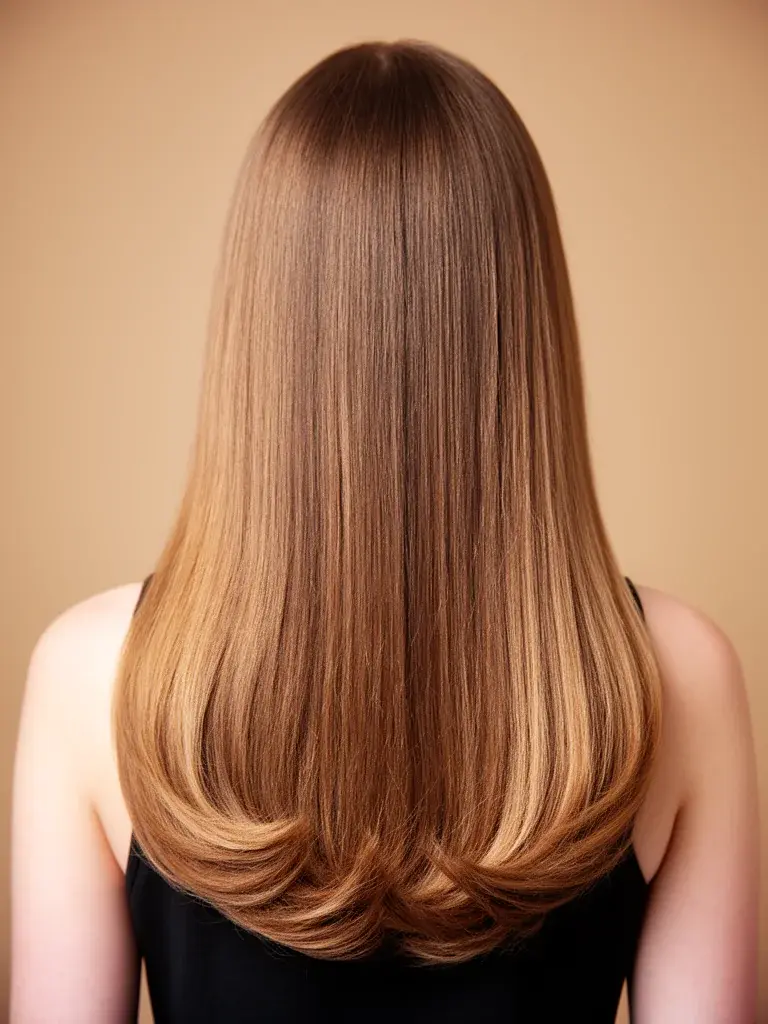
U-cut ends are a long-hair shaping technique where the perimeter is cut into a gentle, rounded U-shape when viewed from behind. Instead of a straight horizontal line (blunt cut) or a sharp downward point (V-cut), the hair curves softly at the sides, with the longest strands at center back and gradually shorter strands curving up toward the front.
The shape is structural, not dramatic. The difference between the longest center strand and the shortest side strand is typically 2-4 inches — enough to create a visible curve, but subtle enough that it doesn't read as "layered." The result is hair that has movement and shape when it swings, but looks full and even when it's still.
The U-cut has been a long-hair staple for decades precisely because it solves the problem that blunt cuts don't address: when long hair hangs straight with a blunt line, the sides fall forward and look thinner than the back. The gentle U-curve accounts for this by cutting the sides slightly shorter, so when the hair falls naturally forward around the shoulders, the visible perimeter still looks full and even.
U-Cut vs V-Cut vs Blunt Cut
| U-Cut Ends | V-Cut Layers | Blunt Cut | |
|---|---|---|---|
| Back shape | Soft rounded curve | Sharp tapered point | Straight horizontal line |
| End density | Maximum — no tapering | Thinnest at center back | Maximum — identical to U-cut |
| Layer visibility | Subtle, blended | Dramatic, cascading | None |
| Braid/updo friendly | Excellent — even ends | Poor — wispy tail pieces | Excellent — uniform |
| Bulk removal | Minimal | Maximum at sides | Zero |
| Grow-out pattern | Stays soft, minimal reshaping | Point blunts into U naturally | Stays blunt |
| Trim frequency | Every 10-12 weeks | Every 8-10 weeks | Every 6-8 weeks |
| Best for | Fine hair, versatile styling | Thick hair, worn-down looks | Maximum density seekers |
Bottom line: U-cut is the V-cut's calmer sibling — it adds shape without sacrificing end density. If you can't decide, get a U — a V-cut is always one trim away.
If you're still deciding between a soft U-shape and a sharper V, see how each one sits on your own photo before you ask for the cut.
Cut Specifications
- Perimeter shape: Rounded U-curve, 2-4 inches of depth (difference between longest center point and shortest side strand). Shallow U (2 inches) is barely perceptible; deep U (4 inches) is clearly visible as an architectural curve
- Layers: None, or very long internal layers only. The U-shape IS the structure — adding visible layers defeats the purpose of preserving end density. If internal layers are added for volume, they should not be visible at the perimeter
- Weight line: Sits at the natural hemline — no raised weight line. The hair falls with gravity, and the U-shape appears as the natural resting silhouette
- Graduation: None. A U-cut is not a graduated bob at long length — there's no stacking or built-in volume at the nape. The curve is achieved by trimming the perimeter, not by cutting angles
- Trim cycle: Every 10-12 weeks. The U-shape softens gradually as it grows, but doesn't lose its shape as dramatically as a V-cut. At 14-16 weeks, a deep U has softened into a shallow U; a shallow U has softened into near-blunt. Easy to maintain.
Color Pairing
- Single-process brunette or dark tones: The U-shape is most visible on uniform dark hair — the rounded silhouette creates a clean arc against clothing and backgrounds. Dark U-cuts look polished and intentional without effort.
- Subtle balayage: Hand-painted highlights that flow through the U-curve add dimension to the shape — the lighter pieces trace the rounded perimeter, making the architecture more visible. The key is subtlety: the color should enhance the shape, not compete with it.
- Face-framing highlights with untouched ends: Since the U-cut's drama is at the back, placing color at the front creates visual interest from the angle where the U isn't visible. Your front view gets dimension; your back view stays a clean, dark U-shape.
- Copper or warm tones: Warm colors catch light at the curve of the U, creating a natural gradient effect where the rounded ends seem to glow. This is especially effective on wavy hair, where the waves distribute the warm tones unevenly through the curve.
Face Shape Tweaks
- Oval: The U-cut works naturally with oval proportions. No adjustments needed — any depth of U-curve and any part complements the balanced face shape
- Round: The long, vertical fall of a U-cut elongates round faces. Keep the part center or slightly off-center. Avoid adding waves or body that puff the hair outward at cheek level
- Square: The rounded U-curve at the bottom echoes softness that balances angular jawlines. Let the front pieces fall past the jaw rather than tucking behind the ears — the hair softens the jaw angle
- Heart: The U-cut adds visual weight at the bottom of the hair, balancing a wider forehead and narrower chin. A deeper U-curve (3-4 inches) creates more visual weight at the perimeter, enhancing the balancing effect
Hair Type Tweaks
- Straight: The U-curve shows with geometric precision — a clean, architectural arc. Straight-haired women benefit most from a deeper U (3-4 inches) since the lack of natural movement means a shallow curve may be invisible
- Wavy: Natural waves soften the U-shape into something more organic. A standard 2-3 inch U works well — the wave movement makes the shape feel natural rather than cut. Wavy hair is arguably the best texture for a U-cut because the combination of shape and movement looks effortless
- Fine: Keep the U shallow (2 inches maximum). A deep U on fine hair can make the sides look thin while the center maintains density — creating an uneven density distribution. The shallow curve adds shape without exposing the thinness of the perimeter
- Thick: You can go deep (3-4 inches) without density concerns. The deep U gives thick hair a noticeable silhouette without layers or thinning. If the thick ends feel too heavy, ask for point-cutting at the ends only — this texturizes the tips without changing the U-shape
Maintaining the U-Shape During Growth
The U-cut's best feature is also its biggest maintenance advantage: it grows out gracefully. Unlike a V-cut (where the point blunts and the dramatic shape disappears) or a blunt cut (where splits appear unevenly), the U-curve simply softens over time.
- Week 1-4: The U is at its most defined. The curve is crisp, the ends are sealed, and the shape swings with every head turn. This is the "just got a haircut" window without it being obvious you got a haircut.
- Week 5-8: The U has softened slightly. Growth at the sides has started to fill in the curve. The shape is still clearly a U, just less geometric. Most people notice no difference.
- Week 9-12: Time for a trim if you want to maintain the defined curve. The U is now a very gentle curve, approaching blunt territory. If you like the softer shape, you can stretch to 14 weeks.
- Beyond 12 weeks: The U has effectively become a blunt-with-slight-movement shape. Not ugly, just less defined. This is why U-cuts are the best choice for women who procrastinate on trims — the worst-case grow-out is still fine.
- The U → V path: If you grow out a U-cut without trimming, it never becomes a V — it becomes blunt. To transition from U to V, you need intentional shaping. The reverse is true too: a V-cut grows into a U naturally. If you've been considering both, try V first; you'll get the U for free as it grows.
What to Tell Your Stylist
"I want a U-shaped back — soft rounded curve, not a V-point and not straight across. Keep all the density at the ends. No internal thinning. I want the U to be [shallow/medium/deep] — about [2/3/4] inches of difference between center and sides."
Reference photo tips:
- Bring a back-view photo — the U-cut's defining feature is invisible from the front. Search "U-cut back view" not just "U-cut hairstyle"
- If you have a photo of a V-cut you like but want it softer, show it and say "This shape, but rounded — a U instead of a V." Most stylists understand the U/V spectrum as a gradient, not two separate cuts
- Specify the depth: point to where you want the side-hair to end and where you want the center to fall. The gap between those two points is your U-depth
- If your stylist isn't familiar with "U-cut" specifically, say "rounded ends" or "horseshoe shape" — different salons use different terminology for the same shape
How to Style
Daily (5 minutes):
- Detangle with a wide-tooth comb, starting from ends
- Apply a leave-in conditioner or lightweight serum to mid-lengths and ends
- Air dry or rough dry with a blow dryer on low. The U-shape looks good without precision styling — the cut does the work
- Let the hair fall naturally. The U-curve creates its own movement without tool intervention
Polished (15 minutes):
- Blow dry with a paddle brush, directing the ends inward slightly to emphasize the U-curve
- Use a round brush on just the last 4 inches to create a subtle inward curl at the ends — this traces the U-shape
- Apply a smoothing serum for shine. The polished version is about surface smoothness, not wave or curl
- The goal is "glossy curtain" — smooth, reflective, with the U-shape creating gentle movement at the perimeter
No-Heat Alternative:
- Wash and condition, focusing extra conditioner on the ends
- Wrap damp hair in a microfiber towel for 10 minutes to absorb excess water
- Apply a lightweight mousse and comb through
- Let air dry completely. The U-cut air-dries well because the shape follows gravity naturally
- Once dry, a boar bristle brush through the top layer creates shine without heat
Maintenance Schedule
- Week 1-4: U-shape is crisp and defined. The curve swings cleanly. Ends feel sealed and smooth. Standard maintenance: deep condition every 1-2 weeks, detangle gently.
- Week 5-8: U is softening. The sides have grown slightly, reducing the curve depth. Still clearly a shaped cut. This is the most natural-looking phase — defined enough to be intentional, soft enough to look effortless.
- Week 9-10: Ideal trim window for maintaining a defined U. The shape is still visible but approaching soft-blunt territory. Book your appointment around week 9 for the best balance of shape retention and length preservation.
- Week 11-14: Extended stretch. The U is now very gentle — more "slight rounding" than "clear curve." Perfectly acceptable if you prefer a low-maintenance approach. The grow-out is graceful, not awkward.
If you color your hair:
- Single-process color: maintain on standard schedule (every 6-8 weeks for root touch-up). The U-cut doesn't change color maintenance.
- Balayage: the U-curve distributes hand-painted color beautifully as it grows. The rounded perimeter creates an even color distribution that ages well between appointments. Refresh every 14-18 weeks.
Pro tip: The U-cut is the most versatile "leave it alone" haircut. If you find yourself unable to get to the salon for 4 months, a U-cut will look better at month 4 than any other shaped cut. It's the built-in insurance policy for busy women.
Common Mistakes
-
Accidentally getting a V-cut instead Fix: The line between a deep U and a shallow V is thin — about 1 inch of angle difference. If your "U-cut" came out pointy at center back, your stylist cut too much angle. Bring a back-view reference photo next time and explicitly say "round, not pointed." The U should curve like the bottom of a spoon, not taper to a tip.
-
Requesting a U-cut on too-short hair Fix: The U-shape needs at least collarbone length to be visible. On shoulder-length hair, the 2-4 inch curve difference is compressed into an almost-invisible rounding. If your hair is medium-length and you want visible shaping, ask for face-framing layers or a lob instead — these give more impact at shorter lengths.
-
Adding heavy layers on top of the U-shape Fix: The U-cut's strength is end density. Adding visible layers inside the U removes the density you're trying to preserve. If you want volume without losing end thickness, ask for internal layers that are invisible at the perimeter. The U-shape should be the only visible structure.
-
Using the wrong brush for the U-curve Fix: A round brush with a diameter matching your desired curve enhances the U-shape during blow-dry. Too small a barrel creates curl rather than curve. A 2-3 inch diameter round brush on just the last 4 inches of hair traces the U-curve naturally. A paddle brush is fine for everyday — it won't enhance the curve but it won't fight it either.
-
Comparing your U-cut to curly-haired U-cuts Fix: The U-shape looks dramatically different on straight vs curly hair. On straight hair, it's a geometric arc. On curly hair, it's softened by texture into something more organic. If you have straight hair and want the organic look, add subtle waves. If you have curly hair and want the geometric arc, that requires straightening — which may not be worth the heat damage for a back-view shape.