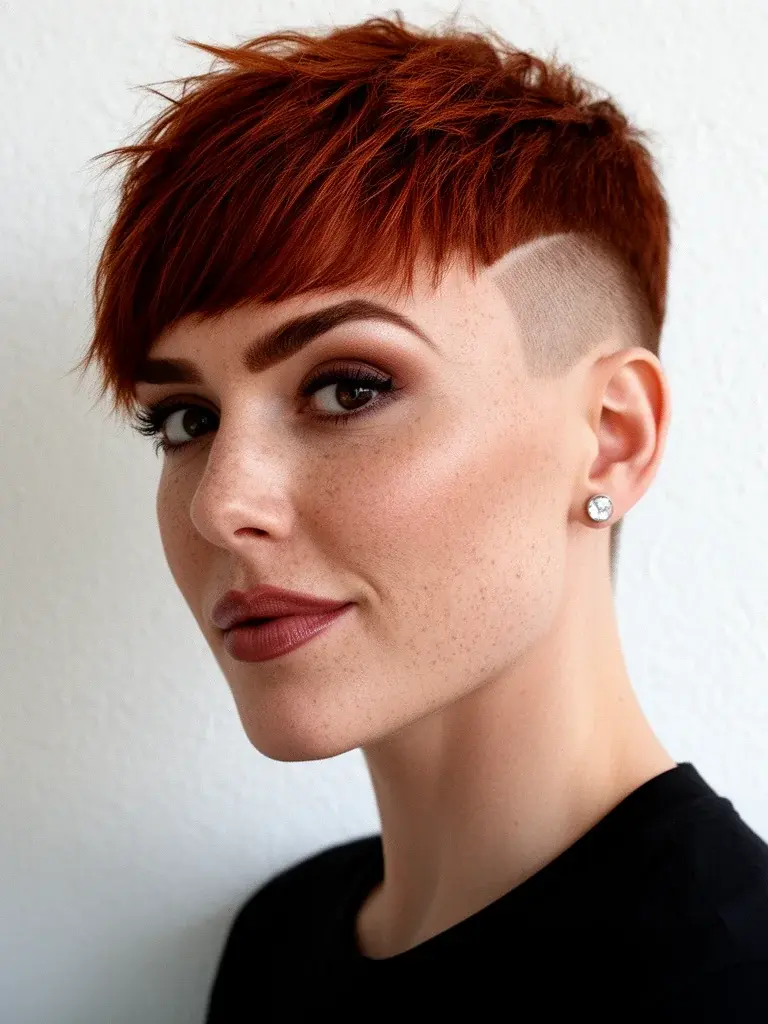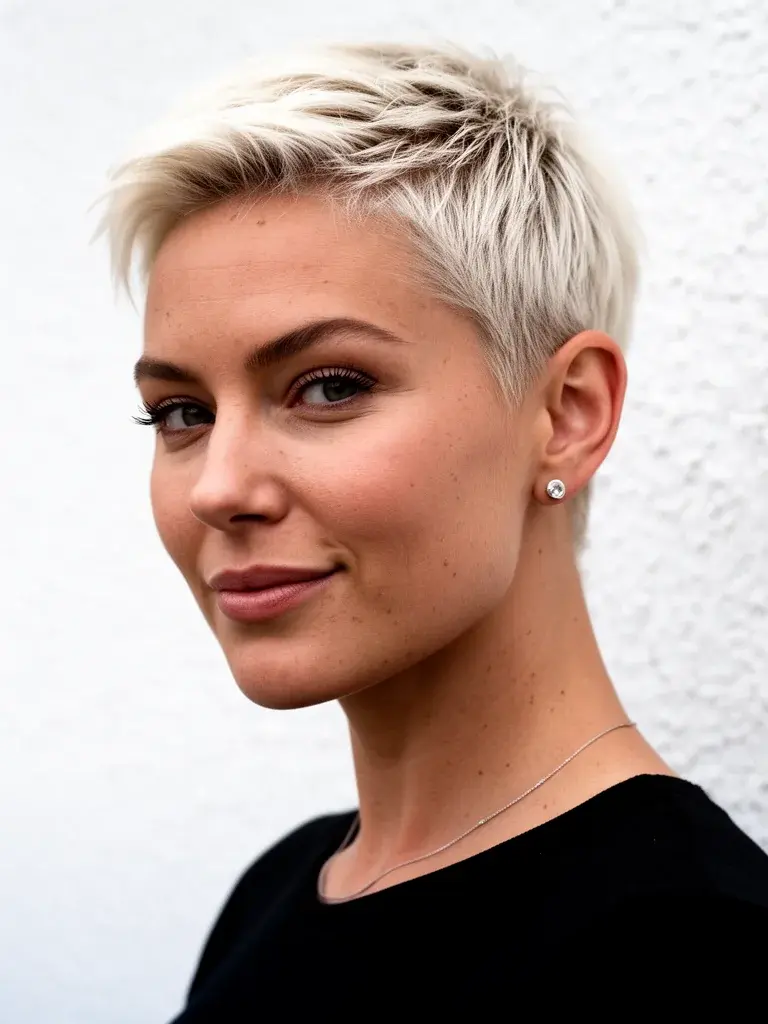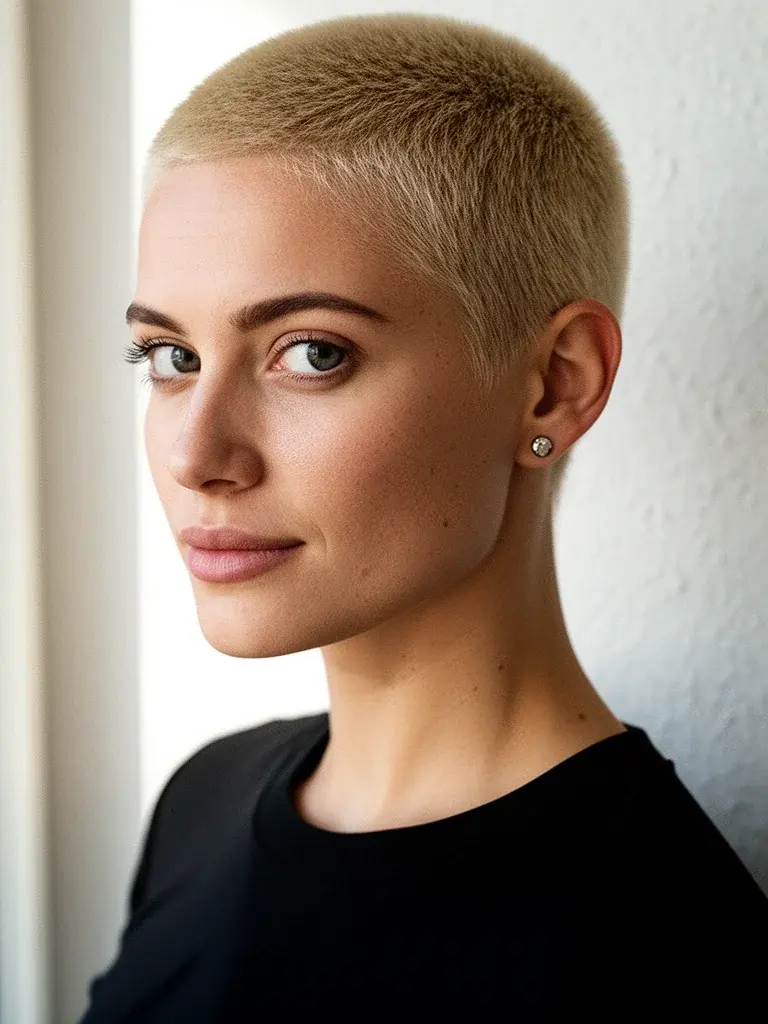
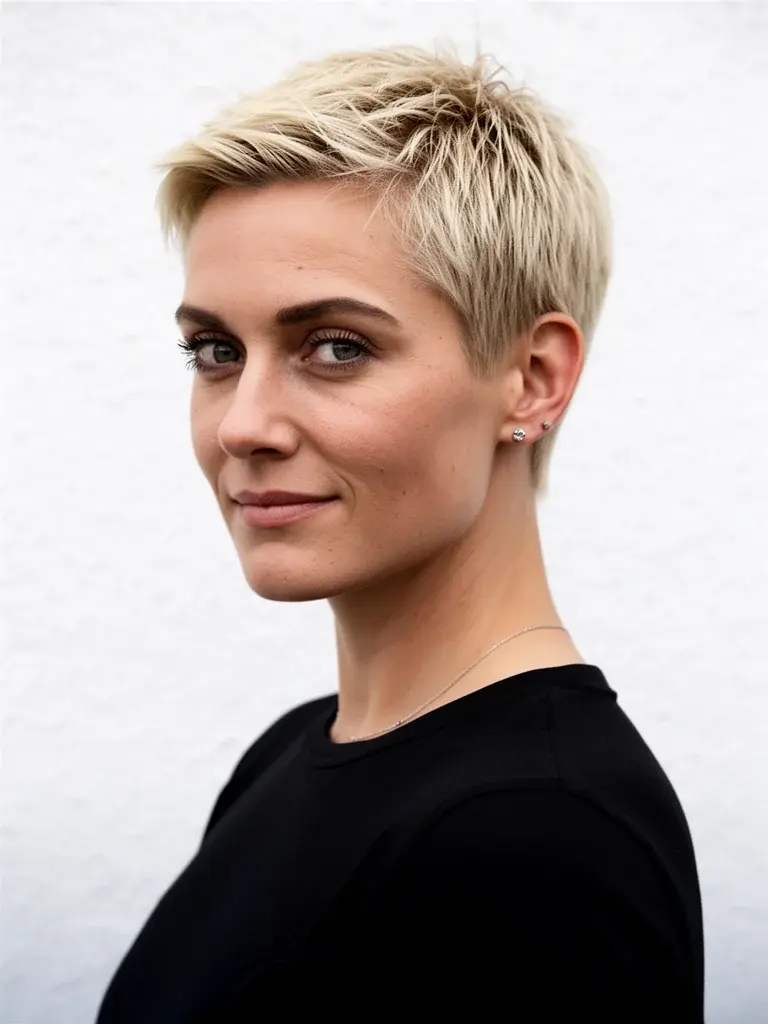
TL;DR
- Best for: Oval, heart, and diamond faces who want a short, androgynous cut with zero daily effort
- Avoid if: Very round face without strong bone structure, or you're not ready for ears-out short
- Ask your stylist: "I want a soft boy cut — about 2 inches on top, tapered at the sides and nape, nothing blunt"
- Maintenance: Trim every 5–6 weeks
Who Does It Suit?
The boy cut works best on women with defined bone structure — it puts your features on display rather than framing them with hair.
Ideal for:
- Oval, heart, and diamond face shapes where cheekbones and jawline do the work
- Women who prefer getting ready in under 5 minutes
- Active lifestyles — running, swimming, cycling — where long hair gets in the way
- Fine or thin hair that falls flat at longer lengths
- Anyone drawn to minimal, clean aesthetics over styled, "done" hair
Hair types:
- Straight: The easiest pairing — falls into place naturally, no product needed
- Wavy: Adds texture and movement, gives the cut a lived-in look without trying
- Fine: Actually the ideal candidate — short length creates the illusion of thickness
Avoid If...
- Very round face with soft jawline → a Short Pixie with longer top layers adds vertical dimension
- Thick, coarse hair that poofs when cut short → thickness needs weight to stay flat; try a Classic Bob that uses gravity
- Curly or coily texture → curls lose their pattern below 3 inches; consider an Afro or Long Pixie which keeps more length for curls to form
- You need to hide your ears → the boy cut is ears-out by design; a bob or lob keeps ears covered
- Not ready for the big chop → transition with a French Crop first, which is short but keeps some forehead coverage
- Your workplace requires a "polished" look and short hair makes you nervous → start with a Classic Bob, build confidence, then go shorter
What is a Boy Cut?
A boy cut is a short women's haircut where the hair is 1.5–2.5 inches all over, with soft tapering at the sides and nape. It borrows the proportions of a men's cut — short, uniform, unfussy — but rounds off the edges. No hard lines at the temples. No squared neckline. No guard-number precision. The silhouette follows the natural shape of your head rather than fighting it.
The key difference from a men's cut is in the finishing. A stylist will point-cut the ends for softness rather than clipper them blunt, taper the sideburns to follow the natural hairline rather than squaring them, and leave just enough length at the nape to create a gentle shape rather than a hard stop. The result looks deliberate and polished without looking like you borrowed a men's haircut.
The boy cut also differs from a pixie in its restraint. Where a pixie plays with contrast — very short sides, longer textured top — the boy cut keeps everything within a narrow length range. There's no dramatic difference between the longest and shortest sections. This uniformity is what gives it that effortless quality: it looks like you woke up this way, not like you spent 45 minutes sculpting it.
Boy Cut vs French Crop vs Buzz Cut
| Boy Cut | French Crop | Buzz Cut | |
|---|---|---|---|
| Length | 1.5–2.5 inches, uniform | 1–2 inches top, fringe forward | Under 0.5 inches all over |
| Defining feature | Soft, tapered all around | Blunt fringe across forehead | No fringe, no layers, just scalp |
| Face shape | Best for oval, heart, diamond | Best for high foreheads | Best for strong bone structure |
| Maintenance | Every 5–6 weeks | Every 4–5 weeks | Every 2–3 weeks |
| Styling time | Under 60 seconds | Under 60 seconds | Zero |
Bottom line: Boy cut = softest and most versatile short option. French crop = structured with forehead coverage. Buzz cut = the ultimate zero-maintenance commitment.
Cut Specifications
- Layers: Minimal internal layering — the cut relies on uniform length, not dramatic layers. Point-cutting at the ends creates a soft, piecey finish. Avoid razor-cutting on thick hair (it creates too much volume), but razor-cutting works well on fine hair to add texture.
- Bangs/Fringe: Optional. If included, a wispy, side-swept micro-fringe that blends into the sides rather than a defined bang line. The fringe should be the same length as the top (about 2 inches) and sit just above the eyebrows when pushed to the side. Many boy cuts skip bangs entirely — the cut works both ways.
- Weight line: No visible weight line — the cut should look the same density from crown to nape. The tapering handles the transition gradually rather than creating any ledge or step. Run your hand from crown to nape; it should feel like a smooth slope, not stairs.
- Graduation: Slight graduation at the nape and above the ears. Not a hard undercut, but the hair should get gradually shorter as it moves down. Target lengths: 2–2.5 inches at the crown, 1.5 inches at the temples, 1 inch at the nape. The transition should span at least 1 inch of length — abrupt changes read as masculine.
- Neckline: Soft and tapered, following the natural hairline. No squared-off or blocked neckline (that's a men's cut detail). The nape hair should feather out and thin to nothing rather than ending in a hard line.
- Trim cycle: Every 5–6 weeks. The boy cut holds its shape longer than most short cuts because the uniform length means uneven growth is less noticeable.
Color Pairing
- Your natural color: The boy cut is strongest in its simplicity — natural color keeps the focus on the cut itself. If your natural shade is mousy or flat, ask your stylist for a gloss treatment to add depth without changing the color.
- Subtle highlights (babylights or fine foils): 10–15 micro-thin highlights around the crown and temples add dimension on fine hair. Keeps the cut from looking one-dimensional in flat lighting.
- Platinum or silver blonde: The bold option. A boy cut in platinum reads as a deliberate fashion choice — striking on cool skin tones, dramatic on warm ones. Be aware: platinum on short hair needs a root touch-up every 4–5 weeks and regular toning to prevent brassiness.
- Warm brunette with caramel pieces: A few face-framing caramel highlights soften the cut and draw attention to your eyes. Works especially well on medium and olive skin tones.
Face Shape Tweaks
- Oval: Standard boy cut works without adjustment — this face shape handles uniform short hair effortlessly
- Heart: Keep slightly more length at the temples (2–2.5 inches) to balance a wider forehead against a narrow chin
- Diamond: Leave extra volume through the crown to elongate the face; taper tighter below the cheekbones to avoid width at the widest point
- Round: Add a side-swept micro-fringe and keep the sides tight — you need vertical lines to counteract the circular silhouette
- Square: Soften the nape and temple areas with extra point-cutting; avoid blunt lines anywhere that echo the jawline
- Oblong: Keep sides slightly fuller (don't taper too tight) and avoid height on top — you want to add width, not length
Hair Type Tweaks
- Straight: The default pairing. Falls into shape on its own. If hair is very straight and flat, ask for razor-cutting to add micro-texture.
- Wavy: Leave an extra half-inch everywhere so waves have room to form. The natural wave pattern adds built-in body that straight hair needs product to achieve.
- Fine: Perfect match — short length creates instant density. Use a dry texturizing spray at the roots every 2–3 days for lift.
- Thick: Ask your stylist to thin from underneath with thinning shears. Without thinning, thick hair in a boy cut turns into a helmet. Focus thinning on the crown and sides.
- Coarse/wiry: Leave extra length (2.5 inches minimum) so the hair bends rather than stands straight up. Use a lightweight smoothing cream daily.
Growing Out a Boy Cut
The grow-out is the boy cut's one real weakness. That 3–6 month window between "short and sharp" and "intentional bob" can feel shapeless. Hair grows an average of half an inch per month, so you're looking at roughly 9 months from a fresh boy cut to chin-length. Here's how to navigate each phase without hating your hair.
- Trim every 6 weeks during grow-out, not less: It sounds counterintuitive — you're trying to grow it, why cut it? Because selective trimming (nape, above the ears, the back) keeps the shape intentional while the top gains length. Tell your stylist "I'm growing this out — clean up the edges, don't touch the top or crown." Budget for these shaping trims; they cost less than a full cut.
- Months 1–2 — the "I look fine" phase: The cut softens and fills in. The taper at the nape disappears. No real awkwardness yet — just a slightly shaggier version of your boy cut. Enjoy it.
- Months 2–4 — the mullet danger zone: The back grows faster than the top and sides, and you start developing a tail at the nape. This is when most people panic and either cut it all off again or suffer through it. Neither is necessary. Get the nape trimmed to match the sides every 4 weeks. The top is gaining length — don't touch it.
- Months 4–6 — the headband phase: The top is now 3–4 inches and falls forward into your face or sideways without structure. Headbands, small clips, a deep side part, and bobby pins are your daily tools. A lightweight texturizing spray keeps hair from lying flat against your head. This is genuinely the hardest phase — power through it.
- Months 6–9 — the home stretch: You're approaching a Classic Bob length. Your stylist can now shape the grow-out into a proper short bob or lob. Book a "grow-out shaping" appointment — they'll remove bulk from the back and sides while preserving the length you've gained. The worst is behind you.
What to Tell Your Stylist
"I want a boy cut — about 2 inches on top, tapered gradually to about 1 inch at the nape and above the ears. Point-cut the ends so nothing looks blunt. No hard lines at the sideburns or neckline. I want it soft, not sharp."
Reference photo tips:
- Bring 2–3 photos showing the length and shape you want, ideally on women with similar face shapes and hair textures
- Specify what you like in each photo — "I like the nape length in this one" and "the overall shape in this one"
- Show a photo of what you don't want, too — "not this short on the sides" or "not this much fringe"
- If your stylist pushes back ("are you sure?"), that's normal for a first big chop. Be specific about the length you want — inches, not adjectives like "short"
How to Style
Daily (45 seconds):
- Towel dry until damp — not dripping, not bone dry
- Run fingers through hair in your preferred direction (forward, to the side, or pushed back)
- Shake your head once to settle the hair into its natural fall
- Let air dry — done
Polished (3 minutes):
- Towel dry until slightly damp
- Apply a pea-sized amount of light hold cream or matte pomade to your palms
- Distribute evenly through the hair, working root to tip, focusing on the crown and sides
- Use a fine-tooth comb to define the part or push hair into shape
- Hit the roots with a blow dryer on low heat for 30–60 seconds, directing the hair where you want it to sit
- Finish by running fingers through once to break the "too-done" look
No-Heat Alternative:
- Apply texturizing spray to damp hair (2–3 spritzes at the roots, 1–2 through the mid-lengths)
- Scrunch and tousle with your hands for 15 seconds, lifting at the roots
- Let air dry completely — the spray adds grit and hold as it dries, creating a piece-y finish
- Once dry, run fingers through to separate any clumps
- Optional: flip your part to the opposite side for extra volume at the roots
Maintenance Schedule
- Week 1–2: Fresh cut, sharp shape. Falls perfectly into place with no effort. The taper at the nape is clean, the sides sit flat, and the crown has defined shape. This is the cut at its best.
- Week 3–4: Still looks intentional. Slight softening at the nape and above the ears. The overall shape holds because the uniform length grows out evenly. No action needed unless you notice the nape starting to curl or flip.
- Week 5–6: Shape is fading. The nape is visibly longer and may start curling outward or flipping up. Sides may poke out above your ears instead of lying flat. The clean taper is gone. Time to book your trim.
- Week 7–8+: Overgrown. The uniform length that defines this cut is gone — you now have an undefined short cut that reads as "growing out" rather than "intentional." Don't wait this long unless you're growing it out on purpose.
If you color your hair:
- Single process color: touch up roots every 5–6 weeks — conveniently aligns with your trim cycle, so book both together
- Highlights or platinum: toning every 4–5 weeks to prevent brassiness; short hair shows warm root growth faster than long hair because there's less length to distract the eye
- Gloss treatments: reapply every 6–8 weeks for shine and color depth; a clear gloss adds richness to natural color without commitment
Pro tip: Book your trim and color on the same appointment — with a boy cut, both together still take under 90 minutes. Some salons offer a short-hair discount since the cut takes 20–30 minutes rather than the usual 45–60.
Common Mistakes
-
Cutting it too uniform without tapering Fix: A boy cut without graduation at the nape and ears looks like a bowl cut from the 1990s. Insist on gradual tapering — the crown should be the longest section, with smooth transitions down to the nape and sides. Show your stylist a side-view reference photo.
-
Going to a barber instead of a stylist Fix: Barbers are trained for men's proportions — squared sideburns, blocked neckline, clipper-over-comb precision. A stylist trained in women's short cuts will soften the sideburns, feather the neckline, and point-cut the ends. The same length cut by a barber vs. a stylist will look completely different.
-
Skipping trims because "it's already short" Fix: Short cuts lose shape faster than long ones because there's less length to hide uneven growth. The 5–6 week trim cycle is non-negotiable if you want the cut to look intentional rather than neglected. Set a recurring calendar reminder.
-
Using heavy products designed for longer hair Fix: Skip anything labeled "smoothing," "anti-frizz," or "deep conditioning." These products add weight that flattens short hair. You need lightweight texturizing spray, matte paste, or light hold cream — products specifically designed for short styles. A fingernail-sized amount is enough for your entire head.
-
Washing daily and stripping natural oils Fix: Short hair shows oil faster than long hair because there's less surface area to absorb it — but daily washing creates a cycle where your scalp overproduces oil to compensate. Every other day is the sweet spot. Use dry shampoo on off days if your roots look flat or oily by midday.