TL;DR
- Best for: Every face shape — adjust length and graduation to match
- Avoid if: You need a ponytail for workouts or childcare every day
- Ask your stylist: "I want a one-length bob hitting at my chin line, with slight internal graduation for movement"
- Maintenance: Trim every 6–8 weeks
Who Does It Suit?
Ideal for:
- Every face shape with the right length adjustment (see Face Shape Tweaks below)
- Women who want a dramatic change without going pixie-short
- Professionals who need a no-fuss, always-appropriate look
- Fine hair that looks limp and thin when grown past the shoulders
- Anyone who values a clean silhouette over complicated styling
Hair types:
- Straight: The classic canvas — falls into place, air-dries clean, shows off the blunt line perfectly
- Wavy: Adds natural texture and body without effort; the bob tames waves into a shape instead of a mess
- Thick: Works well but needs internal graduation (thinning from inside) to prevent the triangle effect
- Fine: One of the best cuts for fine hair — the blunt edge makes thin ends look thicker and healthier
Avoid If...
- You live in a ponytail → try Beach Waves at collarbone length for tie-back flexibility
- You have very tight curls and want a sleek look → a bob will fight your texture daily; consider an Afro shape cut to your natural curl pattern
- You hate going to the salon → bobs show uneven growth fast; a longer, layered style is more forgiving past the 8-week mark
- You want maximum volume → the one-length structure limits lift; Curtain Bangs with layers will give more body
- You're not ready for a commitment → a bob is obvious; if your hair is currently past your shoulders, the chop is dramatic and the grow-out takes months
- You want texture and lived-in personality instead of precision → a Shaggy Bob gives you the same chin-level length with choppy layers that air-dry with character rather than a clean weight line
What is a Classic Bob?
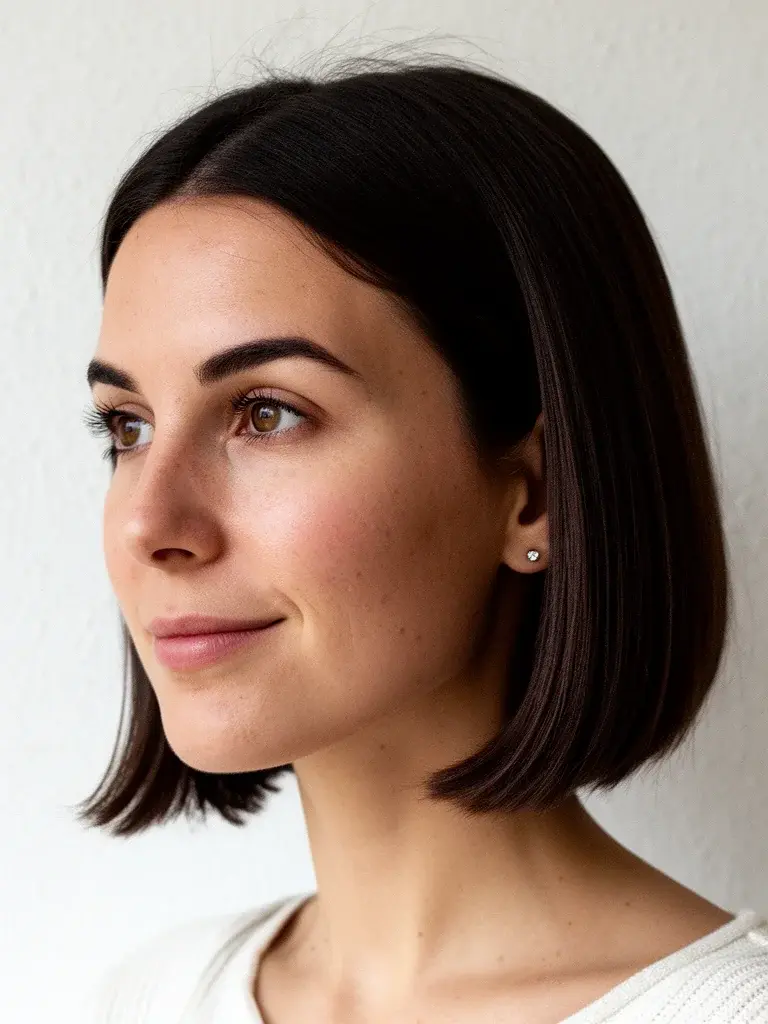
A classic bob is a one-length cut that falls between the earlobe and the chin. The defining feature is the blunt perimeter line — all hair ends at the same point, creating a clean geometric shape. There are no visible layers on the surface.
The structure is deceptively simple. A good bob is cut with internal graduation (also called undercut layering or weight removal) so the hair curves inward at the ends instead of fanning out into a triangle. From the outside it looks like one length. From the inside, the bottom layers are slightly shorter than the top, which creates the shape. This is why a bob from a skilled stylist looks nothing like one from a quick-cut chain — the invisible architecture matters more than the visible line.
Classic Bob vs A-Line Bob vs Blunt Bob
| Classic Bob | A-Line Bob | Blunt Bob | |
|---|---|---|---|
| Length | Same length all around, at the chin | Shorter in back, longer toward the front (1–2 inch difference) | Same length all around, can be any length |
| Shape | Slightly curved inward at the ends | Angular, dramatic side profile | Perfectly flat, no inward curve |
| Face shape | Best for all face shapes with adjustment | Best for round or wide faces (the angle slims) | Best for oval or angular faces |
| Maintenance | Every 6–8 weeks | Every 6–8 weeks | Every 5–6 weeks (flat line shows growth faster) |
| Texture needed | Works on all textures | Best on straight to wavy | Requires straight hair or daily flat-ironing |
Bottom line: Classic bob = the versatile default. A-line = face-slimming with drama. Blunt bob = maximum edge, minimum forgiveness.
Cut Specifications
- Layers: None visible on the surface; internal graduation only, removed from underneath to create inward movement
- Bangs/Fringe: Optional — works with or without; side-swept bangs soften the look, micro bangs sharpen it
- Weight line: At the chin or up to 1 inch below; this single line defines the entire cut
- Graduation: 5–15 degrees of internal graduation (more for thick hair, less for fine); keeps the shape from going triangular
- Trim cycle: Every 6–8 weeks
Color Pairing
- Sleek dark monochrome: A single-process dark brown or black makes the geometric line hit hardest. Best for straight hair and angular faces. The contrast between hair and skin amplifies the clean shape.
- Warm balayage: Hand-painted caramel or honey tones through a brunette base add dimension and make the bob look less severe. Works on every skin tone and softens the blunt line without layers.
- Blonde with shadow root: Platinum or ash blonde with 1–2 inches of natural root growth gives the bob a modern, undone feel. Reduces maintenance since root growth looks intentional. Best on light to medium skin tones.
- Rich auburn or copper: Red tones catch light differently at every angle, turning the simple bob shape into something that shifts and changes as you move. Single process or gloss — skip the highlights and let the color do the work.
Face Shape Tweaks
- Oval: The easiest face for a bob — any length between ear and chin works. Center part or side part, both look balanced.
- Round: Keep the bob at or just below the chin, never above. A deep side part adds asymmetry that breaks the roundness. Avoid adding volume at the sides.
- Square: A bob that falls just below the jawline softens angular features. Add a slight wave or bend at the ends to avoid mirroring the jaw's straight lines.
- Heart: Chin-length is ideal — the width at the bottom balances a narrow chin. Avoid going shorter than the chin, which emphasizes forehead width.
- Oblong: Go shorter (ear to jaw) to avoid elongating the face further. Add slight volume at the sides with a bit of texture or a wider part.
- Diamond: A chin-length bob with a side part balances wide cheekbones. Keep the ends soft — blunt-cut ends at the widest point of the face can exaggerate width.
Hair Type Tweaks
- Straight: Your bob will look the sleekest with minimal effort. If your hair is very slippery and flat, ask for a slight bevel (curving the ends inward with a round brush) to prevent the hair from just hanging limp.
- Wavy: Let the wave work for you — air-dry with a smoothing cream and your bob will have natural movement. If you want it sleek one day and textured the next, a bob at chin length gives you both options.
- Thick: The triangle problem is real (see section below). Ask your stylist to remove weight from the interior without thinning shears on the surface, which creates frizzy flyaways.
- Fine: The bob is your best friend. The blunt line makes thin ends look 2x thicker. Skip internal layering — you want every strand ending at the same point for maximum density at the perimeter.
If You Have Thick Hair
Thick hair in a bob creates the "triangle problem" — the weight fans out from the roots, and the hair gets wider as it reaches the ends. Instead of a clean, inward-curving silhouette, you get a shape that looks like a doorstop. Here's how to solve it.
- Request internal graduation: Your stylist should remove bulk from underneath by cutting the interior layers 0.5–1 inch shorter than the surface. This lets the top layer fall over the shorter underlayers and curve inward. The surface stays one-length; the shape stays controlled.
- Avoid thinning shears on the surface: Thinning shears (also called texturizing shears) create wispy, uneven ends on thick hair that frizz out in humidity. Weight removal should happen underneath, not on top. Tell your stylist you want "point cutting on the perimeter, slide cutting underneath."
- Blow-dry with a round brush: On thick hair, air-drying a bob often means the ends flip outward. A 5-minute round-brush blowout (medium round brush, ends curled under) locks in the inward shape for 2–3 days.
- Use a smoothing cream, not an oil: Oil on thick bob ends creates a stringy, separated look. A lightweight smoothing cream (like a blow-dry balm) coats the cuticle evenly and keeps the shape unified.
- Go slightly longer than you think: Thick hair has visual mass. A bob that hits at the chin on fine hair will look shorter and heavier on thick hair. Start half an inch below the chin and adjust next visit.
What to Tell Your Stylist
"I'd like a classic one-length bob at my chin line. I want slight internal graduation so it curves inward at the ends — no visible layers on the surface. Keep the perimeter blunt. I'll part it on the [left/right/center]."
Reference photo tips:
- Bring 2–3 photos of bobs on hair textures similar to yours, not just faces similar to yours. A bob on straight hair looks nothing like a bob on wavy hair.
- Point out what you like about each photo specifically: "I like this length" from one photo, "I like this amount of graduation" from another. Your stylist can combine elements.
- If you've never had a bob before, tell your stylist your daily routine honestly. If you say "I never use heat tools," they'll cut it to air-dry well. If you say "I blow-dry every day" when you don't, you'll hate the result.
How to Style
Daily (3 minutes):
- Towel-dry until damp, not dripping
- Apply a quarter-sized amount of smoothing cream from mid-lengths to ends
- Smooth hair down with your hands, tucking the ends slightly under
- Air-dry or hit the ends with a diffuser on low heat for 90 seconds
- Done — the cut does the work
Polished (8 minutes):
- Apply heat protectant to damp hair
- Rough-dry with a blow dryer until 80% dry
- Section the hair into top and bottom (clip the top up)
- Blow-dry the bottom section with a medium round brush, curling ends under
- Release the top, repeat with the round brush
- Finish with a light-hold hairspray or shine serum on the surface
No-Heat Alternative:
- Wash and condition, then towel-dry gently
- Apply a leave-in conditioner and a small amount of mousse
- Smooth hair into place with a wide-tooth comb
- Wrap hair around your head (like a silk wrap) and pin with bobby pins or a silk scarf
- Let dry completely (20–30 minutes or overnight)
- Remove pins — smooth, curved bob with zero heat damage
Maintenance Schedule
- Week 1–2: The bob is at its sharpest. The line is clean, the weight is balanced, the shape falls perfectly. This is what you're paying for.
- Week 3–4: Still looking good. The line may lose a bit of crispness but the shape holds. You might notice the ends starting to feel dry — use a weekly mask.
- Week 5–6: Growth becomes visible, especially at the nape. The back may start to curl out or lose its line. This is when most people start wanting a trim.
- Week 7–8+: Time to book. The blunt line is no longer blunt, the shape has softened into something closer to "growing out" than "styled." Don't wait past 8 weeks if you want to keep the bob looking intentional.
If you color your hair:
- Single-process color: touch up roots every 4–6 weeks; the short length means less mid-length fading
- Balayage or highlights: refresh every 10–14 weeks; a bob shows color placement more than long hair, so grown-out highlights look intentional faster
- Gloss treatments: every 4–6 weeks between full color sessions to keep the tone vibrant and the surface smooth
Pro tip: Your bob's worst enemy is sleeping on it. A silk or satin pillowcase reduces friction and keeps the shape from flattening or frizzing overnight — one of the best $15 investments you'll make.
Common Mistakes
-
Cutting too short on the first visit Fix: Start at or just below the chin. You can always go shorter on the second appointment once you know how the bob sits on your specific hair and face.
-
Skipping internal graduation on thick hair Fix: If your bob poofs out like a triangle, go back to your stylist and ask for interior weight removal. This is a 10-minute fix, not a full re-cut.
-
Washing every day Fix: Bobs look better on day-two hair. Over-washing strips oils that help the hair curve inward. Wash every 2–3 days; use dry shampoo at the roots on off days.
-
Using too much product Fix: A bob is a small surface area. A dime-sized amount of product is enough for the entire head. More than that weighs down the shape and makes it look greasy.
-
Flat-ironing a bob dead straight every day Fix: Constant flat-ironing removes all movement, making the bob look stiff and wiglike. Use a round brush instead — it creates a subtle bend that looks natural and alive.