TL;DR
- Best for: Oval, heart, diamond, and oblong faces who want to celebrate their natural curl pattern
- Avoid if: You need a wash-and-go that looks the same in humidity and dry heat (shrinkage is real)
- Ask your stylist: "I want my afro shaped — round/tapered/asymmetric — with my natural curl pattern, no thinning shears"
- Maintenance: Shape every 8–12 weeks, wash day every 7–10 days
Who Does It Suit?
Ideal for:
- Oval, heart, diamond, and oblong faces — the volume balances narrow and elongated features
- Women transitioning from relaxed to natural hair who want a destination style
- Creative professionals and anyone in environments that celebrate individuality
- Type 3c–4c curl patterns — this is literally what your hair does when healthy
- Anyone who's tired of fighting their texture and ready to work with it
Hair types:
- Curly (3c–4a): Looser curls create a softer, rounder silhouette with visible curl definition throughout
- Coily (4a–4b): The classic afro shape — dense, sculptural, holds its form all day
- Kinky (4c): Maximum volume and the most dramatic silhouette — shrinkage is highest, so actual length may surprise people
Avoid If...
- You want predictable size in all weather → shrinkage can reduce visible length by 50–75%. Try Beach Waves for a looser texture style
- Your hair is heat-damaged in sections → uneven curl patterns make shaping difficult. Grow out the damage first or do a big chop
- You're not willing to invest in wash day → the afro needs 1–2 hours every 7–10 days. A Classic Bob cuts styling time significantly
- Your workplace is hostile to natural hair → this shouldn't be a reason, but it's real for some women. The CROWN Act protects natural hair in many states — know your rights
- You have significant thinning at the crown → the afro exposes the entire head shape. A Curtain Bangs style with protective styling might be better while you address the thinning
What is an Afro?
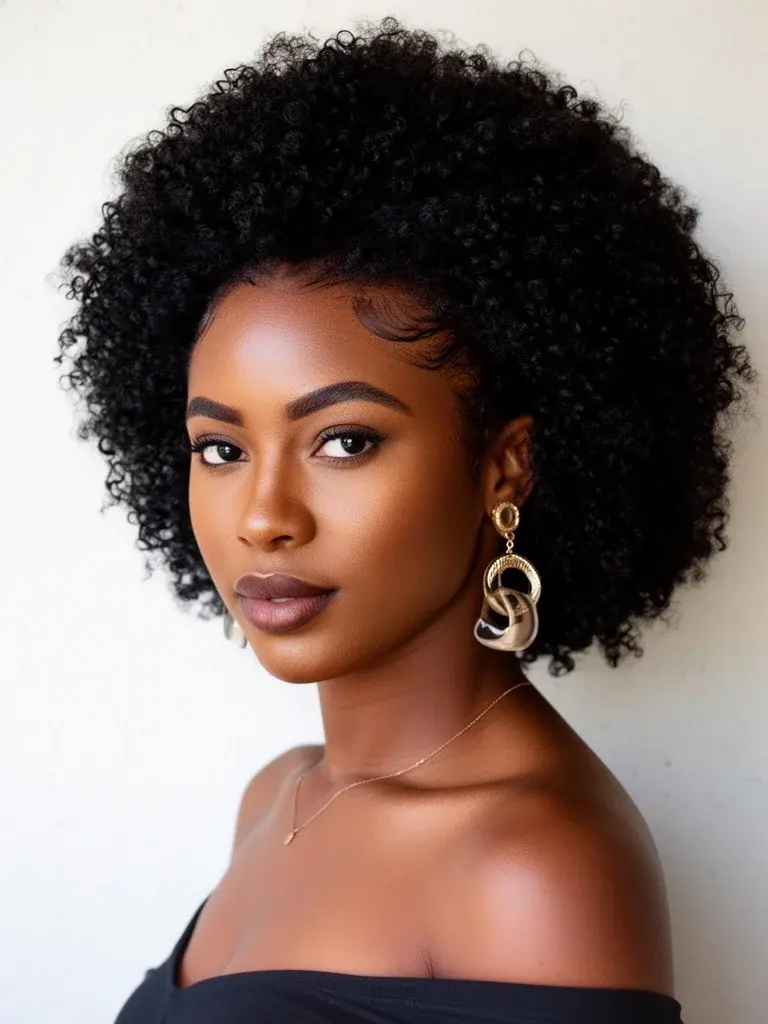
The afro is natural textured hair — typically type 3c through 4c — grown out and shaped into a rounded or sculpted silhouette. There's no chemical straightening, no heat manipulation, no weaving. It's your curl pattern at full volume, defined by how your hair naturally coils, springs, and clusters.
What separates a shaped afro from "just growing it out" is the cut. A natural hair stylist cuts into the dry curl pattern, removing weight where needed and creating a deliberate outline — round, tapered, triangular, or free-form. The shape comes from understanding how each section of your head grows at different rates, how curl patterns vary from temple to crown, and where gravity and density create the final silhouette.
Afro vs Twist-Out vs Wash-and-Go
| Afro | Twist-Out | Wash-and-Go | |
|---|---|---|---|
| Definition method | Natural curl pattern, no manipulation | Two-strand twists unraveled for defined waves | Gel/cream applied to soaking wet hair, air dry |
| Volume | Maximum — hair at full expansion | Medium — stretched and defined | Low-medium — weight of product pulls curls down |
| Hold time | 3–5 days between refreshes | 2–3 days before frizz takes over | 1–2 days, re-wet to refresh |
| Best for | 4a–4c, anyone wanting volume | 3c–4b, defined wave pattern | 3a–3c, looser curl patterns |
| Prep time | 5 min daily, 1–2 hr wash day | 30–60 min twisting, overnight set | 20–30 min application + 2–4 hr air dry |
Bottom line: The afro is volume and freedom — your hair unplugged. The twist-out gives you defined waves with more control. The wash-and-go is lowest daily effort but works best on looser curl types.
Shape Specifications
The afro isn't about guard numbers — it's about shape, density, and how your stylist works with your curl pattern.
- Round shape: The classic. Even length all around, trimmed to create a sphere. Works on most face shapes. Your stylist cuts dry, pulling sections out with a pick and shaping the outline.
- Tapered shape: Shorter at the nape and sides, fuller at the crown. Adds height, flatters round faces, and creates a more sculpted look. The taper can be gradual or dramatic.
- High-top shape: Flat or slightly rounded on top, tight on the sides. A bolder, more geometric statement. Requires more frequent shaping (every 6–8 weeks) to keep the lines clean.
- Free-form shape: No deliberate shaping — you let it grow however it grows. Works if your curl pattern is relatively uniform. Accept the asymmetry; that's the point.
- Trim cycle: Every 8–12 weeks for shaped styles, or whenever you notice the outline losing definition
Color Pairing
- Natural beauty, no color: The afro's texture and volume are already a statement. Many women skip color entirely and let the shape do the talking. Dark, healthy hair with a sheen from proper moisture is striking on its own.
- Copper on dark curls: A warm copper or auburn tint on 4a–4c hair catches light in the curl ridges and creates depth that's invisible on straight hair. Single-process or semi-permanent to avoid damage. Works especially well on medium-to-dark skin tones.
- Sun-kissed highlights: Honey or caramel highlights on the outer layer only (balayage technique adapted for curls). Creates a natural "sun-touched" effect without processing the interior. Your stylist should apply color to stretched hair, then let it coil back — the color concentrates at the tips and bends of each curl.
- Burgundy or deep plum: A single-process tint that reads as "your natural color, but richer." Low commitment, low damage, and the depth shows up dramatically in the afro's rounded silhouette.
Face Shape Tweaks
- Oval: You have the most flexibility. A classic round shape works, but try a slightly tapered afro for visual interest — shorter at the nape, fuller at the crown.
- Heart: The afro's volume at the sides balances a narrower chin. Keep fullness at ear level and below. Avoid too much height on top, which elongates an already top-heavy shape.
- Diamond: Build volume at the forehead and jaw level to soften angular cheekbones. A round afro shape works well. Avoid tight sides that emphasize the widest part of your face.
- Oblong: Go wide, not tall. Keep the sides full and the top slightly flatter. A high-top shape would elongate further — stick with round or even a slightly horizontal oval.
- Round: Add height. A tapered afro or high-top shape creates vertical emphasis. Keep the sides slightly tighter (not shaved — just shaped closer) to lengthen the face.
- Square: Soften the jawline with a round afro that extends past the jaw. Avoid flat-top shapes that echo the angular jaw. Let the curls frame your face with organic curves.
Hair Type Tweaks
- Type 3c (loose coils): Your afro will be softer and less dense than tighter patterns. Use mousse or a lightweight gel to encourage definition. The shape will be looser and more "cloud-like" — lean into it.
- Type 4a (defined coils): The sweet spot for afro shaping. Visible coil pattern, good density, holds shape well. Use the LOC method and let your curls do the work.
- Type 4b (Z-pattern): Less defined coils, more cotton-like texture. This creates the densest, most sculptural afro shape. Use heavier butters and oils — your hair absorbs moisture aggressively. Stretch with banding or African threading to show length.
- Type 4c (tight kinks): Maximum shrinkage (up to 75%), maximum volume. Your afro will look shorter than it is. Pick it out from roots for full expansion. Deep condition weekly — 4c hair is the most fragile and needs the most moisture.
- Mixed textures: Most women have 2–3 curl patterns on their head. A good stylist shapes around this by cutting each section according to its own pattern, not forcing uniformity. The variation adds visual texture.
Moisture and Protection
This is the afro's non-negotiable. Your hair can look incredible or like straw — the difference is moisture management.
- The LOC/LCO method: LOC = Liquid (water or water-based leave-in), Oil (jojoba, argan, or avocado), Cream (styling cream or butter). LCO swaps the last two. Experiment to find which your hair prefers — 4a–4b often likes LOC, 4c often prefers LCO. Apply on wash day to soaking wet hair, section by section.
- Nighttime routine: This is where most women lose moisture. Satin bonnet or satin pillowcase — cotton pillowcases absorb oil and water from your hair all night. Pineapple loosely on top with a satin scrunchie if your afro is large. Re-fluff in the morning with a wide-tooth pick.
- Mid-week refresh: Don't re-wash. Spray a mix of water and leave-in conditioner (3:1 ratio) onto dry sections, scrunch, and let air dry. Takes 5 minutes and extends your style 3–4 more days.
- Deep conditioning: Every wash day (every 7–10 days), sit with a deep conditioner and a plastic cap for 20–30 minutes under a hooded dryer or steamer. This is not optional for afro health. Skip it and you'll see breakage within a month.
- Protein balance: Moisture alone makes hair mushy and limp. Every 4–6 weeks, do a protein treatment (hydrolyzed keratin or rice water rinse) followed by a deep condition. Your hair needs both strength and hydration — the balance is everything.
What to Tell Your Stylist
"I want my afro shaped into a [round/tapered/free-form] silhouette. Please cut it dry so you can see my actual curl pattern. No thinning shears — I want to keep my density. I'd like more [volume at the crown/width at the sides/height on top] to balance my [face shape]."
Reference photo tips:
- Bring 3–5 photos of afros on women with a similar curl pattern to yours — not just the same race, the same curl type. A 3c afro and a 4c afro are completely different shapes.
- Show the photos from multiple angles. Stylists need to see the silhouette from the front, side, and back.
- Point out what you like in each photo: "I want this height" or "I like how the sides are tapered here." Be specific — "I want it like this" without explanation leaves too much guessing.
- Ask your stylist about their experience with natural hair. If they hesitate, find someone else. Natural hair shaping is a specialty — not every stylist has the training.
- If you're transitioning and still have relaxed ends, tell your stylist exactly how many months of new growth you have. They'll plan the cut around the texture boundary.
How to Style
Daily (5 minutes):
- Remove satin bonnet
- Shake hair out and tilt head forward
- Use a wide-tooth afro pick from roots to ends to lift and expand
- Shape the silhouette with your hands — pat and press, don't pull
- Spot-spray any flat sections with water/leave-in mix
Polished (15 minutes):
- Spray entire afro lightly with water/leave-in mix
- Section into 4–6 parts with clips
- Apply a small amount of curl cream to each section, scrunching from ends to roots
- Pick out each section from the root for volume
- Shape the silhouette, pulling any flat spots outward
- Optional: add a headband, scarf, or decorative pins for dimension
No-Heat Alternative:
- On damp hair (wash day), apply curl cream and oil
- Use the "shingling" method: take small sections and smooth product through each curl cluster with your fingers, defining each coil individually
- Allow to air dry completely (2–4 hours) or sit under a hooded dryer (45 minutes)
- Once dry, pick out from roots only — don't disturb the curl pattern at the ends
- This gives the most defined, separated curl look within the afro shape
Maintenance Schedule
- Week 1–2: Freshly shaped and moisturized. This is your afro at its best. Wash day once during this window. Daily pick-and-fluff takes 5 minutes.
- Week 3–4: Still holding shape well. You might notice some sections growing faster than others (temples and nape grow faster for most women). Mid-week refreshes become more important.
- Week 5–8: Shape softening. The outline isn't as clean. This is normal — the afro is one of the most forgiving styles for grow-out. You can stretch to 8 weeks if you don't mind a slightly wilder look.
- Week 9–12: Time to book a shape-up. The silhouette has changed noticeably. If you like the bigger look, keep growing — but a trim removes split ends and resets the shape.
If you color your hair:
- Semi-permanent color fades in 4–6 weeks. Reapply on wash day — it's a simple process you can do at home.
- Permanent color requires root touch-ups every 6–8 weeks. Always deep condition after coloring.
- Bleached highlights need professional maintenance every 10–12 weeks. Be honest about breakage — if your ends feel gummy, trim them.
Pro tip: Track your wash days and shape-up dates in your phone calendar. Consistency is the entire game with natural hair — irregular routines are the #1 cause of breakage and dryness.
Common Mistakes
-
Using thinning shears on natural hair Fix: Thinning shears create uneven layers that frizz out unpredictably. Insist on point cutting or blunt cutting only. If a stylist reaches for thinning shears, speak up.
-
Skipping deep conditioning because "it takes too long" Fix: A hooded dryer cuts deep conditioning from 30 minutes to 15. Or deep condition overnight with a plastic cap and rinse in the morning. There is no shortcut — moisture is the price of admission.
-
Picking the afro out from the ends instead of the roots Fix: Start at the roots and work outward. Picking from ends rips through curl clusters, causes breakage, and creates frizz. Roots first, gentle outward motion.
-
Washing too often and stripping natural oils Fix: Every 7–10 days is enough for most afro textures. If your scalp feels oily at day 5, use a co-wash (conditioner-only wash) instead of shampoo. When you do shampoo, use a sulfate-free formula.
-
Comparing your afro to someone else's curl pattern Fix: A 3c afro will never look like a 4c afro, and vice versa. Shape and volume depend on your specific pattern, density, and porosity. Find reference photos of your curl type, not just "afro" images. Your afro is yours — that's the point.