TL;DR
- Best for: Round, oblong, and diamond faces wanting face-framing length; clean geometric look without much maintenance
- Avoid if: You have a square face and want a purely horizontal cut line; your hair is fine and you want maximum density
- Ask your stylist: "A-line bob — back shorter at [nape / mid-neck], front pieces at [chin / below chin]. [Subtle / standard / dramatic] angle."
- Maintenance: Back every 6–8 weeks; front can stretch to 8–10 weeks
Who Does It Suit?
The A-line bob's defining feature is the length contrast — shorter at the back, longer at the front. That contrast creates specific visual effects that benefit certain face shapes more than others.
Ideal for:
- Round faces — The chin-or-below front length creates vertical lines that elongate
- Oblong faces — The slightly shorter back reduces the visual length at the top while the front adds width at jaw level
- Diamond faces — Front length past the chin adds visual weight at the narrowest facial point
- Those who want a bob that looks deliberate — The angle reads as an intentional design, not a growing-out cut
- Low-maintenance styling — Like the blunt bob, the A-line holds its shape without product; the angle does the visual work
Hair types:
- Straight: Shows the diagonal line most precisely. Excellent for the A-line
- Wavy: Adds texture to the geometric shape, creating a more relaxed version of the same cut
- Fine: The slightly shorter back reduces the heavy look that fine hair can get at a uniform long length
- Thick: Works well; the diagonal naturally distributes thickness rather than bunching it at one line
Avoid If...
- You have a square face and want maximum horizontal line → a Blunt Bob at jaw level works better with square bone structure
- You want stacked back volume → the A-line has minimal stacking; an Inverted Bob gives you structural volume
- You want significant length → the A-line bob is a short cut; a Lob gives the same angle on longer hair
- Your hair is very curly and you want the angle visible → curl pattern may absorb the geometric quality; a Classic Bob cut for curly hair is more predictable
- You dislike any maintenance → even the subtle A-line needs the back trimmed to maintain the angle
- You want the diagonal angle applied side-to-side rather than front-to-back → an Asymmetrical Bob creates the same geometric impact with a left-to-right length difference
What is an A-Line Bob?
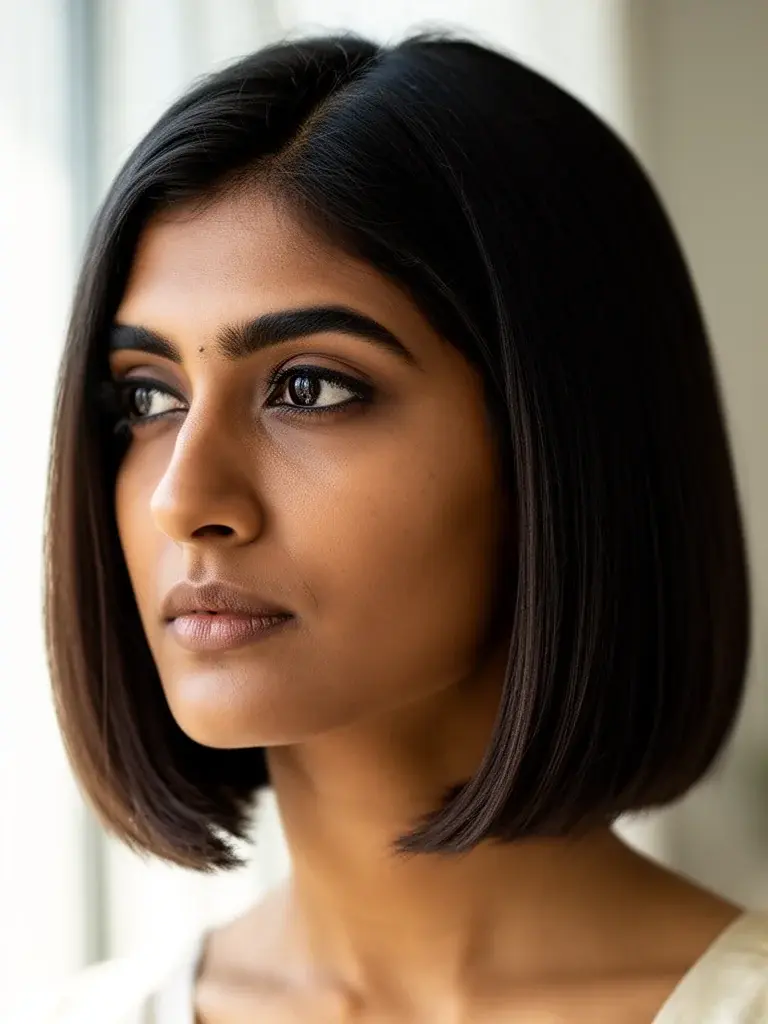
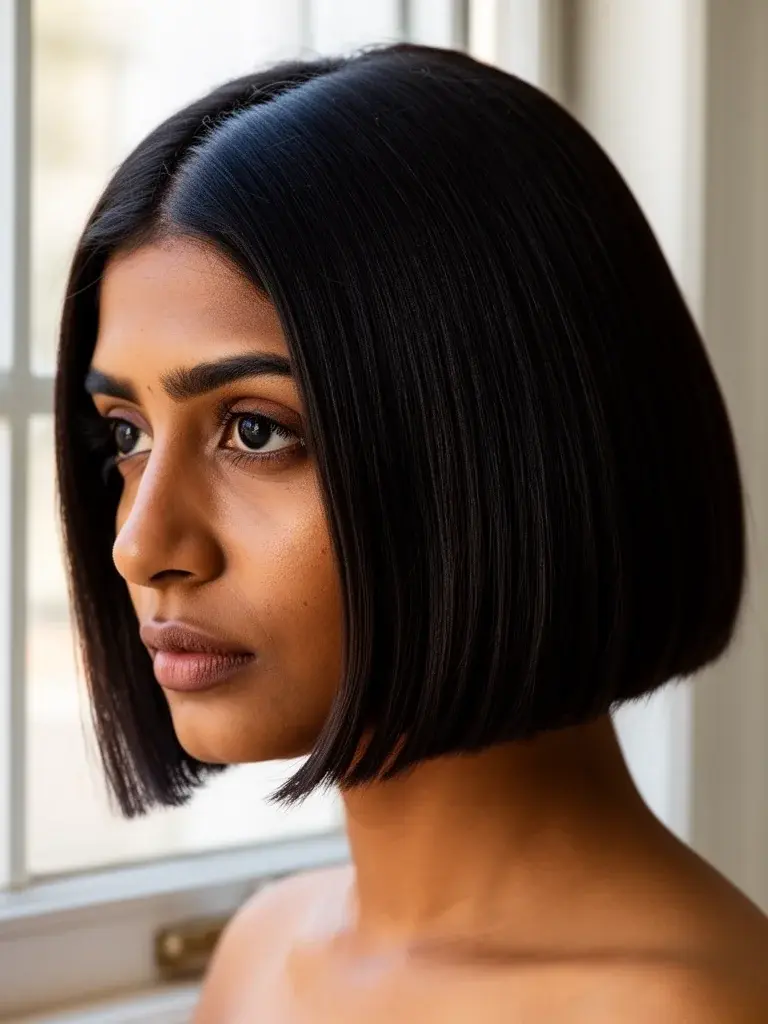
An A-line bob is a haircut where the back sections are cut shorter than the front, creating an angled diagonal that runs from back to front. When viewed from the side, the hair forms an A-shape — hence the name. The cut is typically one-length (no layers) and the back has little to no stacking, which distinguishes it from the inverted bob.
The A-line concept is simple: the back sits 2–4 inches shorter than the front. The transition from short back to longer front happens in a clean sweep, without visible layer lines. The result is a cut with clear geometric identity — sharper than a classic bob, less structural than an inverted bob.
The A-line works because the longer front pieces naturally fall around the jaw and cheekbones, regardless of face shape. This consistent face-framing quality — where the cut points toward the chin on every face — is what makes it genuinely versatile across face shapes.
A-Line Bob vs Inverted Bob vs Classic Bob
| A-Line Bob | Inverted Bob | Classic Bob | |
|---|---|---|---|
| Back-to-front angle | Moderate diagonal | Steep diagonal | Minimal or none |
| Back stacking | None or minimal | Significant, structural | None |
| Back volume | Flat to moderate | Maximum | Flat |
| Maintenance intensity | Low | Medium–high (neckline) | Low |
| Best for round face | ✅ Excellent | ✅ Good | ⚠️ Length-dependent |
| Best for oblong face | ✅ Good | ❌ Adds height | ✅ Good |
Bottom line: A-line = geometric angle without neckline commitment. Inverted = structural volume with maintenance. Classic = universal and the simplest form.
Cut Specifications
- Length: Back typically at or slightly above the nape; front at chin to below chin
- Angle: The back-to-front slope should be visible when standing with hair down. Subtle: 1–2 inch difference. Standard: 2–4 inches. Dramatic: 4+ inches (approaches inverted bob territory)
- Graduation: Minimal. The A-line is a one-length-style cut, not a graduated one
- Stacking: None intended. If stacking appears at the back, it's reading as an inverted bob
- Ends: Can be blunt for maximum geometric effect or slightly point-cut for softness
- Trim cycle: Back every 6–8 weeks; front can extend to 8–10 weeks
Color Pairing
- Ombré from root to ends: The A-line's diagonal creates a natural ombré canvas. Darker at the shorter back, lighter where the longer front pieces fall — the color change follows the cut's direction
- Balayage face-framing: Light pieces concentrated on the longer front sections draw attention to the framing quality that makes the A-line work
- Single-process rich tones: Dark espresso, warm chestnut, or cool ash in a single color lets the geometric angle do the work. One color on an A-line is always clean and intentional
Face Shape Tweaks
- Oval: Any version of the A-line. Adjust the angle to taste — subtle to dramatic all work
- Round: Request the front pieces to land at the chin or below, not above. The longer the front, the more elongating the effect. Avoid very subtle angles that don't create enough vertical
- Oblong: Ask for a shorter front than standard — front pieces at or just below the jaw rather than further below the chin. This reduces the face's vertical emphasis rather than extending it
- Diamond: Keep front pieces at chin level or just below to add visual width at the narrow lower face
- Heart: Front pieces at chin to below chin add weight at the narrowest part of the face, balancing a wide forehead
- Square: Slightly point-cut the front pieces to add a soft texture that rounds the jaw framing — pure blunt on a square jaw reinforces the angularity
Hair Type Tweaks
- Straight: No adjustment needed. The A-line reads at its geometric purest on straight hair
- Wavy: Tell your stylist you wear it wavy and want the angle visible. They'll cut the angle slightly more dramatic to compensate for wave lift at the back
- Curly: Cut dry; curls shrink significantly. A wet cut will produce an angle different from what you expected once dry
- Fine: No interior thinning — you need every strand at the end for density. Consider a slightly more dramatic angle to create more visual interest
- Thick: The diagonal distributes thickness well. Interior thinning at the front pieces only if they're too heavy; the back naturally distributes
How to Style
Daily (5 minutes):
- Brush through damp hair with a paddle brush, working the front pieces forward
- Apply light smoothing cream or volumizing mousse if using
- Blow-dry the back on low heat, directing hair flat. Blow-dry the front sections forward to encourage the framing angle
- The diagonal holds without further styling
Polished (10 minutes):
- Blow-dry as above
- Use a flat iron on the top layer and front sections — straight from the back to the longer front reads as very clean
- For a curved finish, use a large barrel curling iron at the front to slightly curve the ends inward toward the jaw
- Finish with light-hold spray on the front framing pieces
No-Heat:
- Comb through damp hair with a wide-tooth comb
- Apply smoothing cream, working from roots to ends
- Clip the front sections forward (toward the face) with jaw clips while drying
- Release when dry — the front pieces will fall in the framing direction naturally
Maintenance Schedule
- Week 1–2: Full geometric definition. Angle is precise, back-to-front difference is clear
- Week 3–4: Back grows approximately 1–1.5cm. Angle softens slightly but still reads as A-line
- Week 5–6: Back growth narrows the angle. Still an A-line, but the geometric precision is gone
- Week 7–8: Time for the back trim. The cut is starting to look like a classic bob rather than an A-line
- Front length: Usually stable until week 8–10; if the front looks longer than intended, trim then
If you color your hair:
- Ombré and balayage stretch well — 10–12 week intervals before noticeable regrowth
- Single-process needs touch-up every 6–8 weeks, which aligns with the back trim schedule
Pro tip: Ask your stylist to note the back-to-front angle measurement at your first appointment. At every subsequent trim, maintain the same angle rather than cutting to the same length — hair grows at different rates and maintaining the angle matters more than maintaining the measurements.
Common Mistakes
-
Making it too subtle to read as an A-line Fix: At minimum, the back should be 2 inches shorter than the front. Anything less and it just looks like a slightly uneven bob. Go bolder with the angle than you think you need.
-
Treating it like an inverted bob and adding stacking Fix: The A-line is a one-length cut. If layers or stacking appear at the back, the cut is moving toward an inverted bob. Unless that's what you want, be clear: "No stacking at the back — just a clean diagonal."
-
Getting it too long in the back Fix: The A-line's back should be clearly shorter than the front when you stand naturally. If the back is at mid-neck and the front is at the chin, the difference is visible. If both are at the chin, you have a classic bob.
-
Blow-drying the front pieces backward Fix: The front framing pieces should be blown forward toward the face. Blowing them backward creates a flipped style that works against the A-line's face-framing quality.
-
Ignoring the back at maintenance visits Fix: It's tempting to skip the back trim when the front still looks good. Don't — without the back trim, you'll lose the angle, and the cut loses its identity.