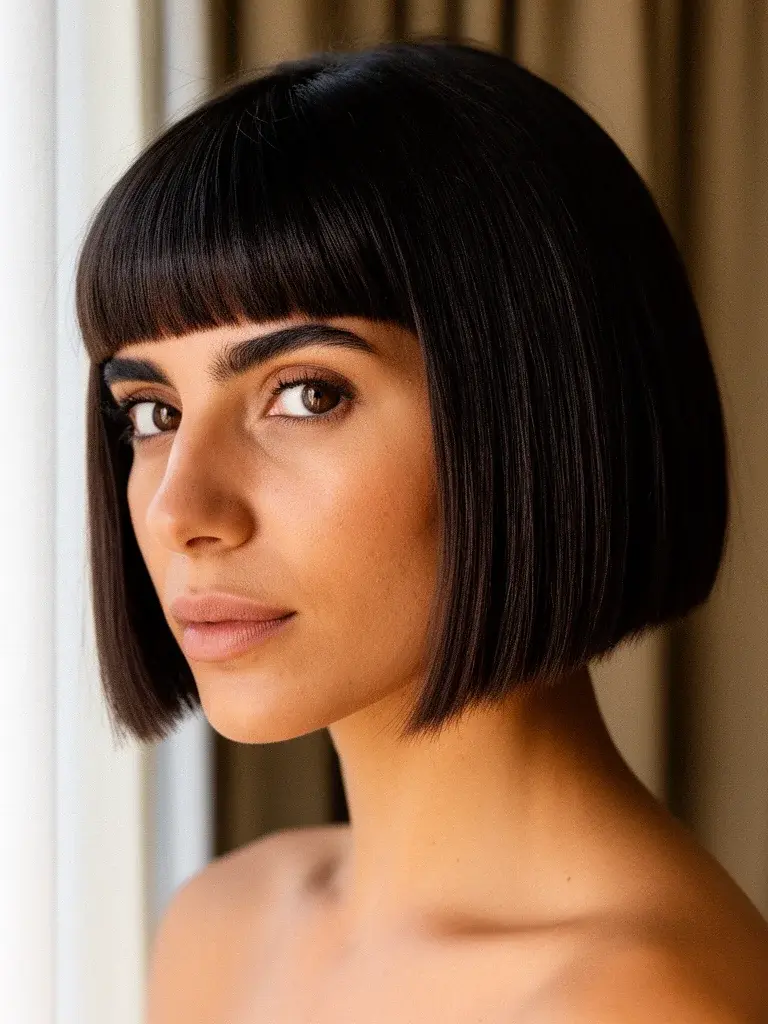
TL;DR
- Best for: Oblong, heart, and diamond faces; fine hair wanting visual density; anyone who wants a bold, low-maintenance cut
- Avoid if: You have a round face and want it shorter than chin level; your hair is very thick and you won't thin it
- Ask your stylist: "Blunt bob — no graduation, no layers, all ends cut to the same horizontal line at jaw level"
- Maintenance: Trim every 6–8 weeks to keep the line sharp
Who Does It Suit?
The blunt bob is a graphic cut. Its power comes from the clean weight line — and that line flatters face shapes that benefit from strong horizontal structure.
Ideal for:
- Oblong faces — The horizontal weight line breaks the face's vertical emphasis and adds perceived width
- Heart faces — A line at or below the chin adds visual weight at the narrowest part of the face
- Diamond faces — Length at the jaw widens the narrow lower half without fighting the cheekbones
- Anyone wanting maximum visual impact from a low-effort cut — The cut does the work; no styling required to look polished
- Fine hair — The blunt line creates visual density that layered cuts destroy
Hair types:
- Straight: The ideal hair type. The cut line reads sharp and geometric, exactly as intended
- Wavy: Works beautifully — adds texture to the geometric shape. Embrace the slight irregularity
- Thick: Works with interior thinning. Without it, the ends can become triangular and heavy
- Fine: Excellent choice. The blunt cut creates more visual density than any other bob variation
Avoid If...
- You have a round face and want it above chin level → a Classic Bob at chin length or just below is safer
- Your hair is very thick and you won't thin it → the weight will push outward; try an Inverted Bob which stacks the back to manage thickness
- You want textured, undone ends → blunt ends are the opposite of textured; a Lob with point-cut ends gives length + softness
- You need to stretch your trim schedule past 10 weeks → the blunt line shows growth fast; a layered bob forgives longer intervals
- You're starting from long hair and want to test short first → the visual change is dramatic; go to a lob first, then commit to the bob
What is a Blunt Bob?
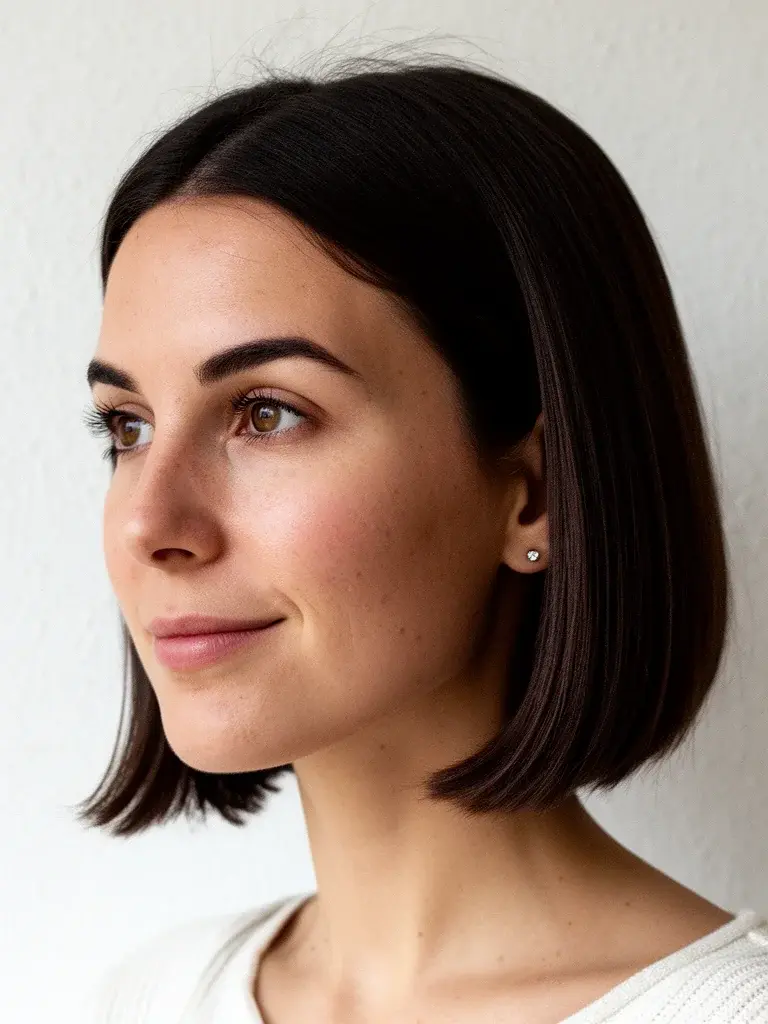
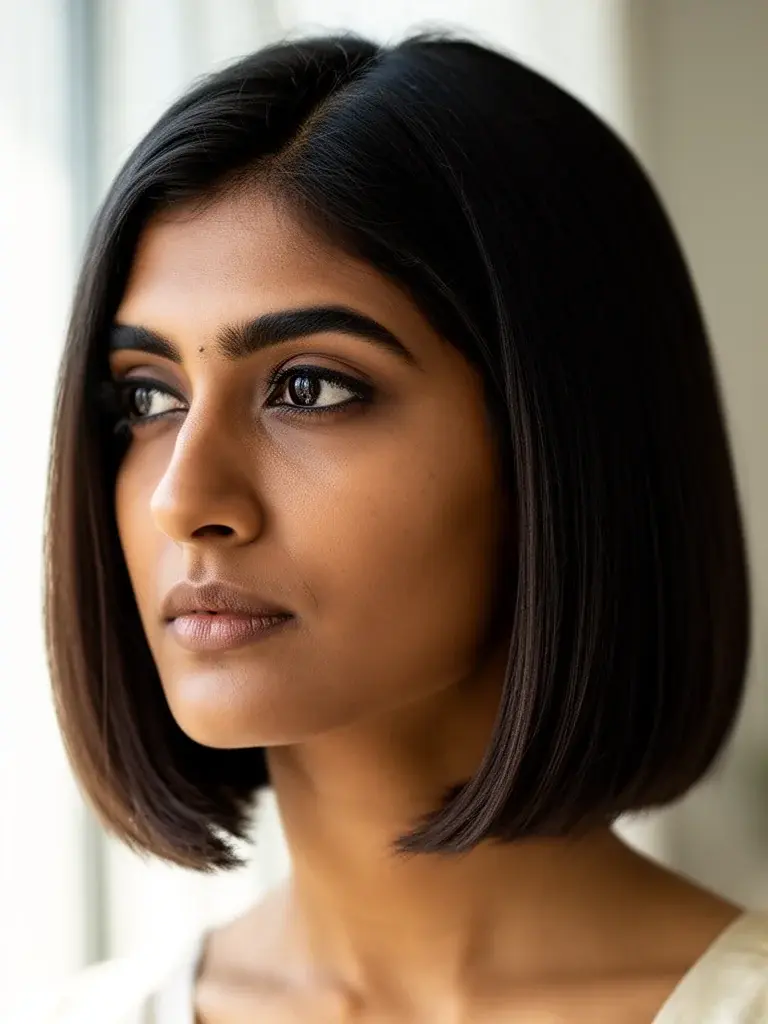
A blunt bob is a chin-length haircut where all strands are cut to the same horizontal line — no graduation, no tapering, no layering. The result is a single, clean weight line that creates a geometric, high-contrast silhouette.
What separates it from adjacent bobs is the cut technique. A classic or standard bob allows slight graduation at the back to hug the head's curve. A blunt bob cuts across that curve instead, creating a line that's visually heavier and more intentional. On fine hair, the absence of graduation makes every strand visible at the cut line, which creates the appearance of denser, thicker hair.
The style became associated with editorial and high-fashion imagery because the clean line photographs graphically — but the same quality that makes it look good in photographs is what makes it look good in daily life without styling.
Blunt Bob vs Classic Bob vs Layered Bob
| Blunt Bob | Classic Bob | Layered Bob | |
|---|---|---|---|
| Cut technique | Zero graduation, horizontal line | Slight graduation possible | Progressive layering |
| End texture | Dense, sharp | Slightly soft | Feathery, textured |
| Best for fine hair | ✅ Best option | ✅ Good | ❌ Thins hair further |
| Best for thick hair | ⚠️ Needs thinning | ✅ Good | ✅ Removes weight |
| Maintenance interval | Every 6–8 weeks | Every 6–8 weeks | Every 8–10 weeks |
| Styling effort | Minimal | Minimal | Minimal–low |
Bottom line: Blunt = maximum graphic impact, fine hair's best friend. Classic = universally flattering, slightly softer. Layered = for those wanting movement and forgiveness.
Cut Specifications
- Length: Jaw to just below the chin — not shorter, which risks emphasizing width on non-oval faces
- Graduation: None. All ends cut at the same horizontal plane
- Layers: None through the exterior. Optional interior thinning on thick hair only
- Ends: Blunt cut — scissors closed fully, no point cutting
- Part: Center or side — both work; side part softens the graphic nature slightly
- Trim cycle: Every 6–8 weeks minimum to maintain the cut line
Color Pairing
- Single-process all-over color: The blunt line and one-color work together — both are clean and graphic. Dark hair especially shows the cut's geometry at its most defined
- Shadow root with a lighter mid-length: Creates dimension without complexity. The root line draws the eye up, the lighter ends emphasize the cut line
- High-contrast money piece: A 2–3 shade lighter strip at the front frame adds a focal point without coloring the whole head. Works particularly well on the blunt bob since the framing pieces are at a fixed length
- Warm copper or auburn: The glossy finish of healthy color catches on the clean edge and makes the cut line visible from across a room
Face Shape Tweaks
- Oval: No adjustment. Any length from ear to below chin works
- Oblong: Keep length at or above the chin — below-chin length extends the face further
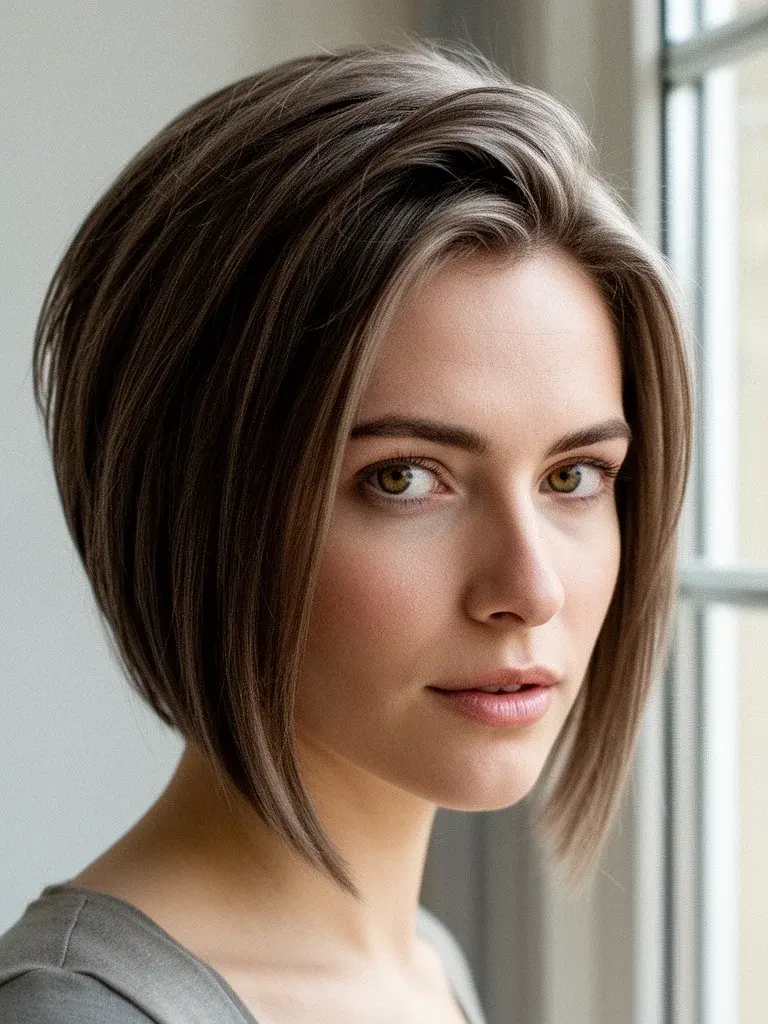
- Round: Push length to below the chin. Ask for a very slight A-line angle (front pieces fractionally longer than back) to create vertical lines
- Heart: Request length at or below the chin; the weight at the jaw balances a wider forehead
- Diamond: Length should clear the jawline. Ask stylist to cut slightly longer than standard — the jaw is the narrowest point, and a line below it adds visual width where you need it
- Square: Avoid a perfectly horizontal cut that echoes the jawline. Ask for a very slight soft angle — not a full A-line, just 3–5mm longer at the front
Hair Type Tweaks
- Straight: No adjustment needed. This is the reference hair type for the blunt bob
- Wavy: Tell your stylist you wear it wavy. They'll compensate by cutting it slightly longer — waves pull the ends up by 1–2cm when dry
- Curly: Cut dry, not wet. Curly hair shrinks significantly when dry; cutting wet will result in a shorter bob than planned. Ask your stylist to cut curly hair in its natural state
- Thick: Request interior thinning (slicing into the interior layers) to remove bulk while keeping the exterior line blunt
- Fine: No thinning. Ask specifically for "no point cutting on the ends" — you want every strand at that line to add to the visual density
Managing Weight on Fine Hair
The blunt bob is the best bob for fine hair — but only if the cut is right. Fine hair and the wrong technique can make a bob look limp and transparent.
- Request a heavier perimeter: Ask your stylist to cut the line slightly above where you want it to end up, then hold the scissors at a slight downward angle to add just a touch of weight to the ends — not tapering, but not purely horizontal either
- Avoid product at the ends: Serum and oil weigh fine hair down and make the ends look thinner. Use a light volumizing mousse at the roots only
- Blow-dry with a paddle brush: Pull the ends outward rather than under or over — you want the cut line to read horizontal, not flipped
- Skip the flat iron: Pressing fine hair flat compresses the weight line and makes it look thinner. If you want a sleeker look, use a concentrator nozzle on the blow-dryer only
- Touch up trim at 6 weeks, not 8: Fine hair ends look ragged faster. The cut looks its best in weeks 1–6; after that the density effect starts breaking down
What to Tell Your Stylist
"I want a blunt bob — no graduation, no layers. Cut all the ends to the same horizontal line at [jaw / just below the chin / choose your length]. No point cutting. [If thick: interior thinning to remove bulk but keep the outside line blunt.]"
Reference photo tips:
- Choose photos where the hair is photographed from the side — the side profile shows whether the ends are truly blunt or whether there's graduation
- Look for photos taken in natural light rather than studio — you can see the actual density of the ends, not just a retouched finish
- Avoid editorial photos with extreme styling — the blunt bob looks different on day-one styling versus how it air-dries naturally
How to Style
Daily (5 minutes):
- Towel-blot damp hair, then brush through smooth with a paddle brush
- Apply a small amount of volumizing mousse at the roots only
- Blow-dry with a paddle brush, pulling hair downward and outward to set the weight line
- Done — the cut holds without product on the ends
Polished (10 minutes):
- Blow-dry as above for volume
- Section the ends and use a medium-barrel round brush to set the cut line — pull ends straight out, not curled under or over
- Optional: a flat iron pass on the top layer only for mirror shine
- Finish with a tiny drop of smoothing serum on the ends, worked through fingertips
No-Heat:
- Comb through damp hair and apply a light smoothing cream
- Clip the top section up to keep it off the face while drying
- Let air-dry — the weight of the blunt cut will hold the shape naturally
- Release clip when fully dry, smooth top section with a paddle brush
Maintenance Schedule
- Week 1–2: Peak shape. The weight line is sharp, the cut is at maximum density
- Week 3–4: Still clean. No visible degradation unless your hair grows very fast
- Week 5–6: Ends start to look slightly rounded rather than sharp. Fine hair will notice first
- Week 7–8: Time to trim. The cut line has lost its graphic edge and now looks like a soft bob rather than a blunt one
- Week 9+: The blunt bob becomes a regular bob. Still wearable, but you've lost the defining quality
If you color your hair:
- Single-process touch-up every 6–8 weeks aligns with the trim schedule — combine appointments to save time
- If you have a money piece, it may need refreshing every 8–10 weeks before it washes out
Pro tip: Ask for a "dusting" at your trim — a light pass on the ends to remove split ends without taking length. This keeps the line clean at the 6-week mark without shortening.
Common Mistakes
-
Asking for "a bob" without specifying blunt Fix: Say "blunt bob — no graduation, all ends at the same horizontal line." Without this, most stylists default to a slight graduation at the back, which softens the geometric quality you're after.
-
Getting it cut too short in one session Fix: If you're going from long or medium hair, take off no more than 4 inches in the first cut. The blunt line is harder to correct than a layered bob if you decide it's shorter than you wanted.
-
Not thinning thick hair Fix: Interior thinning is non-negotiable for thick hair. Ask specifically — some stylists are reluctant to thin for fear of removing the blunt perimeter. Reassure them: thin the inside, not the outside.
-
Washing and air-drying without brushing first Fix: Brush through completely before washing. Air-drying without pre-brushing on a blunt bob creates a slightly puffed shape rather than the clean weight line. Brush, then wash, then air-dry.
-
Skipping the trim at 8 weeks Fix: Set a calendar reminder. The blunt bob's entire value is in the cut line — let it go past 8 weeks and you're paying for a cut that's working against you.