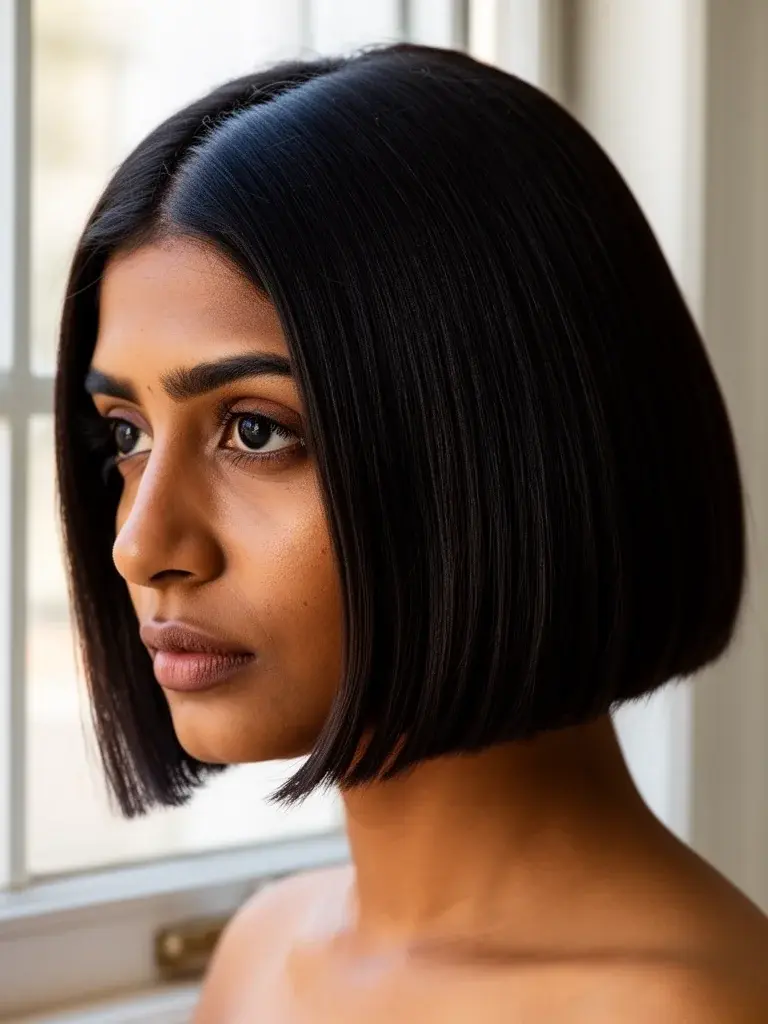

TL;DR
- Best for: Round and square faces wanting vertical interest; fine-to-medium hair wanting volume without product
- Avoid if: You dislike frequent neckline maintenance; your hair is very thick and you won't thin it
- Ask your stylist: "Inverted bob — stacked graduation at the back from nape up, front pieces [jaw / chin / collarbone length]. Gradual or sharp inversion: [your choice]"
- Maintenance: Neckline trim every 4–6 weeks; longer front pieces every 6–8 weeks
Who Does It Suit?
The inverted bob's signature is its architecture — stacked volume at the back that creates a shape distinct from every other bob. That architecture is particularly useful for certain face shapes and hair situations.
Ideal for:
- Round faces — The longer front creates vertical jaw lines; the lifted back adds height, both counteracting roundness
- Square faces — The stacked back lifts away from the jawline, softening the square's angular boundary
- Women wanting volume without daily styling — The stacked back creates volume structurally, not through blow-drying
- Fine-to-medium hair — Stacking fine layers creates the illusion of density
- Those who want a bob that's "more than just a bob" — The silhouette is visually distinct in a way a flat bob isn't
Hair types:
- Straight: Best for showing the graduation clearly. The stacked back reads sharp and structural
- Wavy: Adds texture to the shape. Waves in a stacked graduation create natural movement and dimension
- Fine: The stacking compensates for lack of thickness — layers on top of each other create height
- Thick: Works well with interior thinning; without it, the stacked section can become bulky
Avoid If...
- You dislike frequent neckline maintenance → a Classic Bob grows out more gracefully with fewer visits
- Your hair is very thick and you won't thin it → the stacked back becomes a block of hair, not a graduation
- You want a flat, sleek silhouette → the lifted back is the opposite of flat; a Blunt Bob sits closer to the head
- You have an oblong face → the crown lift can extend a long face; an A-Line Bob flattens through the back and adds width more safely
- You're a first-time bob → the neckline exposure can feel significant; start with a longer inverted bob to assess
- You want left-to-right asymmetry rather than back-to-front graduation → an Asymmetrical Bob creates bold impact through a diagonal length difference between sides instead of stacked volume
What is an Inverted Bob?
An inverted bob (also called a stacked bob) is a graduated haircut where the back is significantly shorter than the front. The graduation runs diagonally from the nape of the neck upward, with each layer folding over the one below — "stacking" to create volume and lift at the back. The front pieces are typically chin-length or longer, creating a visible length contrast when viewed from the side.
The key structural element is the back graduation. The shorter layers at the nape sit on top of the longer layers above them, which creates a puffed, rounded silhouette at the back of the head. This is entirely structural — no product or blow-drying creates it, the geometry of the cut does.
The result is a bob with a very distinct side profile: a steep diagonal from the longer front to the shorter back. The steeper the angle, the more dramatic the inversion. A subtle inversion has the back 1–2 inches shorter than the front; a dramatic inversion has the back at the nape while the front reaches the chin.
Inverted Bob vs Classic Bob vs A-Line Bob
| Inverted Bob | Classic Bob | A-Line Bob | |
|---|---|---|---|
| Back length | Stacked at the nape, shortest | Same length as front (or slightly shorter) | Shorter back, front falls lower |
| Volume | Maximum at the back | Flat, uniform | Moderate angled lift |
| Face framing | Longer front pieces frame jaw | Uniform framing | Longer front points toward chin |
| Side profile | Strong diagonal | Subtle or no diagonal | Diagonal, less steep than inverted |
| Best face shape | Round, square | All shapes | Oval, oblong, round |
| Maintenance | Every 4–6 weeks (neckline) | Every 6–8 weeks | Every 6–8 weeks |
Bottom line: Inverted = maximum structure and volume; Classic = universal and forgiving; A-line = geometric angle without the neckline commitment.
Cut Specifications
- Graduation angle: From nape (shortest) to chin or longer (front). Angle can be gradual (subtle inversion) or steep (dramatic)
- Back layers: Stacked — each layer folds over the one below to create volume. 3–5 visible graduation lines
- Front length: Typically chin to collarbone. Shorter front = more dramatic look; longer front = softer inversion
- Neckline: Clean and defined — this is the defining maintenance element of the cut
- Face framing: Optional disconnected face-framing layers at the front for added texture
- Ends: Can be blunt or slightly point-cut depending on desired softness
- Trim cycle: Neckline every 4–6 weeks; front length every 6–8 weeks
Color Pairing
- Balayage on the longer front pieces: Face-framing highlights that are lightest at the chin create a visual focal point on the cut's longest section
- Root shadow: A darker root 2–3 shades deeper than the base, softening into the mid-length. Grows out gracefully without a harsh regrowth line — ideal given the 4–6 week trim schedule
- Tonal single process: A single solid color on an inverted bob lets the shape speak. Cool ash tones emphasize the geometric angle; warm chestnuts add depth to the stacked graduation
Face Shape Tweaks
- Oval: Any length inverted bob works. Adjust the inversion angle to your preference — dramatic or subtle
- Round: Maximize the front length (chin or below); avoid cutting the front shorter than the chin, which adds width. Request maximum stacking height at the back
- Square: Ask for slightly softened front pieces — light layers or point cutting on the front that soften the jaw framing without fully rounding the shape
- Heart: Keep the front pieces longer (below chin) to add visual weight at the narrowest facial point
- Oblong: Minimize the back stacking height. A flatter back on an oblong face is safer; more stacking adds more crown height, which extends the face
Hair Type Tweaks
- Straight: Reference hair type for the inverted bob. Graduation reads cleanly; stacking shows its full structure
- Wavy: Tell your stylist you wear it wavy. They'll cut it slightly shorter to account for wave shrinkage. The stacked section with waves can look especially dynamic
- Curly: Must cut dry. Curl shrinkage at the back is significant and unpredictable when cutting wet; ask for a dry cut on the graduation
- Fine: Stacking compensates naturally. No interior thinning — you want every strand in the graduation to add to the visual volume
- Thick: Interior thinning is critical. Ask for it specifically within the stacked section only; keep the exterior graduation intact
Neckline Maintenance
The neckline is the inverted bob's defining maintenance element — and the most honest thing to say about it up front.
- Why it matters: As hair grows at the nape, the lower boundary of the stacked graduation moves down. After 4–6 weeks, the neckline looks fuzzy rather than clean — and the bottom of the stack begins to lose its structural quality
- What to expect: The neckline is the part that grows fastest. New growth of 1–1.5cm at the nape is enough to change the look significantly
- Managing the schedule: If you can't trim every 4–6 weeks, ask your stylist to cut the neckline slightly higher initially — leaving more room for growth before the cleanup is necessary
- Between-salon care: A neck trimmer or asking a partner to clean the neckline with a small clipper can extend time between visits if the fuzziness bothers you
- Growing it out: If you decide you don't want the maintenance, stop trimming the neckline and let the back grow toward the front length. It will transition into a regular bob over 3–4 months
What to Tell Your Stylist
"I want an inverted bob — stacked graduation at the back starting from [nape level / mid-nape]. Front pieces to [chin / below chin / collarbone]. I want a [gradual / steep] inversion angle. [If thick: thin the interior of the graduation but keep the exterior stacked.] Clean neckline."
Reference photo tips:
- Side profile shots are the most important for an inverted bob — the front-to-back length difference is only visible from the side
- Look for photos with a visible, clean neckline — that shows you how the back graduation is structured
- Bring photos from multiple angles if possible (side + front) so your stylist can see both the structural goal and the face-framing goal
How to Style
Daily (5 minutes):
- Brush through damp hair
- Apply light volumizing mousse to the back section from the mid-shaft down
- Blow-dry the back section lifting the roots upward — the stacking already creates volume, blow-drying just sets it
- Let the front sections air-dry or smooth briefly with a brush
Polished (15 minutes):
- Apply heat protectant
- Blow-dry the back with a round brush, rolling inward at the graduation for maximum stack
- Use a flat iron on the front sections only for a sleek contrast between structured back and smooth front
- Finish with a light-hold spray on the back only
No-Heat:
- Apply smoothing cream to damp hair
- Twist the front sections away from the face and clip in place while drying
- Leave the back to air-dry naturally — the stacking holds its shape without heat
- Release clips when dry, run fingers through the front
Maintenance Schedule
- Week 1–2: Full shape. Neckline is clean, stacking reads clearly, front length is defined
- Week 3–4: Neckline shows approximately 1cm of new growth. Shape still reads as inverted, but the bottom edge is slightly fuzzy
- Week 5–6: The neckline needs cleanup. Without it, the bottom of the graduation starts to look like a rounded bob rather than a stacked one
- Week 7–8: Front length needs a trim. Fine hair will notice the ends looking thinner; all hair types will notice the angle looking less steep
If you color your hair:
- Root touch-up aligns well with the 4–6 week neckline trim — combine appointments
- Balayage can be stretched to 10–12 weeks; the shadow root is forgiving
Pro tip: Ask your stylist to cut the neckline 3–5mm higher than you want it to end up. This gives you an extra week or two before the cleanup is urgent.
Common Mistakes
-
Underestimating neckline maintenance Fix: Before committing, ask yourself honestly if 4–6 week appointments work with your schedule and budget. If not, a classic or blunt bob is a better fit.
-
Getting the front too short Fix: The face-framing power of the inverted bob comes from the front length contrast. If the front is too short, you lose the graduation and it just looks like a stacked bob without a reason. Keep the front at chin level or below.
-
Not thinning thick hair in the graduation Fix: Thick hair in a stacked graduation creates a solid block of hair rather than defined layers. Ask for the interior of the stacked section to be thinned — specifically ask for "slicing into the graduation" rather than razoring.
-
Blow-drying the stacked back flat Fix: The back volume is structural. Don't blast it flat with a concentrator nozzle. Use a diffuser or a round brush rolling inward at the ends to reinforce the shape.
-
Skipping the neckline cleanup because the front still looks fine Fix: Trim appointments for an inverted bob are partly about the neckline, not just the length. Book by the neckline's schedule (4–6 weeks), not the front's schedule (6–8 weeks).