TL;DR
- Best for: Straight or wavy hair that wants drama without curls — a sculptural wave with visible S-pattern
- Avoid if: You want low-effort tousled texture or your hair is shorter than shoulder length
- Ask your stylist: "I want deep S-waves with a flat iron technique — wide bends, not tight curls. I'm going for sculptural and glossy, not beachy."
- Maintenance: Restyle every 1-3 days; no cut-specific upkeep — this is a styling technique, not a haircut
Who Does It Suit?
Deep waves are a styling technique, not a cut — which means anyone with medium-to-long hair can wear them. The question isn't whether your hair can do it, but whether the aesthetic matches what you're after. Deep waves are deliberate. They're the opposite of "woke up like this." Every S-bend is placed on purpose, and the result looks like it.
Ideal for:
- Straight hair that wants drama without committing to curls or a curling iron spiral
- Women who find beach waves too casual and hollywood waves too bridal
- Square and round faces where the wide wave pattern breaks up facial geometry without adding bulk
- Anyone chasing the 2026 "gothic waves" or "messy girl waves" aesthetic — deep waves are the foundation for both
- Fine hair that drops curling iron curls within hours — the flat iron technique creates a pattern that holds
Hair types:
- Straight: The ideal starting point. Flat iron glides through without fighting existing texture, and the S-pattern shows most crisply against a naturally smooth surface
- Wavy: Your natural texture gives the deep waves a head start. Less heat needed, and the pattern blends into your natural movement at the ends
- Thick: Holds the wave pattern for days and creates the most dramatic S-ridges. Takes longer to style section-by-section but the result is worth the extra 10 minutes
- Fine: Surprisingly good — the flat iron pressing technique works better on fine hair than curling iron wrapping. The wave pattern is less voluminous but equally defined
Avoid If...
- Your hair is shorter than shoulder length → deep waves need at least 2-3 full S-bends to read as waves rather than random kinks. Below 6 inches, the pattern compresses into something that looks more like a crimping accident. Beach waves work better on shorter lengths because the irregular pattern doesn't need repetition to read correctly
- You want a wash-and-go style → deep waves are a styled look that needs to be created each time. There's no cut or product that creates deep waves without heat tools. If you want waves without daily effort, boho waves with an overnight braid technique is lower-commitment
- You're avoiding all heat tools → the flat iron is the deep wave tool. Braiding overnight creates a wave pattern, but it's not the wide, sculptural S-bend that defines deep waves — it's a crimped texture. There's no true no-heat path to this specific pattern
- You want volume and body → deep waves lie flat by design. The S-pattern is a ribbon shape, not a bouncy curl. The drama comes from the pattern, not the lift. If you want waves with volume, hollywood waves or boho waves are better matches
- Your hair is heavily layered with short top layers → layers break up the S-wave pattern, creating visible interruptions in the wave line. Deep waves look best on one-length or long-layered hair where the wave pattern runs unbroken. If you have a butterfly cut or heavy face-framing, the waves will break at each layer transition
What are Deep Waves?
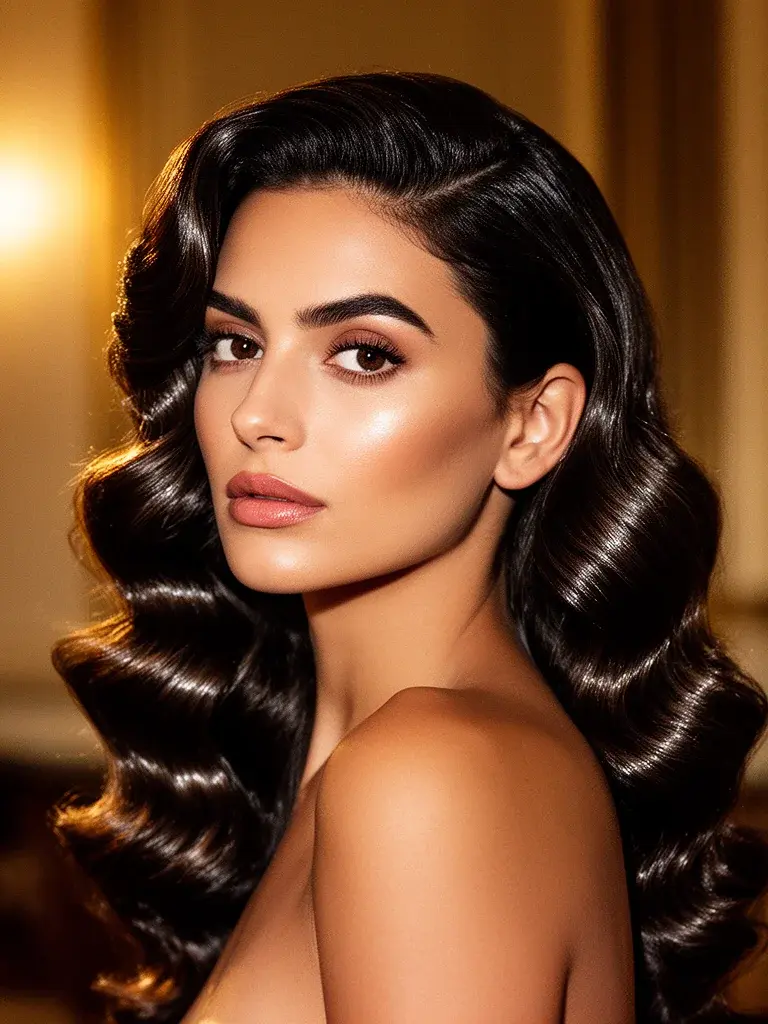
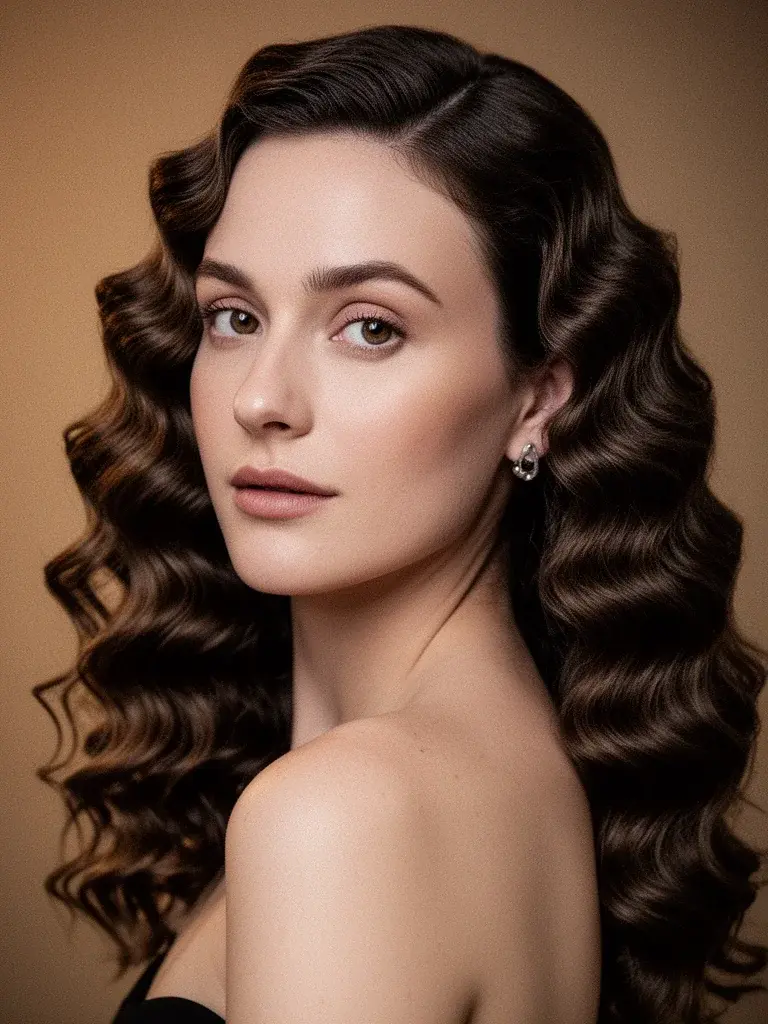
Deep waves are wide, deliberate S-shaped waves with pronounced peaks and troughs — the kind of wave pattern where each bend is clearly visible and evenly spaced. Unlike beach waves (which are loose, irregular, and intentionally imperfect) or hollywood waves (which are smooth, side-parted, and Old Hollywood-polished), deep waves sit in a different territory: sculptural, modern, and slightly moody.
The defining feature is the S-shape itself. Each wave bends in one direction, then bends back the other way, creating a continuous zigzag ribbon effect when viewed from the side. The "deep" refers to the amplitude — the distance between each peak and trough is wider than a standard wave, creating a dramatic, slow-rolling pattern rather than tight ripples.
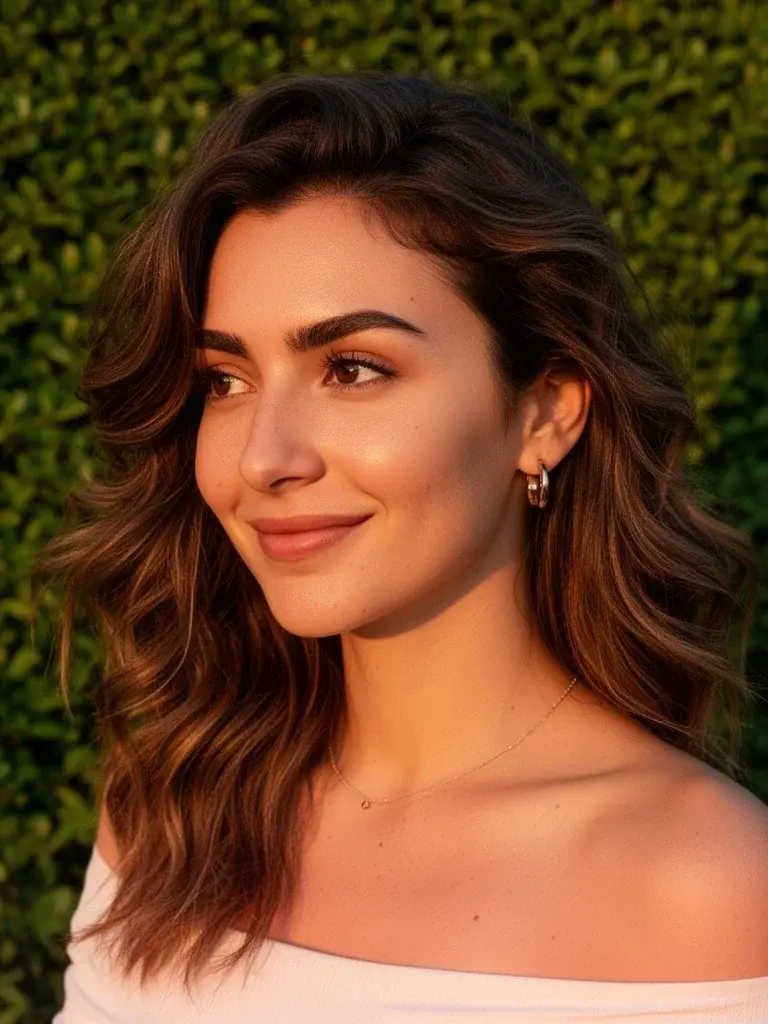
The 2026 wave conversation is split between two aesthetics that both start with deep waves: "messy girl waves" (deep waves roughed up with texture spray and slept on) and "gothic waves" (deep waves kept smooth, glossy, and dark). Both use the same flat iron technique — the difference is what you do after the waves are formed. The base pattern is identical; the finish is opposite.
Deep Waves vs Beach Waves vs Hollywood Waves
| Deep Waves | Beach Waves | Hollywood Waves | |
|---|---|---|---|
| Wave pattern | Wide, uniform S-shape | Irregular, varied sizes | Smooth, continuous S-curve |
| Amplitude | Deep — visible peaks/troughs | Shallow — subtle bends | Medium — controlled, even |
| Texture | Smooth or slightly roughed up | Tousled, matte, gritty | Glossy, brushed, polished |
| Primary tool | Flat iron | Curling wand or braids | Marcel iron or curling iron |
| Effort | Medium (15-25 min) | Low (10-15 min) | High (30-45 min) |
| Hold duration | 1-3 days | 1-2 days | 1 day (evening event) |
| Vibe | Sculptural, moody, modern | Casual, effortless, beachy | Glamorous, retro, formal |
| Best for | Medium-long straight/wavy | Any length, any texture | Medium-long, straight/wavy |
Bottom line: Beach waves are the casual friend. Hollywood waves are the formal one. Deep waves are the one who shows up in all black and looks like they planned every detail — because they did.
Cut Specifications
Deep waves are a styling technique, not a cut — but the haircut underneath determines how well the waves read.
- Best base cut: One-length or long layers with minimal graduation. The wave pattern needs an unbroken canvas to show the full S-shape. Blunt long hair is the ideal foundation — every wave bends at the same level
- Layer compatibility: Long layers (4-6 inch difference between shortest and longest) work fine — the wave pattern flows through the transition. Short layers (less than 3 inches) or heavy layering breaks the wave line at each length change, creating choppy interruptions
- Minimum length: Shoulder-length for a visible wave pattern. Collarbone-length or longer for the full dramatic effect. Below shoulder, you only get 1-2 S-bends, which reads more as "bent hair" than "deep waves"
- Bangs: Compatible with curtain bangs and side-swept bangs — both integrate into the wave pattern naturally. Blunt bangs create a visual break between the straight fringe and waved body, which can work as a deliberate contrast or look like you forgot to wave the front
- Trim cycle: Standard for your base haircut — deep waves don't change the cutting schedule. If your base cut is blunt long hair, trim every 8-10 weeks. If it's long layers, every 10-12 weeks
Color Pairing
- Single-process dark (espresso, ink black, deep auburn): Dark hair makes the S-pattern most visible — the shadows in each trough deepen, and the peaks catch light sharply. This is the "gothic waves" palette. The darker the base, the more sculptural the wave pattern reads.
- Dimensional brunette with face-framing highlights: Warm highlights placed around the face shift color at each wave bend, creating a light-dark rhythm that follows the S-pattern. The waves become a color showcase — each bend reveals a different tone.
- Platinum or silver-toned: Cool blonde deep waves read editorial and modern. The light color shows wave shadows differently — less dramatic contrast than dark hair, but a smoother, liquid-metal effect. Requires significant maintenance (toner every 4-6 weeks) but the visual payoff on deep waves is high.
- Rich copper or burgundy: Red-family tones on deep waves create a jewel-tone effect — the warm color saturates the wave peaks and deepens in the troughs. Copper on deep waves is the 2026 combination that keeps showing up on editorial boards and Pinterest mood pages.
Face Shape Tweaks
- Oval: Deep waves at any length — the balanced proportions handle the wide wave pattern without adjustment. Center or side part both work
- Round: The S-pattern breaks up the circular face shape by adding horizontal rhythm. Keep the deepest wave bend at cheekbone level to create visual angles. A side part helps avoid symmetry that echoes roundness
- Square: Deep waves soften the angular jawline — the organic S-bends counteract geometric facial features. Let waves fall past the jaw rather than ending exactly at jawline level, which frames the angle instead of softening it
- Heart: The wide wave pattern adds visual weight below the chin, balancing a wider forehead. Start the wave pattern from the ears down; avoid adding volume above the ears that would widen the top further
- Oblong: Deep waves add horizontal dimension that shortens a long face. This is one of the best face shapes for deep waves — the wide S-pattern creates visual width at every bend. Keep the volume at cheek level rather than letting it fall flat against the sides
Hair Type Tweaks
- Straight: Your natural texture provides the smooth canvas that deep waves need. The flat iron slides cleanly through straight hair, creating the sharpest S-bends. Straight hair may need a flexible hairspray between each section to hold the wave — without existing texture, the hair wants to return to its flat state.
- Wavy: You have a head start. Your natural wave gives the flat iron something to work with, and the deep wave pattern blends into your natural texture at the ends. You can get away with waving only the front and mid-sections, letting the natural wave carry the back. Less heat, less time.
- Thick: Section carefully — thick hair needs 1-inch sections or smaller for the flat iron to press the wave pattern all the way through. Rush through thick sections and you'll get surface waves with straight hair underneath. The payoff: thick hair holds deep waves for 2-3 days without refresh.
- Fine: The flat iron pressing technique actually works well on fine hair because it's compressing the strand into shape, not wrapping it around a barrel (which fine hair slides off). Use a lower heat setting (300-330°F) and a flexible hairspray on each section immediately. Fine hair deep waves won't have the volume of thick hair, but the pattern reads just as clearly.
Creating the S-Pattern (Flat Iron Technique)
This is the move that separates deep waves from every other wave type. The flat iron isn't just smoothing hair — it's bending it in alternating directions to create the S-shape.
- The technique: Clamp the flat iron at the root area. Bend the iron away from your face, gliding down 2-3 inches. Then reverse — bend the iron toward your face, glide another 2-3 inches. Alternate the direction every 2-3 inches all the way to the ends. Each direction change creates one peak or trough of the S-wave. The slower you glide, the wider and more defined the bend.
- Section size matters: 1-inch sections for thick hair, 1.5-inch for fine or medium hair. Too-thick sections mean the heat doesn't reach the inner strands and the wave pattern only forms on the surface layer. Too-thin sections create waves that are too tight and numerous — more crimped than deep-waved.
- Temperature: 330-360°F for fine or thin hair, 380-400°F for thick or coarse hair. Deep waves need enough heat to reshape the strand, but not so much that you're frying it. One slow pass per section. If the wave didn't form fully, lower the speed of your next pass rather than raising the temperature.
- Cooling is half the work: After forming each section, pin it in its S-shape with a clip or bobby pin and let it cool for 30-60 seconds. Hair sets its shape as it cools. If you drop a section immediately after ironing, gravity pulls the wave out before it sets. The pinning step is the difference between waves that last 3 days and waves that fall out by dinner.
- Direction consistency: For uniform deep waves, bend the first section away from your face, and start every subsequent section in the same direction. This creates waves that flow in the same direction across the whole head — a cohesive pattern rather than random bends. For the "messy girl waves" variation, alternate starting directions between sections to break the uniformity.
What to Tell Your Stylist
"I want deep S-waves with a flat iron — wide bends, not tight curls. The wave pattern should be uniform and deliberate. I want it glossy and smooth, not tousled or beachy. Think sculptural, not casual."
Reference photo tips:
- Search "deep waves" or "S-waves," not "beach waves" — the results are different. Deep wave photos show uniform, wide S-bends. Beach wave photos show tousled irregularity
- Specify whether you want the "gothic waves" finish (smooth, dark, high-shine) or the "messy girl waves" finish (roughed up, textured, lived-in). Same wave pattern, opposite finishing
- If you're getting a blowout at the salon that includes waves, explicitly say "flat iron technique" — many stylists default to curling iron, which creates a different shape
- Bring a side-view photo, not just front. The S-wave pattern is most visible from the side profile, and that's the angle your stylist needs to match
- If you want the waves to start at a specific point (cheekbone level vs ears vs chin), point to the exact spot on the photo and on your own head
How to Style
Daily (20 minutes):
- Start with dry, smooth hair (blow dry with a paddle brush if needed, or use day-old straight hair)
- Apply heat protectant through the lengths — every section
- Section hair into 4-6 horizontal layers, clipping the top sections up
- Starting with the bottom layer, clamp the flat iron at the root area and begin the alternating S-bend technique: away from face for 2-3 inches, then toward face for 2-3 inches, alternating to the ends
- Pin each finished section in its wave shape and let it cool for at least 30 seconds
- Release all sections once cooled. Shake your head gently upside down once — don't brush
- Finish with a light-hold flexible hairspray and a few drops of shine serum on the surface
Polished / Gothic Waves (30 minutes):
- Blow dry hair completely smooth with a paddle brush, using a smoothing serum on damp hair
- Apply heat protectant on dry hair before flat ironing
- Section into 6-8 layers for more precise wave placement
- Create the S-pattern with the flat iron, working in 1-inch sections. Focus on uniformity — every wave should bend at the same width
- Pin every section immediately after waving. Let all sections cool completely (5 minutes)
- Release and smooth with your palms — don't separate or shake. The waves should lie flat against each other
- Apply a high-shine serum generously. For the gothic finish, skip any texturizing products entirely. The look should be smooth, heavy, and reflective
- Optional: a light-hold hairspray misted from 12 inches away to set without adding texture
No-Heat Alternative:
- Wash and towel-dry hair to damp (not dripping)
- Apply a lightweight mousse for hold
- Divide hair into 4 large sections. Braid each section in a loose three-strand braid — the looser the braid, the wider the wave pattern
- Wrap each braid around itself into a flat bun shape and pin at the scalp. The flat bun preserves the S-shape better than a twisted bun
- Sleep on a satin pillowcase or wrap with a silk scarf
- In the morning, unwrap and unbraid gently. The wave pattern will be softer and less uniform than the flat iron version — more "messy girl waves" than "gothic waves"
- Smooth any frizzy sections with a light serum and your palms. Don't brush
- Note: This method creates a wave suggestion, not the crisp S-pattern that the flat iron produces. It's the low-damage option, not the exact match
Maintenance Schedule
- Day 1: Waves are at peak definition. The S-pattern is crisp, the shine is high, and every bend is where you put it. This is the look you're maintaining.
- Day 2: Waves have softened slightly but the pattern is still visible. Sleep in a loose braid or pineapple on a satin pillowcase to preserve the shape. A light refresh with flexible hairspray and your palms reshaping the bends is usually enough.
- Day 3: The "messy girl waves" day — the pattern is relaxing into something less precise and more lived-in. If this is your target aesthetic, day 3 is actually the sweet spot. If you want the crisp pattern back, you'll need to re-iron.
- Day 4+: On thick hair, a ghost of the wave pattern remains. On fine hair, it's mostly gone. Time to restyle or wash.
If you color your hair:
- Deep waves involve regular flat iron use. If you color, use a heat protectant with bond-repair ingredients (look for "bis-aminopropyl diglycol dimaleate" on the label — that's the active in bond-repair formulas). The combination of chemical processing and heat styling is where damage compounds.
- Dark single-process color: touch up every 6-8 weeks. Root grow-out is less visible on deep waves than straight hair because the wave pattern breaks up the color line.
- Highlights or balayage: refresh every 12-16 weeks. The wave pattern shows color transitions beautifully, so subtle grow-out adds to the dimensional effect rather than looking neglected.
Pro tip: Invest in a flat iron with adjustable temperature and beveled plates (rounded edges). Beveled plates create smooth wave bends. Sharp-edged plates create dents and creases in the wave pattern. The plate shape matters more than the brand.
Common Mistakes
-
Using a curling iron instead of a flat iron Fix: Curling irons create cylindrical curls. Even when brushed out, the shape is round and bouncy — not the flat, ribbon-like S-bend that defines deep waves. The flat iron's clamping action is what creates the alternating direction change. If you've been disappointed with your "deep waves," the tool is probably wrong.
-
Not pinning sections to cool Fix: Hair sets its shape as it cools, not as it's heated. The heat makes the strand pliable; the cooling locks the new shape. Dropping a freshly waved section means gravity pulls the wave out before it sets. Pin each section in its wave shape for 30-60 seconds. This single step doubles hold time.
-
Making the S-bends too tight Fix: If your waves look crimped, you're bending every 1 inch instead of every 2-3 inches. Deep waves are called "deep" because the amplitude is wide. Slow down, glide further between each direction change, and let the S-pattern breathe. Wider bends = deeper waves.
-
Using texturizing spray on gothic waves Fix: Texturizing spray adds grit and matte finish — the opposite of what the gothic deep wave aesthetic needs. If you want smooth, sculptural waves, finish with shine serum only. Save the texture spray for the "messy girl waves" variation where you actually want that roughed-up finish.
-
Starting waves from the root Fix: Deep waves that start at the scalp look over-styled and costumey. Start the first wave bend 2-3 inches from the root, leaving the root area smooth and flat. This creates a natural-looking transition from smooth roots into the wave pattern, and keeps root volume from competing with the wave drama.