
TL;DR
- Best for: Round and square faces needing asymmetry; low-maintenance lifestyles; universal fringe for nearly any face shape
- Avoid if: You hate any fringe in your face and want everything swept completely back; your natural growth direction fights the sweep aggressively
- Ask your stylist: "Side-swept bangs — angled cut from [left / right], longest piece at [cheekbone / jaw] to blend into the length, shortest piece between eyebrow and eye corner."
- Maintenance: Every 6–8 weeks; grow-out is virtually seamless
Who Does It Suit?
Side-swept bangs are the most universally flattering fringe style because they work on almost every face shape and almost every hair type. The asymmetric diagonal line is uniquely adaptable.
Ideal for:
- Round faces — The asymmetric diagonal breaks the face's circular symmetry and creates a directional line that elongates
- Square faces — The softer angle at the forehead rounds the upper face and draws the eye diagonally rather than stopping at the square corners
- Oblong faces — The horizontal element of fringe shortens the perceived face length; the sweep adds soft asymmetry that doesn't add visual width
- Anyone who wants fringe without high maintenance — The angled cut and sweep direction require minimal daily work to maintain
- Women returning to bangs after a bad experience — The low maintenance and easy grow-out make this the lowest-risk fringe choice
Hair types:
- Straight: Best result for showing the clean sweep direction. Very little effort to maintain
- Wavy: Works well — the wave adds texture to the swept fringe. Train the sweep direction when wet and let it set as it dries
- Fine: Excellent — the diagonal sweep doesn't require density to read well; individual strands in a swept direction look intentional
- Thick: Works but the fringe section may need thinning to keep it from sitting too heavily on the forehead
- Curly: Works with length adjustment for shrinkage. Softer, more textured result than straight-hair side-swept bangs
Avoid If...
- You want complete forehead coverage → side-swept bangs cover only partially; blunt bangs or a wider fringe section is needed for full coverage
- You want face-framing symmetry → Curtain Bangs frame both sides of the face equally; side-swept is inherently asymmetric
- Your natural part and hair growth direction fight the intended sweep → training against a strong natural growth direction takes consistent effort; a sweep that follows your natural direction works far better
- You need bangs for a second look → side-swept bangs are subtle by nature; Wispy Bangs or blunt bangs make a stronger statement
- You want zero maintenance → "zero maintenance" fringe doesn't exist; side-swept is the closest, but the trim schedule still applies
What are Side-Swept Bangs?
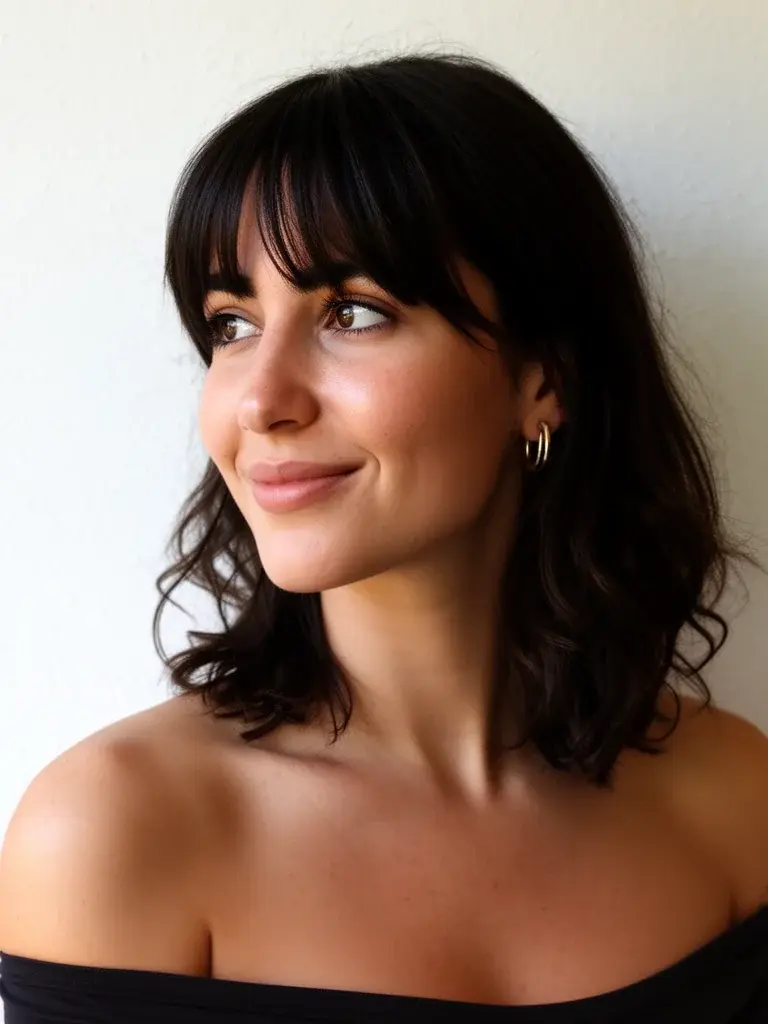
Side-swept bangs are fringe cut at a diagonal angle — longer on one side of the forehead, shorter on the other — and trained to sweep across the forehead in one direction. The cut is specifically designed to fall to one side rather than straight down or outward.
The key distinction from other bangs is the intentional asymmetry. The hair isn't cut horizontally and then pushed to the side — it's cut on the diagonal so that the natural fall direction is across the forehead. This trained direction is reinforced by blow-drying consistently the same way until the hair's growth pattern adapts.
The longest piece of a side-swept bang typically reaches the cheekbone or eye corner on the side away from the sweep, while the shortest piece sits at the opposite eye corner or slightly above. The graduated length is what creates the smooth sweep rather than a blunt wall of fringe.
Side-Swept Bangs vs Curtain Bangs vs Wispy Bangs
| Side-Swept Bangs | Curtain Bangs | Wispy Bangs | |
|---|---|---|---|
| Direction | One side, diagonal | Outward from center part | Straight down, individual strands |
| Symmetry | Asymmetric | Symmetric | Symmetric |
| Forehead coverage | Partial (one direction) | Partial (both sides) | Partial (separated strands) |
| Best for round face | ✅ Ideal | ✅ Good | ⚠️ Can shorten face |
| Maintenance | Every 6–8 weeks | Every 4–6 weeks | Every 4–6 weeks |
| Grow-out difficulty | Very easy | Moderate | Easy |
Bottom line: Side-swept = asymmetric, low-maintenance, universally adaptable. Curtain = structured framing, symmetrical. Wispy = textural, feathery, minimum density.
Cut Specifications
- Angle: Diagonal from shorter (at eye corner or slightly above) to longer (reaching the cheekbone on the opposite side)
- Section width: Approximately the width of the forehead from the natural part to 2–3 inches past center
- Length range: Shortest piece above the brow or at the eye corner; longest piece at or below the cheekbone
- Technique: Scissors held at an angle following the sweep direction. Point cutting at the longer end for a soft blend into the hair length
- Direction: Establish which side the sweep goes before cutting — cutting in the wrong direction means restarting
- Trim cycle: Every 6–8 weeks, primarily trimming the shortest section when it reaches eye level
Color Pairing
- Face-framing highlights on the swept side: A lighter piece or two concentrated on the longer swept strands creates a natural-light effect and draws the eye toward the sweep
- Tonal base: Side-swept bangs work with any single-process color. The diagonal fringe doesn't need special color treatment — the cut shape speaks for itself
- Babylights through the fringe section: Ultra-fine highlights throughout the bang section add dimension without dramatically changing the color, creating depth in the sweep
Face Shape Tweaks
- Oval: Any direction, any angle. Side-swept bangs work without adjustment
- Round: Make the sweep more dramatic — longer piece should reach the cheekbone for maximum diagonal length. The longer and more diagonal, the more elongating
- Square: Sweep toward the more prominent side of the jaw. The diagonal line draws the eye away from the square jaw angle
- Oblong: A slightly wider fringe section (more forehead coverage) breaks the face's vertical proportion more effectively than a narrow sweep
- Heart: Sweep the fringe toward the narrower side of the face (chin area) to create visual balance with the wider forehead
- Diamond: Any version. The diagonal breaks the cheekbone symmetry for a more dynamic facial framing
Hair Type Tweaks
- Straight: No adjustment. Straight hair trains the sweep direction most easily and permanently
- Wavy: Blow-dry the sweep direction while wet and set with a light hold spray. The wave will maintain the trained direction between washes with consistent styling
- Curly: Cut significantly longer than target — curls shrink 30–40%. Work with the curl pattern: a naturally wavy or coiled sweep can look stunning. Don't expect a flat, silky sweep
- Fine: The sweep direction shows clearly on fine hair. If the fringe section is too sparse, ask for a slightly wider section width
- Thick: Ask for the fringe section to be thinned before cutting — thick bangs on a diagonal sweep sit on the forehead with a lot of weight and don't sweep cleanly
How to Style
Daily (3 minutes):
- After washing, comb the damp fringe section in the sweep direction
- Apply a tiny amount of light-hold cream or gel through the fringe only
- Blow-dry on medium heat in the sweep direction with a small round brush or vent brush
- Done — the trained direction will maintain itself
Polished (5 minutes):
- Blow-dry as above
- Use a flat iron at low-medium heat, pulling the fringe across the forehead in a single smooth pass
- Set with light-hold spray — not gel, which can make the sweep look stiff
No-Heat:
- Comb damp fringe in the sweep direction
- Pin in place with 2–3 bobby pins crossing in the intended direction
- Let air-dry fully — remove pins when completely dry
- The set direction will hold for most of the day
Maintenance Schedule
- Week 1–2: Perfect sweep. The shortest piece is above the eye and reads as intentional
- Week 3–4: 1–1.5cm of new growth. Still excellent; the extra length often makes the sweep look more relaxed and flattering
- Week 5–6: The shortest piece is reaching the eye. Slightly annoying if you have sensitive eyes
- Week 7–8: Trim time. The shortest piece is into the eye and the length contrast with the longest piece has narrowed — the diagonal reads less clearly
- Growing out: Because of the diagonal cut, different strands hit blend-in length at different times. The grow-out is nearly imperceptible — side-swept bangs blend into face-framing layers without an awkward phase
If you color your hair:
- No special timing needed. Color maintenance and trim maintenance can be combined
- Touch-up and trim in the same appointment to save time
Pro tip: When blow-drying, start from the underside of the fringe section — lifting and directing from underneath creates movement in the sweep. Directing from the top creates a flat, heavy-looking bang.
Common Mistakes
-
Cutting the sweep in the wrong direction Fix: Before the stylist cuts, decide which direction you want the sweep and ensure you've communicated it clearly with a reference photo or pointing at your face. Cutting against a strong natural part direction means fighting the sweep every morning.
-
Making it too blunt at the end Fix: The longer end of side-swept bangs should be point-cut to blend into the length of your hair. A blunt line at the longer end creates a visible, awkward step. Ask for "soft blending into the length" at the longer end.
-
Using too much product to force the direction Fix: If you're using gel or heavy hold product to keep side-swept bangs in place, it means the trained direction hasn't set yet or is actively fighting your natural growth. Consistent blow-drying in the right direction for 2–3 weeks usually trains the sweep enough that only light product is needed.
-
Trimming the longer end instead of the shorter end Fix: The trim focus is on the shortest piece (at the eye corner) which grows first. Some people mistakenly trim the longer piece for symmetry — this flattens the diagonal angle and loses the side-swept effect.
-
Abandoning the style mid-grow-out and making it look like neglected curtain bangs Fix: If growing out, commit to it. Side-swept bangs growing out look deliberate when left as-is. The problem occurs when you try to maintain them at a different length mid-grow — that creates an inconsistent fringe that reads as unfinished.