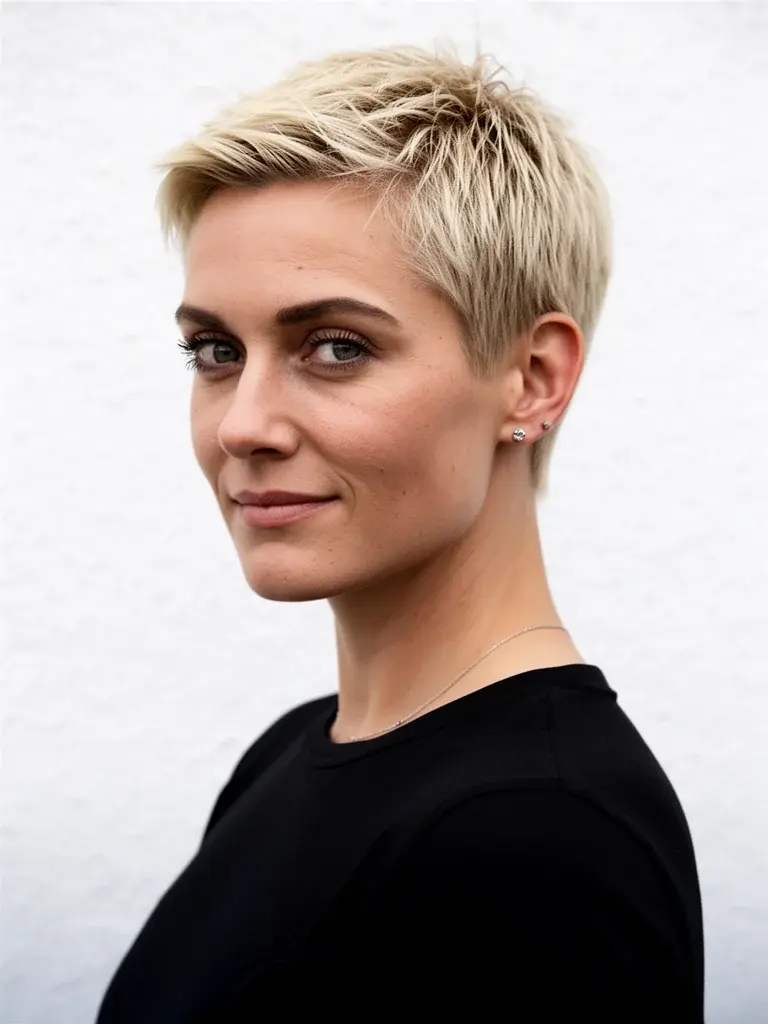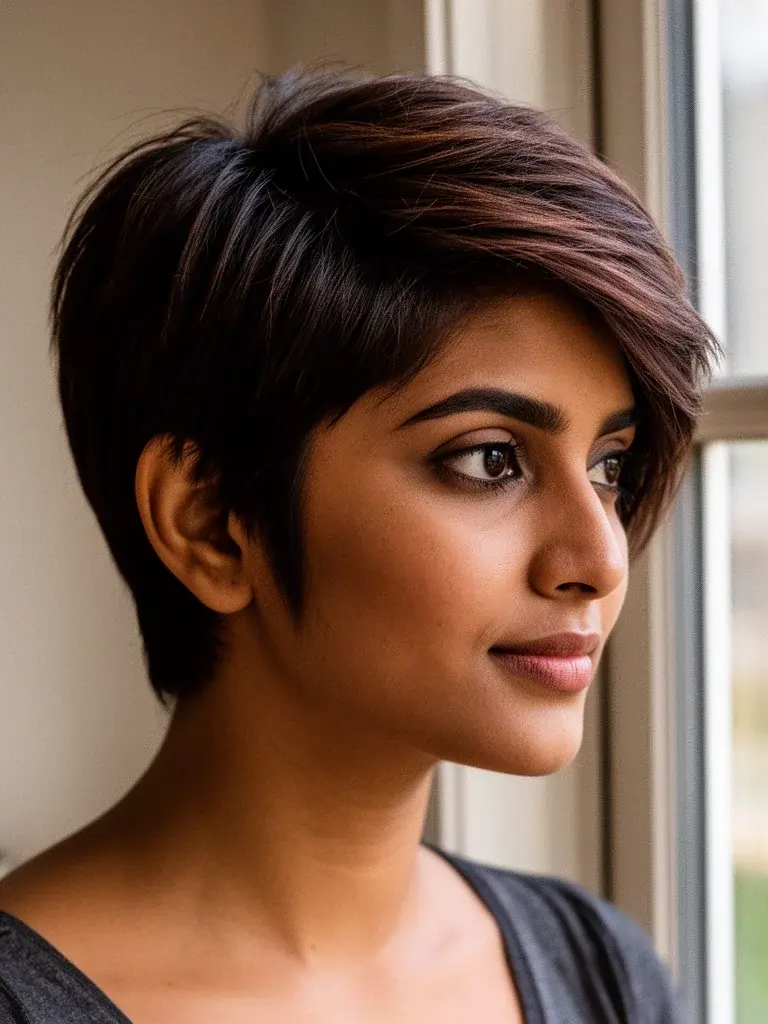

TL;DR
- Best for: Round and oval faces — crown volume elongates, layers add dimension without bulk
- Avoid if: You need sleek, polished hair daily or your hair is pin-straight and won't hold texture
- Ask your stylist: "Short shag, chin-length, heavy crown layers, point-cut throughout — I want it to look good air-dried"
- Maintenance: Trim every 6–8 weeks; the grown-out look is part of the style
Who Does It Suit?
The short shag trades precision for personality. Heavy layers at the crown create lift, while textured ends at chin level frame the jaw. It's designed to look better with less effort — day-two hair is the target, not a compromise.
Ideal for:
- Round faces that want crown height to elongate proportions
- Heart-shaped faces that benefit from chin-level fullness balancing a wider forehead
- Women who air-dry and want a cut that cooperates with that decision
- Thick hair that needs weight removal without losing volume
- Anyone transitioning from a longer shag or wolf cut who wants to go shorter
Hair types:
- Straight: Needs product (sea salt spray or texture paste) to activate the layers — without it, straight short shags can look flat rather than textured
- Wavy: The ideal texture — natural wave fills the layers and creates movement without any product
- Thick: Excellent — the layers remove weight progressively, preventing the mushroom effect that thick short hair can create
- Fine: Works well at this length — short fine hair has more natural body than long fine hair, and fewer layers prevent see-through sections
Avoid If...
- You need sleek, polished hair daily → the short shag's whole identity is textured and undone; if your workplace demands a smooth finish, try sleek-straight-medium or a classic bob
- Pin-straight hair + no willingness to use product → straight hair needs at least a sea salt spray to activate shag layers; without it, the cut lies flat and looks like a bad haircut rather than an intentional shag
- Very tight curls (4A+) → the crown layers can shrink too short and create an unintended shape; a layered pixie gives you similar textured energy with better curl management
- You love your long hair → a short shag means chin-length. The grow-out is graceful, but growing back to shoulder length takes 8–12 months
- You want a defined, geometric shape → the short shag is deliberately imprecise; for structure with texture, try a shaggy bob
What is a Short Shag?
A short shag is a chin-to-jaw length haircut with heavy layering throughout — shortest at the crown, gradually lengthening to the perimeter. The layers are cut with disconnection, meaning each layer moves independently rather than blending into a smooth gradient. The result is visible texture, natural volume, and a shape that looks better with movement than when sitting still.
The shag originated in the 1970s as a unisex cut — David Bowie, Jane Fonda, Mick Jagger all wore versions. The 2025–2026 short shag is softer than the original: less razor-cut aggression, more point-cut feathering. The layers are still bold, but the edges are kinder. It reads modern rather than retro.
Short Shag vs Wolf Cut vs Shaggy Bob
| Short Shag | Wolf Cut | Shaggy Bob | |
|---|---|---|---|
| Length | Chin to jaw | Shoulder to collarbone | Chin to jaw |
| Layer distribution | Even throughout, crown-heavy | Concentrated at crown, long back | Light, on top of a one-length base |
| Structure | Least structured — deliberate disconnection | Semi-structured — mullet-adjacent silhouette | Most structured — bob foundation |
| Maintenance | Every 6–8 weeks | Every 6–8 weeks | Every 6–8 weeks |
| Best texture | Wavy, thick | Wavy, thick, straight | Straight, wavy |
| Styling time | 45 seconds | 2–3 minutes | 2–3 minutes |
Bottom line: Short shag = maximum texture, minimum structure. Wolf cut = same texture, more length and mullet influence. Shaggy bob = bob shape with texture added on top. The short shag is the most effortless of the three.
Cut Specifications
- Crown layers: 2–3 inches at the shortest, creating visible lift and volume at the top of the head
- Graduation: Layers lengthen gradually from crown to chin — no blunt weight line, no one-length base
- Cutting technique: Point-cut throughout — never blunt-cut, never razor-cut (point-cutting creates soft, feathered ends; razoring can thin fine hair too aggressively)
- Face-framing: Shorter pieces at the cheekbones that taper into the longer perimeter layers
- Back shape: Slightly rounded or natural — not blunt across the back, not tapered to a point
- Overall length: Chin to jaw — shorter reads more pixie-adjacent, longer reads more bob-adjacent
- Trim cycle: Every 6–8 weeks; can push to 10 if you like the overgrown look
Color Pairing
- Dimensional balayage: The layers catch highlighted pieces at different lengths, creating a sun-kissed 3D effect. Best on brunettes transitioning to warmer tones. The short length means balayage is concentrated and visible, not lost in long lengths.
- Warm copper or strawberry blonde: The '70s shag connection makes warm tones a natural pairing. Copper on a short shag is peak 2026 aesthetic — editorial but wearable.
- Rich chocolate single-process: A uniform dark tone lets the layers and texture do the talking. The shadow and light play between layers creates dimension without needing multi-tonal color.
- Root shadow with blonde ends: A darker root melting into lighter ends — the short length makes the transition zone visible and intentional. Adds depth at the crown where layers are shortest.
Face Shape Tweaks
- Oval: Standard short shag — no modifications needed; the balanced proportions work with any layer distribution
- Round: Maximize crown volume (shorter crown layers) and keep chin-level layers close to the face — vertical emphasis elongates
- Heart: Build fullness at the chin level to add width at the narrowest part of the face; keep crown layers moderate to avoid emphasizing the forehead
- Square: Add more face-framing pieces at the cheekbone to soften angular features; keep the overall shape rounded rather than geometric
- Oblong: Add width at the sides with fuller temple layers; avoid too much crown height, which would elongate further
- Diamond: Standard works well; the layers at cheekbone level soften the widest point naturally
Hair Type Tweaks
- Straight: Add sea salt spray or texture paste after washing — straight hair needs product to activate the disconnected layer look. Without it, the cut appears flat and one-dimensional.
- Wavy: Cut dry if possible. Wavy hair fills the shag layers naturally — you may need zero product. Just scrunch and go.
- Thick: Request aggressive layering through the crown and mid-lengths. Thick short shags without enough layering become mushroom-shaped. The goal is separation between layers, not bulk.
- Fine: Fewer layers, more widely spaced. Fine short shags with too many layers end up see-through. Keep the crown layers longer (3 inches instead of 2) and maintain density at the perimeter.
Volume Without Pouf
The short shag promises volume — but the wrong kind of volume turns textured into puffy. Managing this is the cut's core challenge.
- Dry shampoo at the roots before styling, not after: Applying dry shampoo to clean, dry roots before adding any texture product prevents the roots from going flat by midday. It's a preemptive move, not a fix.
- Scrunch upward, never blow dry downward: Scrunching pushes layers apart and up, creating the right kind of volume. Blow drying straight down compresses layers together, creating poof instead of texture.
- Sea salt spray on damp hair, texture paste on dry hair: These are not interchangeable. Spray on damp hair creates wave and body. Paste on dry hair creates definition and separation. Using both creates crunch.
- Skip the round brush entirely: Round brushing a short shag smooths the layers into each other, destroying the disconnection that makes the cut work. If you want a polished day, use your fingers or a flat brush, never round.
- Sleep on it: The best short shag days are day-two days. The pillow creates random texture that looks better than anything you can replicate intentionally. If your shag looks too "done" on day one, sleep on it and see what happens.
What to Tell Your Stylist
"I want a short shag — chin length, heavy layers starting at the crown around 2–3 inches, point-cut throughout so the ends are feathered. I want it to air-dry well and look undone. No blunt lines, no one-length base."
Reference photo tips:
- Bring photos of short shags on your hair texture — a wavy-haired shag looks completely different from a straight-haired one
- Point out the crown layer length you want — "I want this much lift at the top"
- Specify face-framing: do you want shorter pieces at the cheekbones, or should the layers start at the chin?
- Tell your stylist your styling philosophy — "I air-dry 90% of the time" helps them decide how much to rely on cut vs. styling for the shape
- If you're cutting from longer hair, show the before-and-after transformation you have in mind, not just the final result
How to Style
Daily (45 seconds):
- Towel-dry hair until damp, not dripping
- Apply a coin-sized amount of sea salt spray to palms
- Scrunch hair upward from the ends, focusing on the crown area
- Walk out the door — the air will finish the job
Polished (5 minutes):
- Apply mousse or light volumizing spray to damp hair
- Diffuse on low heat, scrunching sections upward with the diffuser attachment
- Once 80% dry, flip your head upside down and diffuse the crown for 30 seconds
- Finish with a tiny amount of texture paste on fingertips, twisting individual pieces for definition
No-Heat Alternative:
- Wash hair before bed
- Divide into 3–4 loose braids (not tight — loose braids create waves, tight braids create crimps)
- Sleep on it
- Unbraid in the morning, scrunch once, add a mist of texture spray if needed
- The braid waves add body and movement that holds all day
Maintenance Schedule
- Week 1–2: Freshly cut. Crown layers have maximum lift. Ends are feathered and textured. This is peak shape.
- Week 3–4: Layers growing in slightly. Still looks great — the shag is designed to look good at this stage. Texture is softening from crisp to lived-in.
- Week 5–6: The overgrown-shag phase. Many people prefer this look to the freshly cut version. Layers are blending, shape is looser, overall vibe is more relaxed.
- Week 7–8: Time to trim if you want to maintain the shape. Crown layers are getting flat. Perimeter is starting to lose its feathered texture.
- Week 9–10+: The shag has evolved into a grown-out layered cut. Still wearable, but the deliberate disconnection is gone. Book a trim or decide you're growing it into a medium shag.
If you color your hair:
- Balayage: refresh every 10–12 weeks; the short length means color grows out faster but the grow-out looks intentional with the textured style
- Single-process: roots at the crown (shortest layers) show first — consider a root smudge for seamless grow-out
Pro tip: The short shag is the most forgiving short haircut for skipped appointments. A pixie at 10 weeks looks unkempt. A short shag at 10 weeks just looks like a longer shag. This is the beauty of the style — it evolves instead of degrading.
Common Mistakes
-
Too many layers on fine hair Fix: Fine-haired clients ask for "lots of layers for volume" and end up with see-through sections. Fewer layers, more widely spaced, create the illusion of volume without removing the density that fine hair can't afford to lose. Tell your stylist "I want volume, not layers" — they'll know the difference.
-
Razor-cutting instead of point-cutting Fix: Razoring creates wispy, thin ends that can look damaged rather than textured — especially on fine or dry hair. Point-cutting creates the same feathered texture with more control and weight. If your stylist reaches for the razor, ask for point-cutting instead.
-
Blow-drying with a round brush Fix: Round-brushing a short shag smooths the layers into a bob shape, eliminating the textured disconnection. Use your fingers or a diffuser. If you want a polished day, use a flat brush to smooth the perimeter only, leaving the crown layers free.
-
Skipping product on straight hair Fix: Straight short shags without any texture product look like a bad haircut, not an intentional shag. A single spray of sea salt spray activates the layers. It takes 3 seconds.
-
Asking for the wolf cut when you want a short shag Fix: Wolf cut and short shag are not the same — the wolf cut is longer with heavier crown layers and a mullet-like back. If you show your stylist a short shag photo and say "wolf cut," you may end up with more length and back weight than you wanted. Use the term "short shag" and show the chin-length photos.