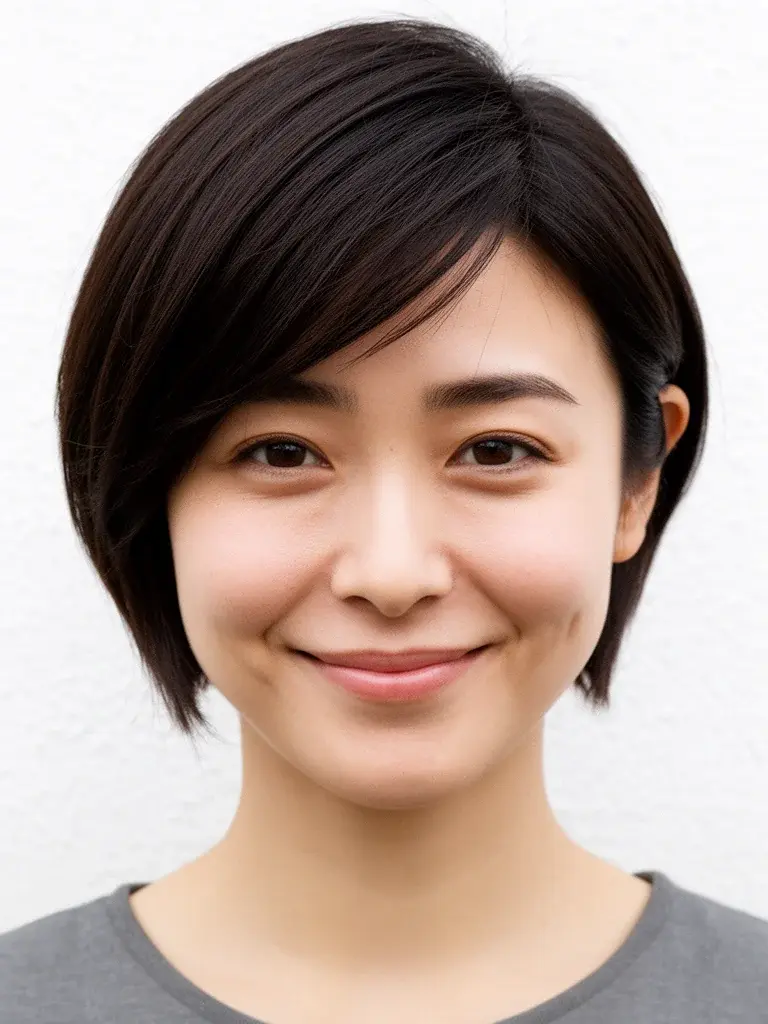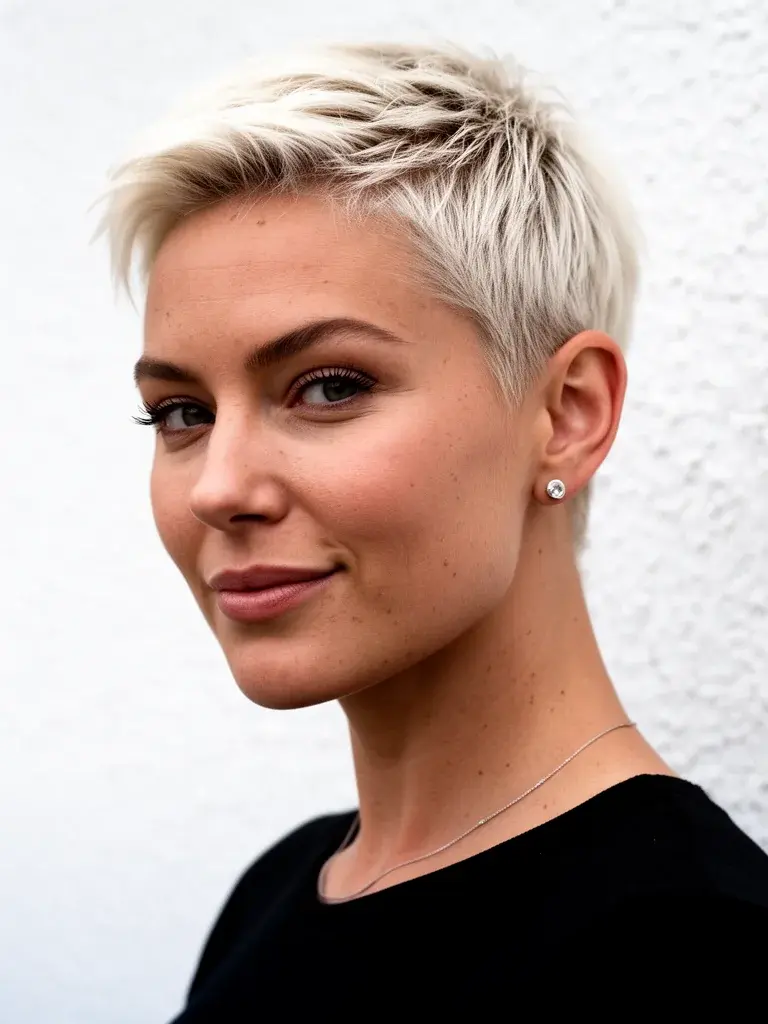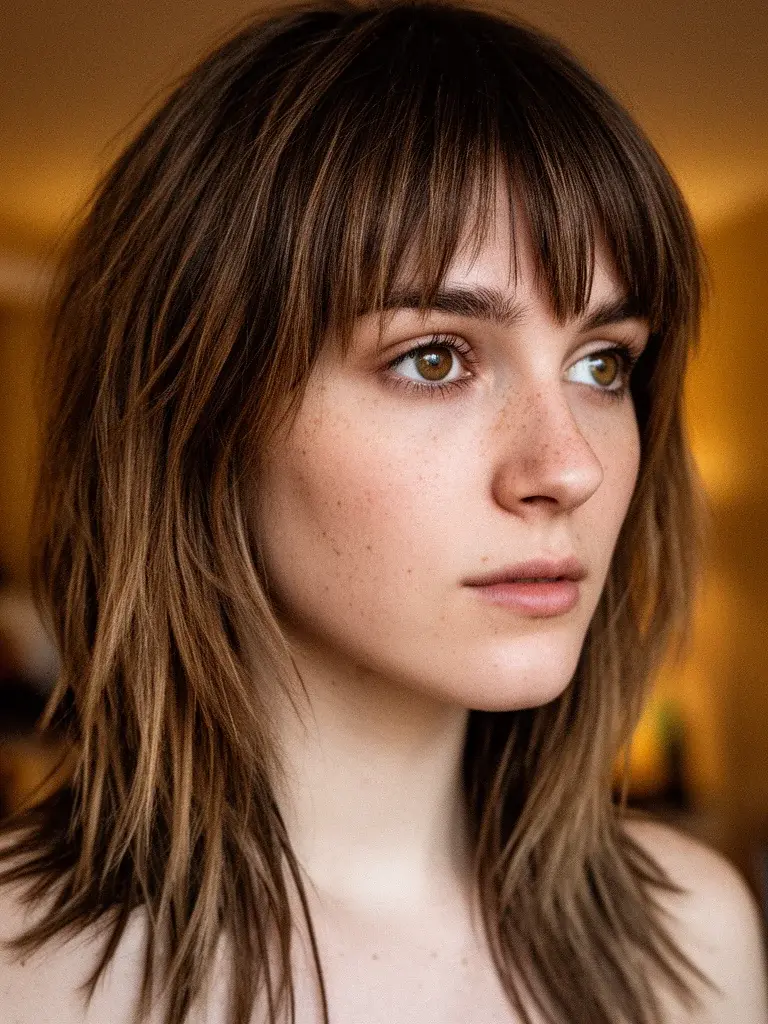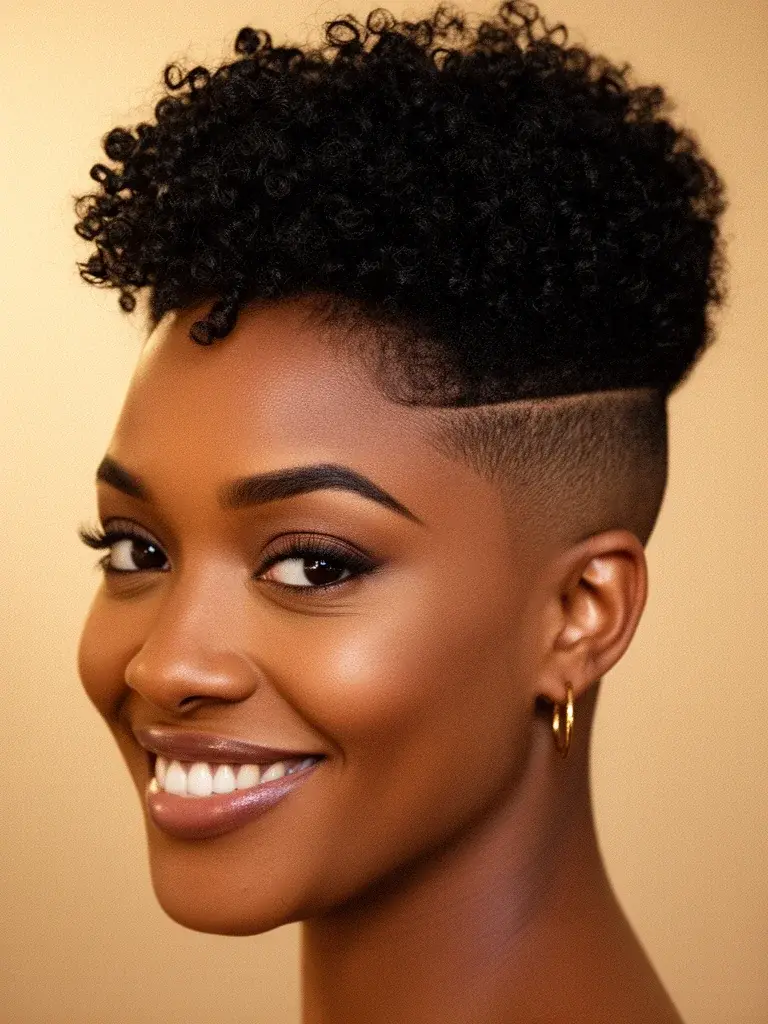
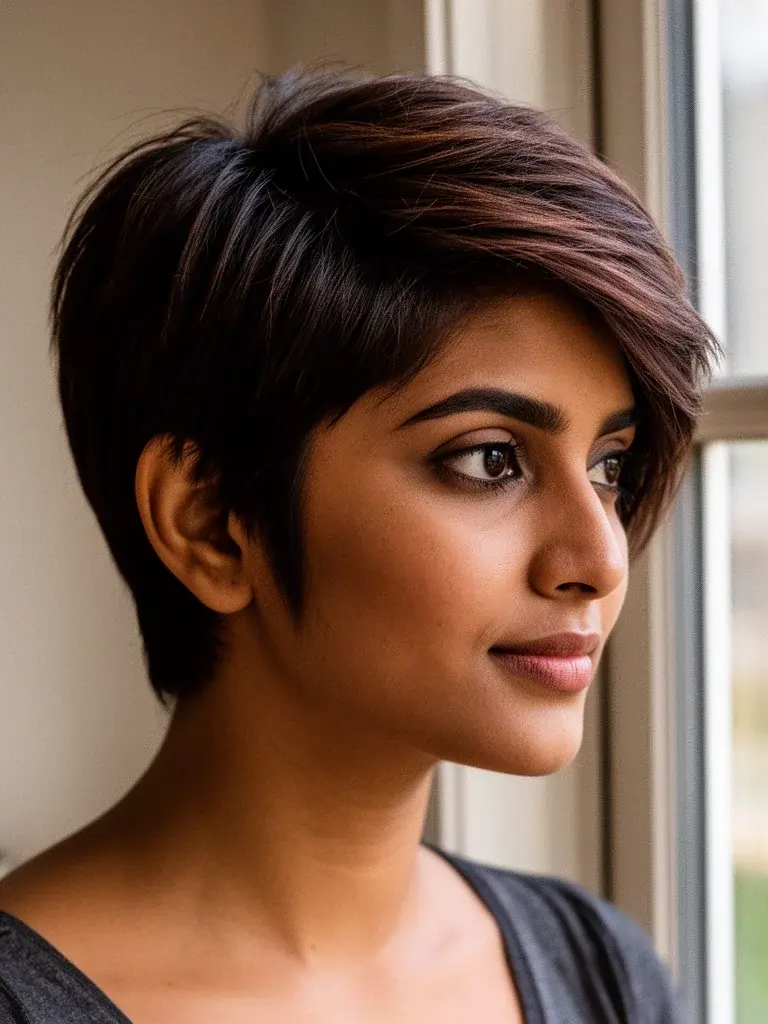
TL;DR
- Best for: Fine hair that wants volume; anyone who finds one-length pixies look flat on their head; oval and round faces
- Avoid if: Your hair texture is very curly and dense (layers can create unpredictable volume); you want a very graphic, architectural look
- Ask your stylist: "Layered pixie — point-cut layers through the top section for texture and lift. 2–3 inches on top, graduated sides, no blunt ends."
- Maintenance: Trim every 6–8 weeks
Who Does It Suit?
Ideal for:
- Fine hair — layers create volume that no product can replicate long-term; this is the structural solution rather than the topical one
- Women who want a pixie but don't want it to look flat or severe
- Anyone who wants a wash-and-go texture without using heavy product
- Oval and round faces — the layers create crown lift that benefits both shapes
- Women transitioning from longer layered styles — the layered pixie maintains the "feel" of texture they're used to
Hair types:
- Straight: Layers on straight hair create piece-y texture and movement that reads as intentionally styled; point-cutting is the technique to ask for
- Wavy: The best match — natural wave activates the layers immediately after air-drying, creating effortless volume and movement
- Fine: Primary use case for layered pixie — internal layers remove the "flat helmet" effect that fine hair creates at pixie length
- Thick: Layers control bulk and prevent the boxy look; interior thinning of the sides and back is equally important
Avoid If...
- You want a very clean, architectural pixie shape → layers soften the silhouette; for a more graphic look try a Short Pixie with clean lines
- Your hair is very densely curly → curly hair creates its own volume at pixie length; adding layers can lead to excessive puffiness; discuss carefully with your stylist before committing
- You want easy home maintenance with clippers → a layered pixie requires stylist precision; unlike a buzz cut or very short crop, you can't easily maintain this at home
- You're growing out your hair → the layered technique actually complicates grow-out slightly since different sections are different lengths; a Long Pixie grows out more cleanly
What is a Layered Pixie?
A layered pixie is a short haircut built on the same foundation as a classic pixie — tapered or graduated sides and back, with more length retained on the top — but the key difference is in the technique applied to that top section. Rather than cutting the top to a uniform length, the stylist uses point-cutting or razor-cutting to create internal layers that vary in length by half an inch to an inch.
These internal layers serve a structural purpose: they allow sections of hair to sit at slightly different heights, creating movement and texture rather than a flat, weighted panel on top of the head. The effect is subtle from a distance — the cut still reads as a pixie — but close up, the top has visible dimension and the hair moves rather than sitting still. On fine hair, this is the difference between a pixie that looks scalpy and flat and one that looks full and intentional.
Layered Pixie vs Short Pixie vs Long Pixie
| Layered Pixie | Short Pixie | Long Pixie | |
|---|---|---|---|
| Top length | 2–3 inches, with internal layers | 2–3 inches, more uniform | 4–6 inches |
| Texture | Built-in, structural | Product-dependent | Length-dependent |
| Fine hair | Best match | Tricky (flat risk) | Good match |
| Styling time | Under 60 seconds | Under 60 seconds | 1–3 minutes |
| Maintenance | Every 6–8 weeks | Every 4–6 weeks | Every 6–8 weeks |
| Grow-out | Moderate | Awkward 3–5 months | Smooth |
Bottom line: Layered pixie = texture and lift built into the structure. Short pixie = clean precision that relies on product. Long pixie = more length with more styling options.
Cut Specifications
- Layers: Internal point-cut or razor-cut layers through the top section; typically 0.5–1 inch of length variation between layers; the ends are not blunt
- Bangs/Fringe: Optional; a short side-swept fringe or long curtain fringe incorporates naturally into the layered top; the layers often create a natural fringe-like piece at the hairline
- Weight line: At the occipital bone; the back and sides remain closely tapered while the layered top creates the visual difference
- Graduation: Standard graduation from nape upward; the sides are tapered rather than layered; only the top section receives the layer technique
- Trim cycle: Every 6–8 weeks; interior layers grow out more gracefully than blunt cuts but need reshaping to maintain definition
Color Pairing
- Natural with baby highlights through the top: On a layered pixie, highlights interact with the layers to create even more visible dimension — each layer catches light differently. Ask for highlights applied only through the top section where the layers are. The effect: more depth than a single-process color, more movement than a flat tone.
- Dimensional brunette: Adding a subtle warm gloss over natural brown tones on a layered pixie makes the texture visible in photos and natural light. Single-process colors can flatten layered hair; dimension through tonal variation lets the structure show.
- Bold fashion color with contrast roots: The deliberate messiness of a layered pixie pairs well with bolder color choices. A fashion color (dusty pink, deep violet) with intentional root shadow creates the impression of a heavily considered, artfully textured cut.
Face Shape Tweaks
- Oval: Every proportion works; experiment with the layers directed forward, back, or to the side.
- Round: Direct the layers upward on top for crown height. Deep side part adds asymmetry. Avoid layering that falls flat on top — the lift is the whole point for round faces.
- Heart: Layers add softness at the temples; a slightly longer front piece or side fringe element incorporated into the layers helps balance a wider forehead.
- Oblong: Keep the layers on top more horizontal rather than building height — additional crown lift on an oblong face emphasizes length. A fringe element helps add horizontal weight.
Hair Type Tweaks
- Straight: Point-cutting is essential — razor-cutting can be used for maximum texture. Without the layer technique, straight pixies look flat; with it, straight hair shows the most defined layer effect.
- Wavy: Minimum product needed. Natural waves activate the layers automatically. Let it air-dry and you're done. If it air-dries with a section that goes the wrong way, just redirect it with one finger while damp.
- Fine: The primary reason to choose a layered pixie over a standard one. Internal layers are the structural solution to the volume problem — they work even when product fails. Ask your stylist to point-cut aggressively through the top.
- Thick: Interior thinning of the sides and back is as important as the top layers — otherwise the layered top will look delicate while the sides look solid. Both elements should be addressed at every appointment.
The Volume Equation
The central appeal of a layered pixie is that it creates volume structurally rather than through product. Understanding why this matters makes the cut decision clearer:
- One-length pixie top: All strands fall to the same height and lie on top of each other, creating a compacted panel of hair. Volume requires product to push this panel upward.
- Layered pixie top: Strands are cut to different heights, so they don't all rest at the same point. Some sit higher, some lower, creating natural separation and perceived volume with no product required.
For fine hair especially, this is a meaningful difference — product-dependent volume always fails by noon; structural volume stays put regardless of weather, oil production, or activity level.
What to Tell Your Stylist
"Layered pixie — I want internal point-cut layers through the top section, about 2–3 inches of top length, graduated sides. I want texture and lift from the layers, not from product. No blunt ends. Soft fringe or no fringe [specify your preference]."
Reference photo tips:
- Find a reference photo taken in natural light or slightly air-dried — this is when layered pixie texture is most visible. Salon photos under strong overhead light sometimes flatten the texture in photos.
- Bring photos of the top and crown specifically, not just the front. The layer technique shows most clearly from above or from a three-quarter angle — this is what you're asking your stylist to replicate.
- Tell your stylist your hair texture. A layered pixie on wavy hair looks very different from one on straight hair — the same technique produces different results. They need to know what they're working with.
How to Style
Daily (60 seconds):
- Shake hair out or towel-dry briskly
- Apply a small amount of matte texture paste (pea-sized) to fingers
- Work through the top section with your fingers, lifting from the roots
- Done — the layers do the styling work
Polished (4 minutes):
- Apply heat protectant to damp hair
- Blow-dry upward with a medium-bristle brush or your fingers, lifting the layers at the roots
- Direct each section in your preferred direction as it dries
- Finish with a tiny amount of texture clay through the ends to define layer separation
No-Heat Alternative:
- Towel-dry until barely damp — brisk towel-ruffling actually helps separate the layers
- Apply lightweight volumizing mousse to the roots only
- Shake and finger-style in your preferred direction
- Air-dry fully (8–12 minutes for this length)
- Once dry, use dry texture spray to add grip — don't smooth it, just work it through lightly
Maintenance Schedule
- Week 1–2: The layers are sharp and well-defined. Texture is visible and the volume is at maximum.
- Week 3–4: The layers are softening as the hair grows. The texture is still present but slightly less defined — many people prefer this slightly grown-in feel.
- Week 5–6: The interior layers are starting to grow together and lose their definition. The top starts to feel heavier and less textured. This is the trim window.
- Week 7–8+: Without a trim, the layers have mostly grown out and the top returns to a heavy, flat appearance. The main benefit of the cut — structural volume — is gone until the next appointment.
If you color your hair:
- Highlights interact with layers especially well: add or refresh highlights every 8–10 weeks on your trim schedule
- Tonal gloss treatments to add warmth or dimension: 4–6 weeks, can often be done same-day as a trim
- Single-process root touch-up: align with your 6–8 week trim appointment to minimize salon visits
Pro tip: A layered pixie is one of the few haircuts that genuinely looks good — sometimes better — as it grows. Week 4 often produces a slightly more relaxed version of the cut that many clients prefer over the freshly cut version. Don't panic if the first week feels too sharp.
Common Mistakes
-
Asking for a layered pixie at a salon that doesn't cut short hair regularly Fix: The internal layering technique on pixie-length hair requires precision. Ask to see your stylist's portfolio of short cuts specifically — layered pixies in particular — before booking.
-
Using heavy products that cancel out the layer texture Fix: Glossy pomades, heavy waxes, and thick creams flatten layers and eliminate the dimensional look you got the cut for. Use matte paste, texture clay, or dry texture spray only. Less product than you think you need.
-
Expecting volume in very humid weather without adjustment Fix: Humidity adds weight to fine hair and makes layers fall together. In humid conditions, apply a light anti-humidity spray before styling and use dry texture spray at the crown for grip. The layers won't be as defined but will still add more movement than a one-length pixie.
-
Going too short on the sides when asking for a layered pixie Fix: The contrast between very short sides and layered top can look disconnected rather than graduated. Ask for a moderate taper on the sides (1–1.5 inches) rather than an aggressive undercut unless you specifically want that contrast.
-
Getting layers on the sides as well as the top Fix: Layering belongs on the top section only. Layering the sides creates a feathered, '70s effect that's harder to manage and doesn't age as well. Sides should be tapered and graduated, not layered.