TL;DR
- Best for: Oval and oblong faces — the vertical fall elongates, and the clean line adds structure without adding width
- Avoid if: Naturally wavy/curly hair (you'll fight it daily) or you want volume and movement
- Ask your stylist: "One-length cut at collarbone, no layers, internally thinned, blunt weight line — I want glass hair"
- Maintenance: Trim every 8–10 weeks to keep the blunt ends sharp
Who Does It Suit?
This is the anti-texture cut. In a world of wolf cuts, shags, and lived-in layers, sleek straight medium makes a statement through precision and restraint. It works because of what it doesn't have — no layers, no graduation, no texture.
Ideal for:
- Naturally straight hair that you want to work with, not against
- Women in polished, professional environments where "undone" reads as unkempt
- Anyone tired of the textured-everything trend who wants a clean palette
- Fine hair that looks best when kept smooth and one-length
- Square faces that want the vertical fall to elongate rather than layers adding width
Hair types:
- Straight: The ideal base — requires almost zero daily styling to achieve the glass effect
- Fine: Excellent — fine hair produces the smoothest, most reflective surface
- Thick: Works with internal thinning — without it, thick straight hair triangles out at medium length
Avoid If...
- Naturally wavy or curly hair → you'll be flat-ironing daily, and the grow-out between washes kills the sleek look; try lob instead — it works with natural texture
- You want volume → no layers means no built-in volume; this cut falls flat by design; shoulder-length layers add movement without sacrificing length
- You skip trims beyond 12 weeks → the blunt weight line shows damage faster than layered cuts; split ends shatter the glass-hair illusion
- Very thick hair and you won't thin internally → one-length thick hair at medium length becomes a triangle; internal thinning is mandatory, not optional
- You live in a humid climate → humidity is the enemy of sleek straight hair; consider whether you want to fight your environment daily
What is Sleek Straight Medium?
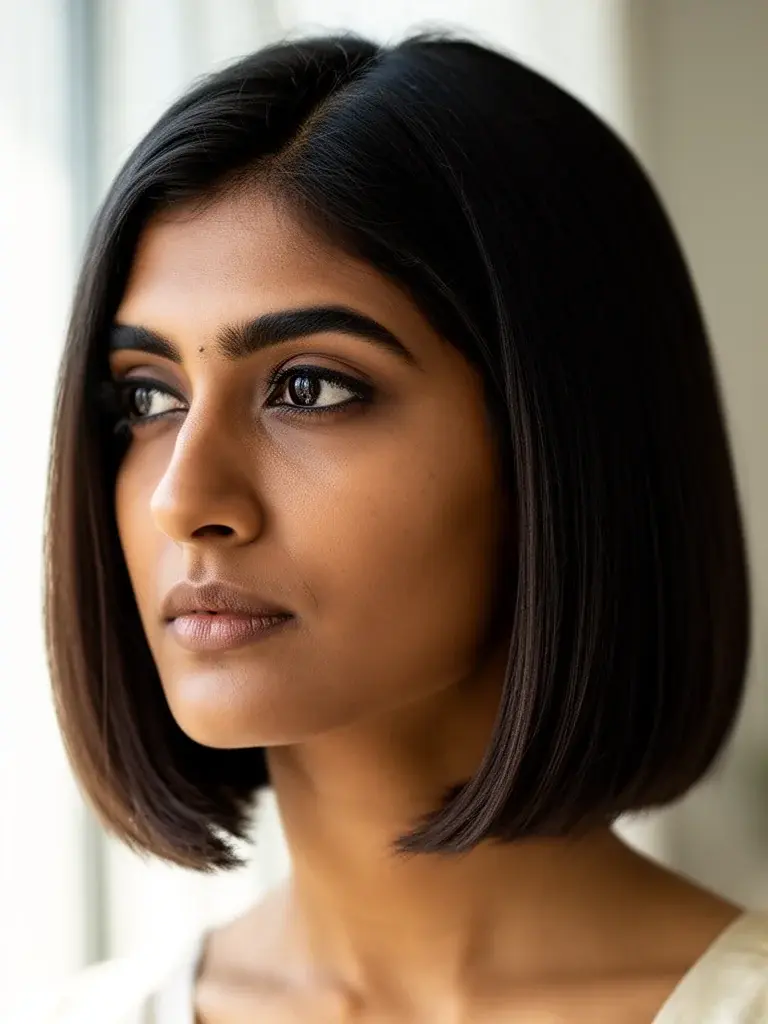
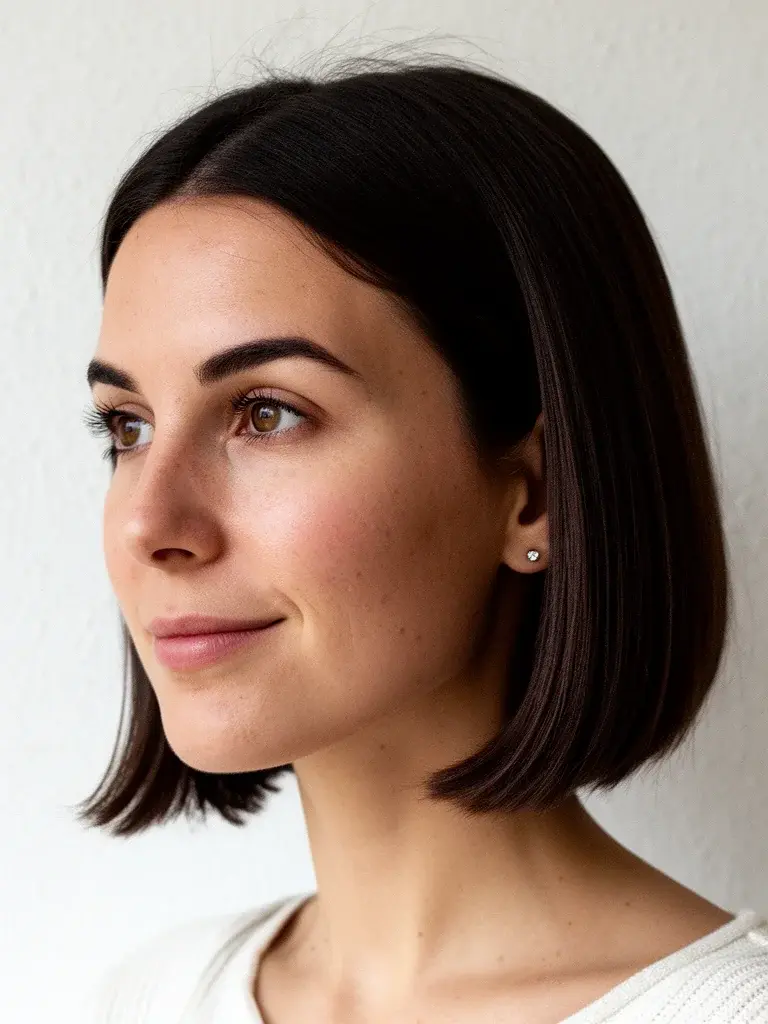
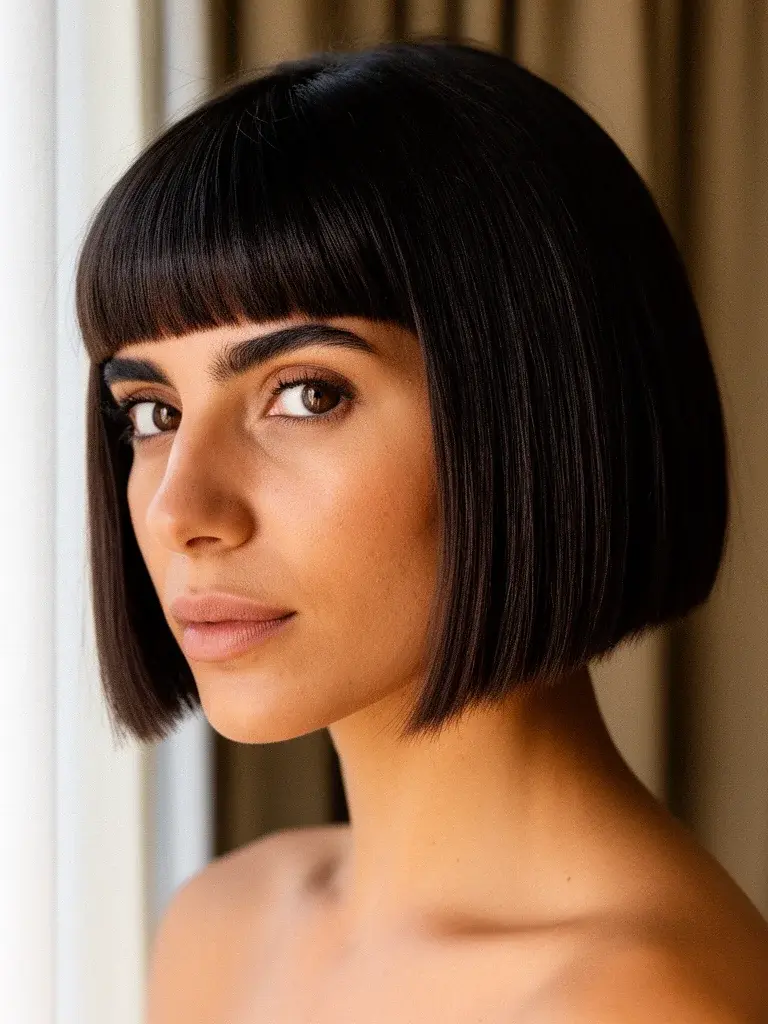
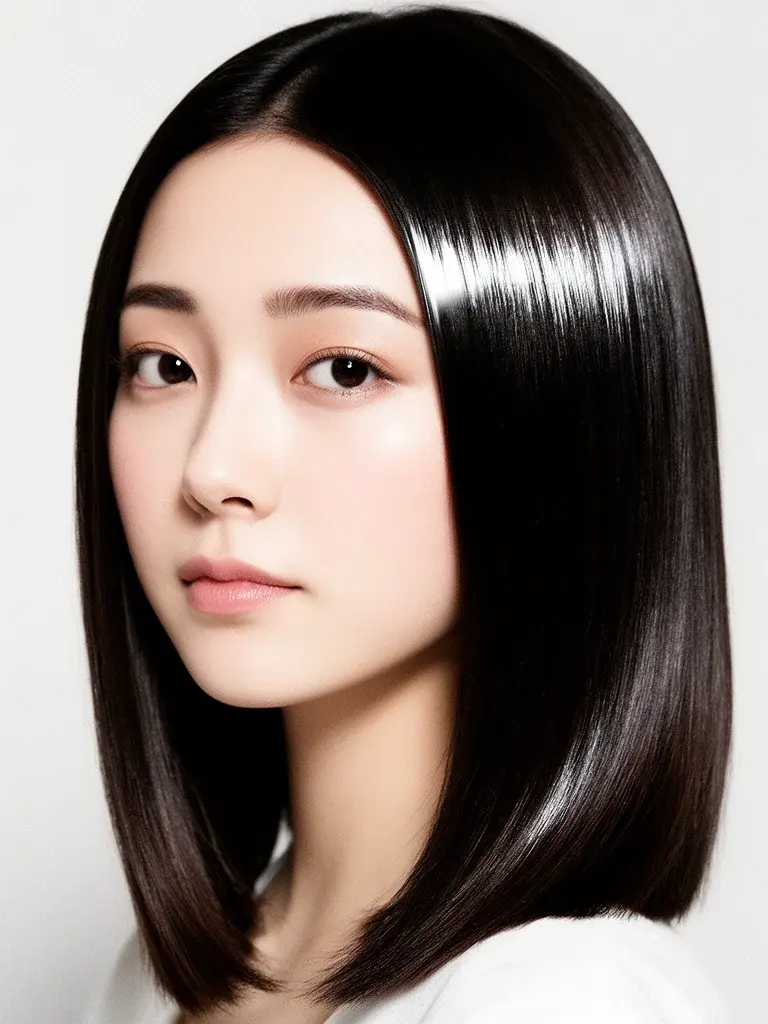
A collarbone-length, one-length cut with zero visible layers, a blunt weight line, and internal weight removal. The goal is a smooth, uniform sheet of hair that reflects light like glass — each strand lying in the same direction, the ends forming a single clean line.
This is the cut that the "glass hair" trend made famous. The term originated in 2017, fell out of fashion as the texture-forward era (wolf cuts, shags, layers-on-everything) took over, and is now returning for 2026 as a counterpoint. The current version is less severe than the 2017 original — a slightly softer blunt line, a bit more internal movement — but the philosophy is the same: simplicity, precision, shine.
Sleek Straight Medium vs Lob vs Classic Bob
| Sleek Straight Medium | Lob | Classic Bob | |
|---|---|---|---|
| Length | Collarbone | Collarbone (same) | Chin to jaw |
| Layers | None | Subtle face-framing possible | None or minimal |
| Texture | Smooth, straight | Versatile — can be straight or wavy | Versatile — straight or textured |
| Weight line | Blunt, crisp | Soft or blunt | Blunt, precise |
| Best hair type | Straight, fine | All types | Straight, wavy |
| Styling time | 0–5 min | 0–10 min | 0–5 min |
| Vibe | Polished, minimal | Versatile, modern | Classic, structured |
Bottom line: Sleek straight medium and lob are the same length but different philosophies. The lob is a versatile canvas that works with waves, curls, or straight styling. Sleek straight medium is committed to one look — smooth, shiny, precise. The classic bob is the same philosophy at a shorter length.
Cut Specifications
- Length: Collarbone — touching but not past; this is the sweet spot for swing without heaviness
- Layers: Zero — not subtle layers, not hidden layers, zero
- Weight line: Blunt and straight across — the clean bottom edge is the visual anchor of the entire style
- Internal thinning: Slide-cutting or thinning shears through the interior to remove bulk WITHOUT creating visible layers; the exterior remains a smooth sheet
- Cutting technique: Blunt-cut the perimeter, then thin internally — never point-cut the ends (point-cutting creates texture, which defeats the purpose)
- Face-framing: Optional — a few barely-there pieces at the cheekbone can soften the look without disrupting the one-length silhouette
- Trim cycle: Every 8–10 weeks — the blunt line degrades as ends split and fray
Color Pairing
- Rich single-process brunette: The definitive glass-hair color. A uniform dark brown (chocolate, espresso, or chestnut) reflects light in a continuous band from root to end. No variation to scatter the light. Maximum shine.
- Glossy black: The most dramatic version — jet black at medium length with a blunt cut creates the highest-contrast shine line. Works best on cool skin tones.
- Low-contrast balayage (2 shades max): If you want dimension, keep it subtle. A gentle melt from slightly darker roots to slightly lighter ends adds depth without breaking the uniform shine. More than 2 shades of difference scatters the light and kills the glass effect.
- Gloss treatment on any color: A salon gloss (clear or tinted) seals the cuticle and adds a reflective coating. For this style specifically, a gloss is not cosmetic — it's structural. Schedule one every 6–8 weeks.
Face Shape Tweaks
- Oval: Standard one-length at collarbone — the balanced proportions need no correction
- Oblong: Cut slightly shorter (above collarbone) so the horizontal weight line creates a visual break that shortens the face
- Heart: The vertical fall slims the wider forehead while the blunt line at collarbone adds visual width at the narrow lower face — flattering without modifications
- Square: The vertical lines soften the horizontal jawline — keep it longer (touching collarbone, not above) for maximum elongation
- Round: Proceed with caution — the lack of volume can make a round face look rounder; if you go sleek straight, keep it slightly longer than collarbone to elongate
- Diamond: Works well — the smooth fall softens angular cheekbones without competing visual elements
Hair Type Tweaks
- Straight: No modifications needed. Blow dry with a paddle brush for the smoothest result, or air-dry (naturally straight hair often air-dries glass-smooth with just a finishing oil).
- Fine: Leave the weight line fully blunt — no texturizing at the ends. Fine hair needs every strand for density. Ask for minimal internal thinning — fine hair doesn't need much bulk removed.
- Thick: Aggressive internal thinning is mandatory. Without it, thick one-length medium hair flares into a triangle shape. The exterior should look untouched; the interior should be significantly lighter.
Shine Without Grease
The glass-hair effect depends on controlling shine — too little and the hair looks dull, too much and it looks greasy. This balance is the style's core challenge.
- Blow dry downward, always: Point the nozzle down the hair shaft, following the direction of growth. This closes the cuticle layer flat, creating a smooth surface that reflects light. Blow drying against the grain (upward) roughens the cuticle and kills shine.
- Finishing oil on ends only, never roots: A pea-sized drop of lightweight oil (argan or jojoba) on the last 3 inches of hair adds glass-like shine. On the roots, the same oil creates a greasy look within hours. Mid-lengths can handle a tiny amount; roots need nothing.
- Dry shampoo as insurance, not rescue: Apply dry shampoo at the roots BEFORE your hair gets oily — in the morning after styling, not at midday when it's already flat. The preventive approach absorbs oil before it's visible.
- Avoid silicone-heavy products that build up: Silicone serums create initial shine but build up over washes, making hair progressively duller. Use water-soluble silicones or oil-based products that rinse clean. If your glass hair is getting duller over weeks, product buildup is the likely cause — use a clarifying shampoo once a month.
- Cold water final rinse: After conditioning, rinse with cool (not ice-cold) water for 30 seconds. The temperature contracts the cuticle, creating a smoother surface that reflects more light. Subtle but visible.
What to Tell Your Stylist
"One-length cut at collarbone, no layers at all. Internally thin it to remove bulk, but keep the exterior clean and smooth. Blunt weight line — I want the ends in a straight line. I'm going for glass hair."
Reference photo tips:
- Show photos of the specific shine level you want — "glass hair" ranges from subtle polish to literal mirror-finish
- Specify whether you want face-framing pieces or a completely uniform length
- Tell your stylist your natural texture — if it's straight, they'll cut differently than if you have subtle wave you plan to iron out
- Ask about their thinning technique — slide-cutting creates a more natural internal weight removal than thinning shears, which can create visible steps
- If your hair is thick, explicitly say "I need internal thinning" — some stylists avoid it unless asked
How to Style
Daily (0 minutes — naturally straight hair):
- Wash and condition
- Apply a drop of lightweight oil to damp ends
- Air dry
- Done — naturally straight hair at one-length with no layers often dries glass-smooth on its own
Daily (5 minutes — needs a touch-up):
- Blow dry with a paddle brush, nozzle pointing down the shaft
- One pass with a flat iron on medium heat for any sections that kinked while drying
- Light finishing oil on the ends
Polished (10 minutes):
- Blow dry completely with a paddle brush — work in sections, nozzle down
- Flat iron every section on lowest effective heat (300–350°F)
- Apply a finishing oil to ends
- A light mist of shine spray from 12 inches for the full glass effect
No-Heat Alternative:
- Wash, condition, and apply a leave-in smoothing cream to damp hair
- Part hair in center, smooth flat against head on both sides
- Wrap hair around your head in one direction (the "wrap" technique), pinning flat with bobby pins
- Cover with a silk scarf or silk pillowcase and sleep on it
- Unwrap in the morning — the hair dries straight and smooth from the tension of the wrap, with a subtle bend at the ends
Maintenance Schedule
- Week 1–2: Peak glass hair. Weight line is razor-sharp. Ends are sealed and reflective. This is the look to maintain.
- Week 3–4: Still polished. Ends are slightly less crisp but the one-length silhouette holds. No action needed.
- Week 5–6: Ends starting to show micro-splits. Still looks good from a distance but loses the mirror-finish up close. Consider a dusting (removing just the split ends, not changing the length).
- Week 7–8: The blunt line is softening. Ends look slightly uneven. Still a good cut, but the "glass" descriptor no longer applies.
- Week 9–10: Time to trim. The split ends have progressed enough that the weight line is ragged rather than crisp. Book your appointment.
If you color your hair:
- Gloss treatment every 6–8 weeks is nearly mandatory for glass hair — it seals the cuticle and boosts reflectivity
- Single-process roots: touch up every 4–5 weeks; regrowth on sleek hair is more visible than on textured styles
- If you have balayage: keep it low-contrast so the shine line stays continuous
Pro tip: Glass hair is 50% cut, 50% condition. If your hair is dry or damaged, no amount of oil or ironing creates true glass-level shine. Invest in a good conditioner and a monthly deep conditioning mask. Healthy hair reflects light naturally — damaged hair scatters it.
Common Mistakes
-
Adding "just a few layers" for movement Fix: Even subtle layers break the one-length silhouette and scatter the shine line. If you want movement, use styling technique (a slight bend with the iron at the ends) rather than structural layers. The whole point of this cut is zero layers.
-
Over-thinning the interior Fix: Internal thinning removes bulk, but too much creates visible steps and uneven density when you tuck the hair behind your ears. Ask for conservative thinning and come back for more if needed — you can always thin more, but you can't put hair back.
-
Point-cutting the ends Fix: Point-cutting creates a soft, feathered edge — the opposite of what glass hair needs. The perimeter must be blunt-cut for a crisp weight line. If your stylist automatically point-cuts, specifically say "blunt ends, straight across."
-
Using heavy conditioner on the roots Fix: Conditioner weighs hair down, and sleek straight medium already has zero volume. Apply conditioner mid-lengths to ends only. If your roots look limp by midday, you're conditioning too high on the hair shaft.
-
Flat-ironing on maximum heat daily Fix: Daily high-heat flat-ironing damages the cuticle — which destroys the shine you're trying to create. Use the lowest temperature that works (300°F for fine hair, 350°F for thick). Better yet, let naturally straight hair air-dry and save the iron for touch-ups only.