
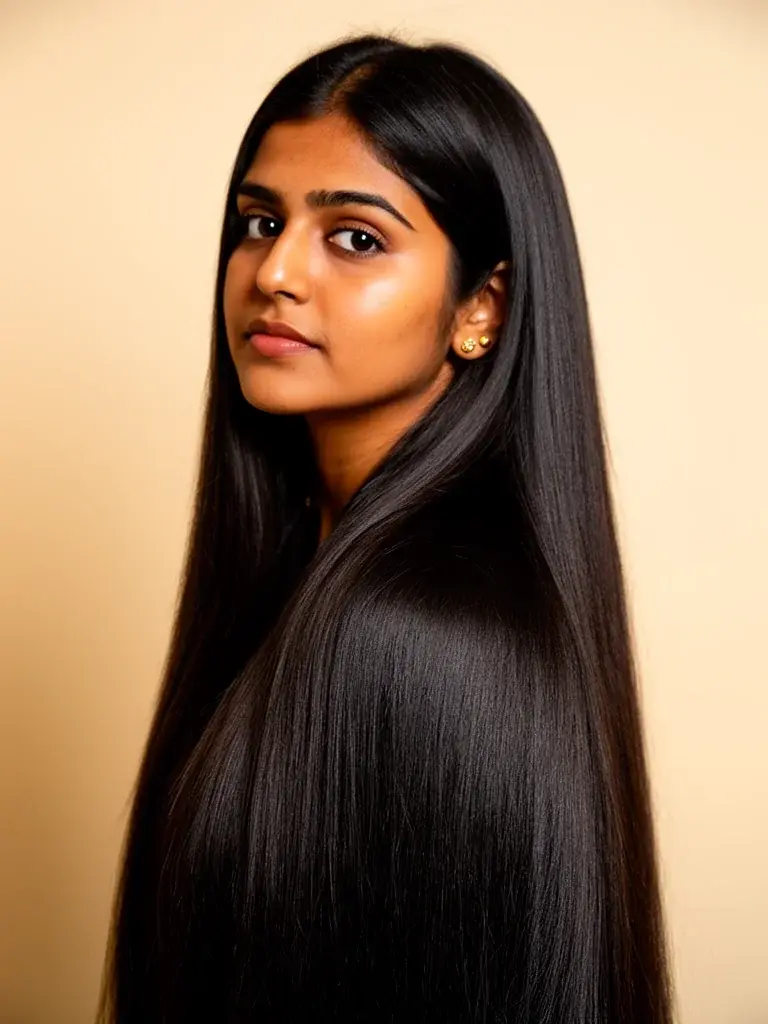
TL;DR
- Best for: Women committed to a multi-year growth journey who want dramatic, statement-making length
- Avoid if: You need frequent style changes or find daily hair management tedious
- Ask your stylist: "Dusting only — I'm growing. Take off the splits, nothing more. Less than half an inch."
- Maintenance: Micro-trim every 12-16 weeks; deep condition weekly; protective styles for sleeping
Who Does It Suit?
Rapunzel hair isn't a haircut — it's a long-term commitment. The question isn't whether your hair can grow long (most people's can), but whether your lifestyle supports the maintenance that super-long hair demands. Every inch past shoulder length multiplies the care requirements: more conditioning, more gentle handling, more time in the shower, more creative solutions for keeping it out of the way.
Ideal for:
- Patient women willing to commit 2-5 years to a growth journey without dramatic changes
- Anyone whose hair has already reached mid-back and wants to push further — you've proven your retention game works
- Women with desk jobs or flexible dress codes — rapunzel hair at work requires ponytails, braids, or buns most days
- Fine-haired women who've been told they can't grow long — fine hair is actually lighter per strand, putting less tension on follicles at extreme lengths
- The growing-out community (#rapunzelhair, #longhairjourney) — there's a supportive subculture that makes the patience more bearable
Hair types:
- Straight: The lowest-maintenance path to rapunzel length. Less tangling, less breakage from brushing, less moisture loss. Straight hair shows length most dramatically because there's no shrinkage
- Wavy: Grows well to extreme lengths but needs anti-frizz management. The wave pattern hides minor damage at the ends, which is actually an advantage — your hair looks healthy longer
- Thick: The most dramatic visual impact at rapunzel length — a thick curtain of hair that commands attention. The challenge: weight. Very thick waist-length hair is heavy. Headaches and neck strain are real concerns; lightweight updos and braids become essential daily tools
- Fine: Can absolutely reach rapunzel length — and often does faster than thick hair because there's less weight pulling on each follicle. The ends won't be as thick as thick-haired rapunzel styles, but a blunt or U-cut at the bottom keeps the perimeter from looking see-through
Avoid If...
- You change hairstyles seasonally → Rapunzel hair is a years-long commitment. Once you cut, the length is gone and the clock resets. If variety is more important than length, a versatile shoulder-length layers cut lets you change looks without growing for years
- You use heat tools daily → Daily flat iron or curling iron use will prevent your hair from ever reaching rapunzel length. The cumulative heat damage causes breakage that keeps a ceiling on length. If you love heat styling, blunt long hair at a maintainable length gives you a styled look without the growth struggle
- You swim frequently in chlorinated pools → Chlorine is the enemy of long hair retention. It strips moisture, weakens bonds, and turns light hair green over time. If swimming is non-negotiable, wear a silicone cap and pre-soak your hair with fresh water before every swim. Without protection, chlorine will keep you at shoulder length forever
- You have severe split-end problems → If your ends split visibly within 4-6 weeks of a trim, you have either a damage pattern or a protein deficiency that needs diagnosis before attempting rapunzel length. Growing damaged hair longer just moves the damage further from the root — the ends get progressively worse
- You find daily hair management tedious → At waist length, hair gets caught in car doors, sits on in chairs, falls in food, wraps around purse straps, and needs to be moved before every physical activity. It's not a background feature — it's an active part of your daily logistics. If that sounds exhausting instead of exciting, this isn't your style
What is Rapunzel Hair?
Rapunzel hair is a length descriptor, not a cut. It refers to hair that reaches waist length or beyond — the territory where length itself becomes the defining feature, overshadowing any particular cut, color, or styling choice. The name comes from the fairy tale, but the modern rapunzel community (#rapunzelhair has 101M+ TikTok posts) treats it as a practical achievement measured in milestones.
The milestones, measured at the longest point: Mid-back (bra-strap length, 22-26 inches) → Waist (28-32 inches) → Hip (34-38 inches) → Classic (past hips to tailbone, 40-46 inches) → Knee (48+ inches, extremely rare). Most women who set out to grow rapunzel hair target waist length as the primary goal — it's achievable for the majority of hair types and dramatically longer than average.
2026 has seen a resurgence of "modern rapunzel" aesthetics, driven by two forces: the anti-short-hair pendulum swing (after years of bobs and lobs dominating trends), and the "Glass Hair 2.0" movement that prizes mirror-like shine on long, one-length hair. The modern version isn't the fairy-tale maiden with floor-length locks — it's waist-to-hip-length hair that's meticulously maintained, worn in practical styles (braids, half-ups, low buns) on weekdays and let loose for impact when it matters.
Rapunzel Hair vs Blunt Long Hair vs V-Cut Layers
| Rapunzel Hair | Blunt Long Hair | V-Cut Layers | |
|---|---|---|---|
| Length goal | Waist or beyond (28+ inches) | Any long length (shoulder to mid-back) | Any long length |
| Cut involvement | Micro-trims only — no shaping | Regular blunt trim every 8-10 weeks | Layered shaping every 8-10 weeks |
| End density | Varies — depends on terminal thickness | Maximum — blunt line preserves all density | Tapered — thinnest at center back |
| Maintenance commitment | Multi-year growth journey | Standard salon schedule | Standard salon schedule |
| Visual impact | Length IS the statement | Sleekness and density | Shape and movement |
| Grow-out | Continuous growth, no target shape | Easy — line stays blunt | V shape softens to U over time |
| Heat styling compatible | Minimal — heat causes breakage | Yes | Yes |
Bottom line: Blunt long hair and V-cut are destinations — you reach the length and maintain the shape. Rapunzel hair is a journey — the length keeps going, and the shape is secondary to the growing.
Growth Milestones & Timeline
Rapunzel hair doesn't have "cut specifications" because there's no cut — there's a growth strategy. Hair grows an average of 6 inches per year (0.5 inches per month), but retention (preventing breakage) determines your actual progress.
- Starting point → Mid-back (22-26"): 1-2 years from shoulder length. This is where most women plateau — not because growth stops, but because friction breakage from clothing necklines and daily manipulation catches up with growth rate. Key milestone: when you need to move your hair before sitting back in a chair
- Mid-back → Waist (28-32"): 1-1.5 years. The critical retention phase — hair at this length is 3-4 years old at the ends. Deep conditioning weekly becomes mandatory, not optional. Your hair routine should now take 15-20 minutes per wash, not 5. Key milestone: your hair reaches the top of your jeans waistband
- Waist → Hip (34-38"): 1-1.5 years. The "lifestyle adjustment" phase — you're now managing hair that gets caught in everything. Sleep in a braid or bonnet nightly. Sitting on your own hair in chairs becomes a daily occurrence. Key milestone: strangers comment on your hair regularly
- Hip → Classic (40-46"): 1-2 years. Only achievable if your terminal length allows it. At this length, the oldest ends are 6-7 years old and extremely fragile. Trims should be microscopic (quarter-inch dustings). Few women attempt this without a dedicated long-hair community for support
- Classic → Knee (48+"): Rare. Most people's terminal length caps between hip and classic. Those who reach knee length typically have exceptional genetics and extremely disciplined care routines
Growth accelerators (evidence-supported): Scalp massage (increases blood flow to follicles, 4 minutes daily), biotin-rich diet (eggs, nuts, salmon — supplements only if deficient), minimal heat (air-dry when possible), satin pillowcase (reduces friction breakage by 30-40% vs cotton).
Growth myths (no evidence): Hair vitamins beyond what a balanced diet provides, inversion method, rice water (no long-term studies), castor oil on scalp (moisturizes but doesn't accelerate growth).
Color Pairing
- Virgin hair (uncolored): The fastest path to rapunzel length. No chemical processing means no weakened bonds, no dryness from developer, and no salon appointments that risk scissor-happy stylists. Your natural color at rapunzel length develops a beautiful gradient — slightly lighter at the ends from years of sun exposure, creating a natural ombré that can't be replicated in a salon.
- Single-process, close to natural: If you must color, stay within 2 shades of your natural color with a demi-permanent formula. Less developer damage, less maintenance, and root grow-out is nearly invisible. Avoid bleach entirely — bleached hair has a dramatically lower terminal breakage point.
- Subtle balayage on the bottom third: If you want dimension without risking the full length, hand-painted highlights on just the bottom third of your hair keeps the roots and mid-lengths virgin while adding visual interest at the ends. Since ends are trimmed over time, the colored section gradually refreshes. Zero root maintenance.
- Henna (for redheads and brunettes): Henna actually strengthens hair by coating the shaft — it's the one color treatment that can improve retention. The trade-off: it's permanent, it can't be lifted, and it limits future color options. But for rapunzel-aspirant women who want red tones, henna is the only color that's also a treatment.
Face Shape Tweaks
- Oval: Rapunzel hair flatters oval faces naturally — the length elongates without over-narrowing. You can wear it center-parted, side-parted, or pulled back without face-shape concerns
- Heart: The length adds visual weight below the chin, balancing a wider forehead. Avoid all-one-length — a slight U-cut at the bottom creates the fullest perimeter, which balances the narrow chin
- Oblong: Long hair can over-elongate an already long face. Counter this with waves or body in the mid-lengths (chin to collarbone) to add horizontal volume. Avoid stick-straight rapunzel hair on oblong faces — it creates a vertical column effect
- Diamond: The angular cheekbones are beautifully framed by super-long hair falling past them. Keep some face-framing softness (even just a few wispy pieces) to avoid the hair acting like a curtain that hides your best feature
- Round: Rapunzel hair elongates round faces — the extreme vertical length creates an oval illusion. Keep the volume close to the head (smooth, not fluffy) and avoid bangs that shorten the face further. A center part maximizes the elongating effect
Hair Type Tweaks
- Straight: The easiest path to rapunzel length — less tangling, less breakage points, less product needed. The main challenge is avoiding heat styling that would compromise retention. Air-dry with a leave-in conditioner, and you'll hit milestones on schedule
- Wavy: Protect the wave pattern — it's your natural texture advantage at length. Avoid brushing dry (use a wide-tooth comb on conditioned, wet hair only). The wave hides minor damage and split ends better than straight hair, buying you extra weeks between trims
- Thick: Weight management is your primary challenge. At waist length, thick hair can weigh over a pound — enough to cause headaches and tension alopecia if worn in tight styles. Use braids, not tight ponytails. Never use elastic bands without a fabric coating. Consider internal layers to reduce bulk without shortening the perimeter
- Fine: Moisture retention is the key. Fine hair dries out faster per strand (more surface area relative to volume), making ends brittle at extreme lengths. Deep condition weekly, use a leave-in on mid-lengths and ends daily, and apply oil to the last 3 inches before bed. Fine hair at rapunzel length can look stunning — it just needs more consistent hydration
Preventing Breakage at Length
At rapunzel length, the oldest strands are 4-7 years old. Every breakage-causing event from those years has accumulated. The battle isn't growing hair — it's keeping what grew.
- Sleep protection is non-negotiable: A satin or silk pillowcase reduces friction breakage by 30-40% compared to cotton. Better yet: sleep in a loose braid inside a satin bonnet. At waist length, unprotected hair wraps around your neck, gets trapped under shoulders, and rubs against sheets for 8 hours. That friction compounds every night.
- Detangle from ends up, never root down: Start 3 inches from the bottom, work out the knots, then move up another 3 inches. Brushing from root to tip on 30+ inches of hair tears through every tangle, snapping mid-shaft breakage points. A wide-tooth comb on conditioned hair or a wet-detangling brush — never a fine-tooth comb on dry hair.
- Minimize mechanical stress: Tight ponytails, metal clips, elastic bands without fabric coating, and hair wrapped around bag straps all create snapping points. Use fabric scrunchies, claw clips, and loose braids. At rapunzel length, your hair touches more surfaces than you realize — seat backs, car doors, desk chairs, kitchen counters. Awareness becomes a habit.
- The protein-moisture seesaw: Long hair needs both, but the ratio matters. Over-moisturized hair feels mushy and stretches without bouncing back. Over-proteinized hair feels stiff and snaps. Alternate between protein treatments (every 4-6 weeks) and deep moisture masks (weekly). If your hair feels gummy, it needs protein. If it feels straw-like, it needs moisture.
- Heat is the length ceiling: Every heat styling session weakens bonds at the application point. At rapunzel length, damage at the mid-shaft means the entire bottom half is compromised. If you want waist-length hair, commit to air-drying and heatless styling methods. One flat iron pass per month won't ruin your journey; daily heat styling will keep you at shoulder length forever.
What to Tell Your Stylist (About Trims)
"I'm growing my hair to waist length [or your target]. I need a dusting — just the split ends, nothing more. Please take off less than half an inch. I'd rather come back in 8 weeks than lose an inch today."
Reference photo tips:
- Bring a photo of your target length, not your target style. The goal of the appointment is maintenance, not transformation
- Show your stylist a photo of healthy waist-length hair ends — thick, blunt-ish, no visible thinning. This is the standard you're maintaining
- If your stylist suggests "just taking off 2 inches to even things up," say no. Uneven ends are fine during the growth phase. Evenness matters when you've reached your target length
- Request a dry dusting if available — the stylist can see splits more clearly on dry hair, and dry cutting removes less length than wet cutting (wet hair stretches, hiding how much is actually being cut)
- Ask your stylist to show you each trim section before cutting. Hold the strands between your fingers and look at how much they're removing. This isn't being difficult — it's preventing miscommunication about what "just a trim" means
How to Style
Daily (10 minutes):
- Detangle with a wide-tooth comb starting from ends, working up in 3-inch increments
- Apply a leave-in conditioner to mid-lengths and ends — skip the roots
- Choose a protective style for the day: loose braid, low bun with a claw clip, or half-up with a scrunchie
- For loose wear: part as desired, smooth flyaways with a tiny amount of hair oil on your palms, and let it hang. Move hair to the front of your shoulders before sitting in chairs
Polished (20 minutes):
- Detangle gently, apply leave-in conditioner and a light anti-frizz serum
- Blow dry on cool-to-medium setting with a paddle brush — focus on smoothing, not volume
- Use a boar bristle brush to distribute natural oils from mid-length to ends — this creates the "glass hair" shine that makes rapunzel length look intentional rather than neglected
- Finish with a few drops of lightweight hair oil, concentrating on the last 6 inches
- Wear down for impact, or style into a polished low chignon for a different kind of dramatic
No-Heat Alternative:
- Wash, condition heavily (5-minute mask on ends), and gently squeeze out excess water
- Apply leave-in conditioner + lightweight mousse for some hold
- Braid hair into 2-4 braids while damp (fewer braids = bigger waves, more braids = tighter waves)
- Let air dry completely — this may take hours at rapunzel length. Start before bed
- Unbraid in the morning for soft waves that add dimension and body to extreme length
- Finger-comb only — never brush out the wave pattern
Maintenance Schedule
- Week 1-4: Hair is at peak condition after your micro-trim. The ends are sealed, minimal splitting visible. Deep condition once per week. Sleep in a braid or bonnet every night.
- Week 5-8: First signs of split ends appearing on the oldest strands. This is normal — you're not trimming for another month. Continue the weekly deep condition. If you notice more tangles than usual, add a mid-week leave-in conditioner application on ends.
- Week 9-12: Splits are visible if you look for them, but they haven't traveled up the shaft yet. This is the window to schedule your next micro-trim. Don't wait until the splits are obvious from arm's length — by then they've traveled and you'll lose more length.
- Week 13-16: Maximum stretch between trims. Only continue past 12 weeks if your ends still feel smooth between your fingers. If they feel rough or catch when you run your fingers through, book the trim immediately — every week of delay means more length lost when you do cut.
If you color your hair:
- Demi-permanent or henna: minimal impact on trim schedule
- Permanent color: the chemical processing makes ends more fragile. Shorten your trim interval to 10-12 weeks instead of 12-16
- Bleached sections: trim every 8-10 weeks. Bleached ends at extreme length are the most fragile combination possible
Pro tip: Keep a hair journal. Log your trim dates, how much was taken, and how your ends felt. After 3-4 trims, you'll know your personal optimal trim interval — the sweet spot between "too early" (losing unnecessary length) and "too late" (splits forcing a bigger cut).
Common Mistakes
-
Trimming too much, too often Fix: More than half an inch per trim is too much for the growth phase. At 6 inches of growth per year, 1-inch trims every 8 weeks means you're only netting 2.5 inches per year — the journey doubles in length. Ask for "dusting" not "trim." If your stylist can't do precision micro-trims, find one who can. Long-hair specialists exist.
-
Wearing tight ponytails daily Fix: Tight elastic ponytails create a breakage point at the exact same spot every day — you'll develop a visible thinning ring. Use fabric scrunchies, claw clips, or loose braids instead. If you must ponytail, change the height daily (high one day, low the next) to distribute the stress across different points of the hair shaft.
-
Neglecting protein treatments Fix: Long hair needs structural protein to maintain strand integrity at extreme lengths. Hair is made of keratin protein, and years of washing, friction, and environmental exposure depletes it. A protein treatment every 4-6 weeks (bonding treatment, keratin mask, or rice water rinse) rebuilds strand strength. Without protein, hair becomes elastic and mushy — the precursor to mid-shaft snapping.
-
Comparing your timeline to others Fix: Growth rate (4-8 inches per year), terminal length, and starting condition vary enormously. Instagram and TikTok rapunzel accounts rarely show the 3-5 year journey — they show the result. Your hair grows at its own pace. Track your own milestones instead of comparing to someone whose genetics, hair type, and starting length are different from yours.
-
Skipping the silk pillowcase Fix: Cotton pillowcases create friction that snaps mid-shaft hairs all night, every night. At rapunzel length, you're sleeping on 2-3 feet of hair — that's a lot of surface area grinding against cotton for 8 hours. A satin or silk pillowcase costs $15-30 and is the single highest-ROI purchase for hair retention. It's not luxury — it's infrastructure.