TL;DR
- Best for: Anyone who wants bangs without the weight — small foreheads, K-beauty aesthetic, fine hair that can't handle dense fringe
- Avoid if: Thick curly hair (3A+) that clumps rather than separating, or you want real forehead coverage
- Ask your stylist: "See-through bangs — take hair from a very shallow section, no more than half an inch deep, point-cut to just above my eyebrows. I want to see my forehead through them."
- Maintenance: Trim every 4–5 weeks; the few strands grow noticeably fast
Who Does It Suit?
See-through bangs are the lowest-commitment fringe option. They work on almost everyone because they add so little and remove nothing.
Ideal for:
- Small foreheads that get overwhelmed by heavier bang styles
- K-beauty and minimal aesthetic lovers who want subtle face-framing
- Anyone who's tried bangs before and found them too heavy, too hot, or too high-maintenance
- Fine hair that looks thin with denser bang cuts
- First-time bang experimenters who want a reversible starting point
Hair types:
- Straight: The classic canvas — individual strands lie flat and separate naturally, creating the most defined see-through effect
- Wavy: Natural wave creates organic gaps between strands — some consider this the most flattering version because the separation looks effortless
- Fine: Ideal texture — fine strands are light enough to stay wispy without product
- Thick: Works if cut from a very narrow section — thick individual strands actually create great definition
Avoid If...
- Very tight curls (3A–4C) → strands cluster together when dry, eliminating the see-through effect; face-framing layers give a similar softening without fighting curl physics
- You want full forehead coverage → see-through bangs are deliberately transparent; blunt bangs or curtain bangs provide actual coverage
- You sweat heavily on your forehead → the few strands stick to damp skin and look stringy; heavier bangs with more mass hold their shape better when wet
- Your hair is extremely coarse → coarse strands don't stay light and wispy; they stick out rather than draping
- You live in high humidity without straightening → humidity causes the few strands to frizz individually, which is more noticeable than frizz in denser bangs
What are See-Through Bangs?
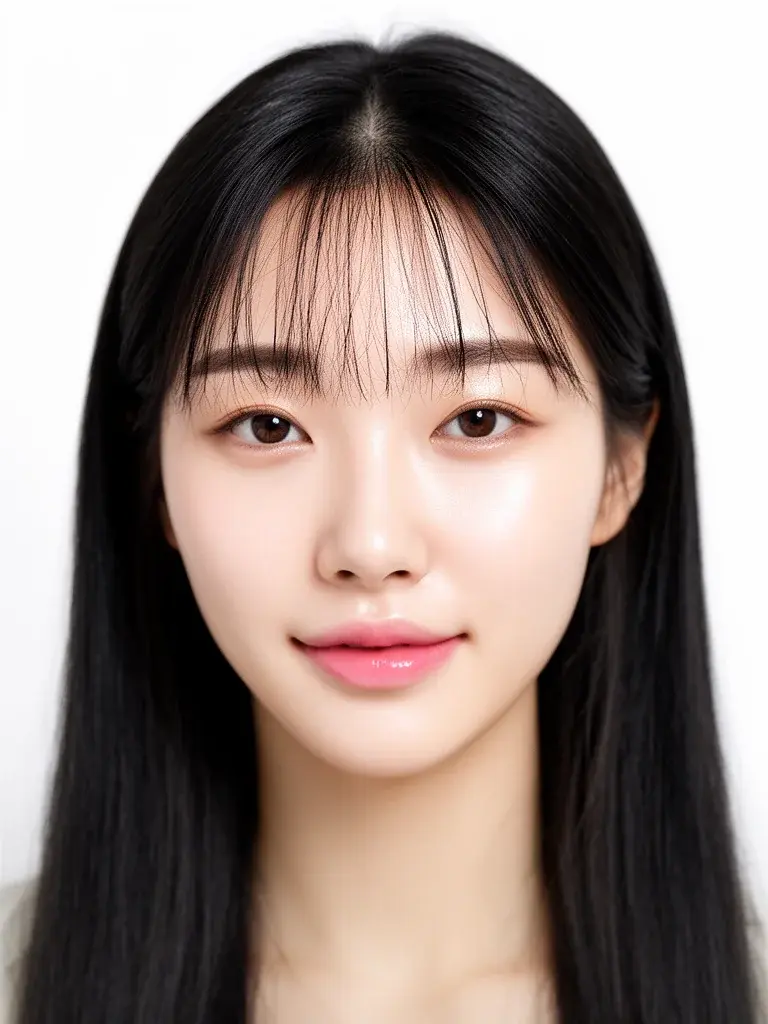
See-through bangs are an ultra-thin fringe cut from a very shallow section of hair at the front of the hairline. The defining characteristic: you can see the forehead through the bangs. Where blunt bangs create a wall, and curtain bangs create a frame, see-through bangs create a veil — barely-there strands that skim the forehead without hiding it.
The style originated in Korean beauty culture, where it's called "air bangs" (공기 앞머리). The aesthetic intent is the opposite of Western heavy bangs: rather than making a statement, see-through bangs are designed to look almost accidental — like a few wisps escaped from an updo. They soften the face and shorten a tall forehead without the visual weight or commitment of a full fringe.
What makes them structurally different from other bangs is the amount of hair involved. Blunt bangs use a section 2–3 inches deep from the hairline. Curtain bangs use 1–2 inches. See-through bangs use less than half an inch — sometimes just a single row of hair at the very front of the hairline. This extreme thinness is the point, not a flaw.
See-Through Bangs vs Wispy Bangs vs Curtain Bangs
| See-Through Bangs | Wispy Bangs | Curtain Bangs | |
|---|---|---|---|
| Thickness | Extremely thin — forehead visible | Thin but more coverage than see-through | Medium density with center part |
| Parting | Optional — can center part or wear straight across | Usually straight across, slightly irregular | Always center-parted |
| Forehead coverage | 10–20% — more veil than curtain | 40–60% — soft coverage | 50–70% — more coverage with cheekbone framing |
| Maintenance interval | Trim every 4–5 weeks | Trim every 5–6 weeks | Trim every 5–6 weeks |
| Grow-out difficulty | Easiest — barely noticeable | Easy — blends into layers | Easy — becomes face-framing layers |
| Best for | K-beauty minimalists, small foreheads | Anyone wanting softness without commitment | Universal — suits everyone |
Bottom line: See-through bangs = the most minimal fringe possible. Wispy bangs = soft coverage with texture. Curtain bangs = the most structured and flattering on all face shapes. See-through is for people who want the idea of bangs rather than the full experience.
Cut Specifications
See-through bangs are a modifier — they add onto your existing base haircut, same as any other fringe.
- Section depth: Take hair from no more than 0.5 inches back from the front hairline. This is the single most important measurement. More depth = more hair = not see-through anymore. When in doubt, take less.
- Width: Temple to temple (full width) or concentrated at the center third of the forehead. K-beauty style usually covers the full width; Western adaptations sometimes concentrate the strands at center.
- Length: Just at or slightly above the eyebrows — about 2.5–3 inches from the root. Longer and they lose the airy quality; shorter and they look like they were cut by accident.
- Cutting technique: Point-cut every strand individually. Never blunt-cut see-through bangs — a blunt line on this few strands looks like a mistake. Each strand should taper to a different length for organic separation.
- Thinning: If the section still looks too dense after point-cutting, use thinning shears at the mid-lengths of each strand. The goal is individual strands that don't touch each other.
- Trim cycle: Every 4–5 weeks. With so few strands, even a quarter inch of growth changes the look noticeably — they go from "above eyebrows" to "in your eyes" faster than denser bangs.
Color Pairing
- Face-framing babylights: Ultra-fine highlights painted onto the see-through bang strands themselves. On dark hair, this creates a luminous veil effect — each strand catches light individually. The most K-beauty-aligned color option.
- Monochrome gloss: A clear or tinted gloss treatment makes the few strands ultra-shiny and reflective. The glass-hair effect is amplified on see-through bangs because each strand is isolated and visible.
- Natural base, no color: Often the best choice. See-through bangs are already minimal — adding color complexity can overwhelm the subtlety. If your base color is solid, the bangs blend seamlessly.
- Soft ombré or shadow root: If you already have a dark-to-light gradient, the bangs will pick up the lightest shade at the tips. This creates a natural sun-kissed effect on the fringe without any additional coloring.
Face Shape Tweaks
- Oval: Standard see-through bangs at eyebrow length — no adjustments needed, this face shape works with any fringe
- Round: Keep bangs slightly longer (just past eyebrows) and wispy at the outer edges — the vertical lines created by the sparse strands elongate a round face
- Heart: Concentrate the see-through strands at the center of the forehead — this narrows the upper face visually and draws attention to the eyes
- Square: Point-cut the strands at varying lengths to create softness — uniform-length see-through bangs on a square face can echo the angular jawline
- Diamond: See-through bangs at full temple-to-temple width soften the cheekbones — keep the center strands slightly shorter than the sides
Hair Type Tweaks
- Straight: The easiest texture for see-through bangs. Strands naturally separate and lie flat. Minimal styling needed — a quick finger-comb after washing is enough.
- Wavy (2A–2B): Waves create natural gaps between strands, which enhances the see-through effect. Cut 0.25 inches longer than target length to account for shrinkage when the wave sets.
- Fine: The ideal candidate. Fine strands are light and airy by nature — they stay separated without effort. Don't thin the strands further or they'll disappear entirely.
- Thick: Take hair from an even shallower section (0.25 inches from the hairline) and thin aggressively. Individual thick strands create bold see-through lines — a different aesthetic than fine strands but equally striking.
Making See-Through Bangs Last All Day
See-through bangs have one weakness: they're so light that they don't hold their shape on their own. Here's how to make them behave from morning to night.
- Morning foundation: After washing, isolate the bang strands and blow dry them first — straight down, round brush optional. If you let them air-dry mixed with the rest of your hair, they get tangled into the longer layers and lose their separation.
- The forehead oil problem: Your forehead produces oil all day. See-through bangs sit directly on that oil. By midday, they can look stringy or greasy. Fix: dust a tiny amount of translucent powder on your forehead before the bangs settle in the morning — not on the hair, on the skin. This absorbs oil before it reaches the strands.
- Wind management: Dense bangs resist wind. See-through bangs don't — a gust scatters them everywhere. If you're outdoors, a light mist of flexible-hold spray (not hard-hold) keeps the strands in their approximate formation without making them stiff.
- Humidity defense: Humidity makes individual strands frizz independently, which is more visible when you only have a few of them. A tiny dab of anti-frizz serum — emphasis on tiny, spread between fingertips first — smoothed along each strand prevents this.
- Evening refresh: By evening, the bangs may have flattened against your forehead. Lift them with your fingers, mist with water, and smooth back into place. Takes 10 seconds. Or embrace the slightly disheveled end-of-day look — it's honest and often more flattering than trying to maintain perfection.
What to Tell Your Stylist
"I want see-through bangs — Korean air bangs style. Take hair from less than half an inch back from my hairline, full width temple to temple. Point-cut each strand to just above my eyebrows. I want to see my forehead through them — if you can't see skin, it's too thick."
Reference photo tips:
- Bring K-drama or K-pop reference photos — these show the authentic see-through density better than Western fashion editorial
- Zoom in on the forehead area and point to the transparency level you want — "I want to see this much skin through the bangs"
- Tell your stylist "less is more" and mean it — the biggest mistake is cutting too many strands. You can always add more on a follow-up visit
- If your hair is thick, explicitly say "take from a very shallow section" — stylists accustomed to Western bangs instinctively take more hair than see-through bangs need
- Ask for a dry-cut finish on the bangs — you need to see the true density and separation before leaving
How to Style
Daily (1 minute):
- Separate the bang strands from the rest of your hair with your fingers
- Blow dry just the bangs straight down with a round brush or your fingers — low heat, 30 seconds
- Gently separate any strands that clumped together — you want visible gaps between them
- Style the rest of your hair as normal
Polished (3 minutes):
- Wash or wet just the bangs (lean over the sink)
- Blow dry with a mini round brush, rolling the ends very slightly inward
- Use a tiny flat iron (mini plates) to smooth each strand individually — 2 seconds per strand
- Mist with lightweight flexible-hold spray from 12 inches away
- Ensure the separation is visible — adjust any strands that clustered together
No-Heat Alternative:
- Wet the bang strands with a spray bottle
- Smooth each strand flat against the forehead with your fingers
- Pin each section flat with mini bobby pins (or a single clip across the whole fringe)
- Let air dry for 10–15 minutes
- Remove pins — the strands will hold their flat, separated shape
Maintenance Schedule
- Week 1–2: Bangs are at ideal length. The see-through effect is perfect — sparse, airy, just above the eyebrows.
- Week 3–4: Bangs are growing into the eyes. The see-through effect is still intact but the strands are hitting your lashes. You're probably pushing them aside more often. Time to book a trim.
- Week 4–5: Trim time. Without a trim, the strands are long enough to poke your eyes and lose their floating, airy quality. They start to look like overgrown fringe rather than intentional see-through bangs.
- Week 6+: The bangs have become long wisps blending into your face-framing layers. If you're growing them out, this is the easiest grow-out of any bang style — barely noticeable. If you want to keep them, you're overdue.
If you color your hair:
- Babylights on the bang strands: refresh every 8–10 weeks. The trims between color sessions are too small to remove noticeable color.
- Full highlights or balayage: follow your normal schedule. See-through bangs are such a small amount of hair that color maintenance on them is negligible.
- Single process: the bangs get trimmed before roots show, so color grow-out is essentially invisible on the fringe.
Pro tip: Learn to trim see-through bangs at home. It's the easiest fringe to DIY because there are so few strands. Hold each strand individually, point-cut tiny amounts. You're removing millimeters, not inches. A pair of sharp haircutting scissors ($15) pays for itself in two saved salon visits.
Common Mistakes
-
Cutting too many strands Fix: The single most common mistake. See-through bangs should use hair from less than half an inch of depth from the hairline. If your stylist takes more, you'll get wispy bangs — nice, but not see-through. Say "I want to count individual strands" and show a reference photo with visible forehead skin.
-
Using conditioner on the bangs Fix: Conditioner adds weight and moisture that see-through bangs can't handle. They'll flatten against your forehead and look greasy within hours. Only shampoo the bang strands — skip conditioner entirely on the fringe section. The rest of your hair gets conditioner as normal.
-
Expecting them to work like regular bangs Fix: See-through bangs don't "frame" or "cover" — they float. If you want your forehead hidden, you need a different bang style. See-through bangs suit people who want to add a subtle detail, not people who want to change their face shape dramatically.
-
Ignoring the forehead oil factor Fix: Your forehead produces oil constantly. See-through bangs sit on that oil all day and get stringy. Prevention: translucent powder on the forehead in the morning, dry shampoo on the bang strands at midday. Both add less than 30 seconds to your routine and make the difference between fresh-looking and greasy-looking fringe.
-
Blunt-cutting instead of point-cutting Fix: A straight-across line on see-through bangs looks like a mistake — like someone cut three strands at the same length. Every strand needs to be a slightly different length to create the organic, wispy separation. Always request point-cutting. If your stylist doesn't know the term, say "cut each strand to a slightly different length so they don't form a line."