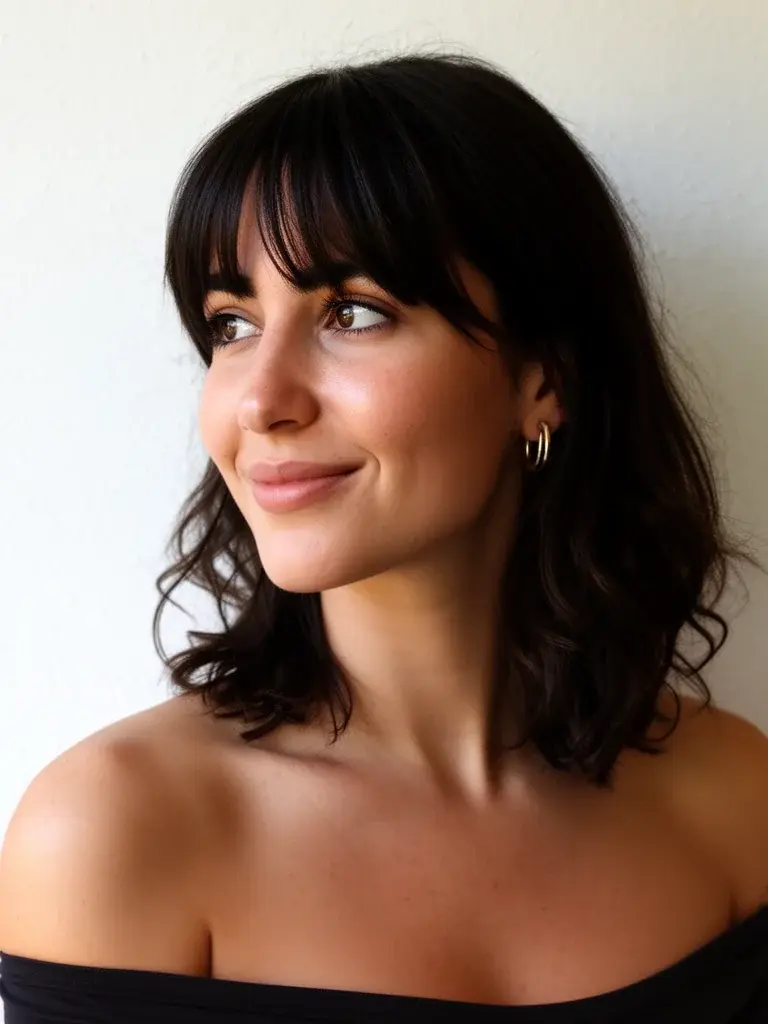

TL;DR
- Best for: Fine hair that goes flat with dense fringe; bangs-curious people who don't want full commitment; faces needing forehead coverage without visual weight
- Avoid if: You have very oily skin at the hairline; your hair is very thick and you won't thin the fringe section
- Ask your stylist: "Wispy bangs — point-cut or razor-cut at eyebrow level, with separated strand texture. Not blunt, not dense. Light and individual."
- Maintenance: Trim every 4–6 weeks to keep them from growing into your eyes; grow-out is graceful
Who Does It Suit?
Wispy bangs are the most versatile fringe style because the lack of density means they work with more face shapes and hair types than any other bang style.
Ideal for:
- Heart and oval faces — The soft forehead coverage shortens the perceived face length without adding visual weight
- Oblong and square faces — Breaking up the vertical forehead line with even light fringe creates horizontal balance
- Fine hair — The separated strand quality is natural on fine hair; it's the goal, not a limitation
- Anyone wanting a subtle change — Wispy bangs change the overall look without a dramatic transformation; they're the safest bang option
- Women who've had bad bang experiences — The grow-out is the most forgiving of any fringe style
Hair types:
- Fine: Ideal. Natural strand separation looks exactly right without extra effort
- Straight: Works very well. The lack of wave means strands fall predictably and stay separated
- Wavy: Works with technique — ask for point-cutting that accounts for slight wave, which can make the bangs curl up more than expected
- Thick: Works with significant thinning of the bang section. Without it, wispy is hard to achieve
Avoid If...
- You have a round face and want to shorten it further → wispy fringe shortens face length; a Side-Swept Bang creates asymmetry that's more flattering on round faces
- You have very oily skin at the hairline → any fringe including wispy will look greasy faster; scalp care routine is essential
- Your hair is very thick and you refuse any thinning → dense hair section can't achieve true wispy separation without thinning
- You want fringe that frames the face → wispy bangs sit on the forehead, they don't curve outward; Curtain Bangs frame the face around the eyes and temples
- You're growing your hair and want zero interruption to length → bangs always require commitment to the grow-out phase even when that phase is relatively easy
What are Wispy Bangs?
Wispy bangs are a fringe style where the strands are point-cut or razor-cut to create visible separation between individual hairs — the opposite of the dense, wall-like quality of blunt-cut bangs. Rather than a continuous sheet of fringe, wispy bangs are a collection of individual strands that brush the forehead lightly, with gaps of skin visible between them.
The technique that creates this look is point cutting: holding scissors vertically into the end of the fringe section and cutting at irregular angles rather than straight across. This removes weight from the tips and disconnects strands from each other. Razor cutting achieves a similar result with even softer edges — each strand tapers to a fine point rather than ending bluntly.
The result is fringe that sits lightly on the forehead without adding visual density. On fine hair, the effect is particularly natural — fine hair has fewer strands per section, so point cutting creates the wispy quality with minimal intervention. On thick hair, the stylist needs to reduce the density of the bang section before point cutting.
Wispy Bangs vs Curtain Bangs vs Blunt Bangs
| Wispy Bangs | Curtain Bangs | Blunt Bangs | |
|---|---|---|---|
| Cut technique | Point-cut/razor, separated ends | Layered, center-parted | Horizontal scissors, uniform ends |
| Forehead coverage | Partial — gaps visible | Partial — sweeps outward | Full — covers brow to brow |
| Best for fine hair | ✅ Ideal | ✅ Good | ⚠️ Goes flat easily |
| Best for thick hair | ⚠️ Needs thinning | ✅ Good | ✅ Density is the feature |
| Grow-out difficulty | Easy — natural-looking | Moderate | Hard — looks obviously grown-out |
| Maintenance | Every 4–6 weeks | Every 4–6 weeks | Every 3–4 weeks |
Bottom line: Wispy = light and textural, most forgiving. Curtain = framing and face-shaping. Blunt = bold, high-maintenance, high-impact.
Cut Specifications
- Length: Eyebrow level is classic. Can be cut to just above the brow (shorter) or between the brow and lash line for a longer, more veil-like effect
- Technique: Point cutting (scissors held vertically) or razor cutting. Not horizontal scissor cuts
- Section width: Narrow — approximately 2–3 inches at the hairline. Not a full brow-to-brow section like blunt bangs
- Density: Reduced. If hair is thick, the stylist should remove interior bulk before shaping
- Texture: Each strand should taper to a fine tip rather than ending in a blunt line
- Trim cycle: Every 4–6 weeks before they reach the lashes; sooner if fast growth
Color Pairing
- Face-framing highlights: Light pieces specifically through the bang section create dimension and emphasize the strand separation that defines the style
- Tonal color: A subtle tonal treatment that's 1–2 shades lighter on the bang section only adds a soft highlighted-from-the-sun quality
- Dark, rich single process: Deep espresso or near-black makes the individual strands sharper and more visible against the skin — the wispy texture reads very clearly on dark hair
Face Shape Tweaks
- Oval: Standard wispy bangs at brow level. Any variation works
- Heart: Keep them at or just above the brow to cover more of the wider forehead. Avoid very short wispy bangs above the brow line
- Oblong: The forehead coverage breaks vertical emphasis. Keep them a bit longer — between brow and lash line — for more visual width
- Square: Ask for slightly longer wispy bangs (between brow and lash) and ensure the section is slightly wider than the brow arch to create softening coverage over the squared corners
- Round: Be cautious — wispy bangs sit on the forehead and add horizontal coverage that can shorten the face. Consider side-swept bangs instead if your round face feels too wide
Hair Type Tweaks
- Fine: No adjustment needed. This is the reference hair type for wispy bangs
- Straight: Works perfectly. Straight strands fall predictably and maintain the separated quality
- Wavy: Ask for slightly longer wispy bangs — wave shrinkage will pull them up by 0.5–1cm when dry. Diffuse or blow-dry lightly to control the wave direction at the forehead
- Thick: The stylist must thin the bang section before point cutting. Ask specifically for "thinning scissors through the bang section before shaping the ends"
The Grow-Out Guide (6 Stages)
Wispy bangs are the most forgiving to grow, but knowing the stages helps you manage the process.
- Stage 1 — Fresh cut (0–3 weeks): Eyebrow level. Wispy, light, exactly as intended
- Stage 2 — Longer eyebrow (3–6 weeks): Reaching the upper lash line. Still looks intentional — this is actually many people's favorite length for wispy bangs
- Stage 3 — Lash line (6–9 weeks): At the lashes. Starts to feel like it needs a decision: trim back or start growing
- Stage 4 — Just past lashes (9–12 weeks): Can be swept to the side with minimal bobby pin assistance. Looks intentional if swept; awkward if hanging
- Stage 5 — Upper cheek (3–5 months): Now behaving like a longer face-framing layer. Can be tucked behind the ear or incorporated into a curtain-bang style if you're growing toward that
- Stage 6 — Blend-in (5–7 months): Long enough to fully incorporate into the rest of the hair as face-framing layers. Grow-out complete
What to Tell Your Stylist
"I want wispy bangs — point-cut or razor-cut, eyebrow level, thin and separated. Not blunt, not dense. I want visible gaps between the strands. [If thick: thin the bang section before shaping.]"
Reference photo tips:
- Look for photos taken in natural, diffused light — studio light can make any bang look denser than it is
- Find photos that show the forehead skin visible between strands — that gap is the key visual indicator of true wispy bangs
- Avoid photos where the bangs are fresh from a salon blowout — wispy bangs look different when just styled versus air-dried; choose photos that show the air-dried result
How to Style
Daily (3 minutes):
- Brush damp bangs forward with a small round brush or paddle brush
- Blow-dry on low heat with a concentrator nozzle, directing strands downward
- Run fingertips through to separate strands once dry
- Optional: a light hold spray or setting spray to keep in place
Polished (5 minutes):
- Blow-dry as above
- Use a flat iron at low heat (150°C / 300°F) — a single pass downward to smooth without completely flattening the texture
- Use a spoolie or eyebrow brush to separate and set individual strands
No-Heat:
- Comb damp bangs forward
- Pin across the forehead with bobby pins at the direction you want them to fall, or use a headband to hold them flat
- Let dry naturally — remove pins when fully dry to reveal the set direction
Maintenance Schedule
- Week 1–2: Ideal length and texture. Strands brush the forehead cleanly
- Week 3–4: Growing toward the lash line. Still excellent; many prefer this slightly longer look
- Week 5–6: Reaching the lashes. Time to decide: trim or start the grow-out intentionally
- Week 7–8: Past the lashes. Looking overgrown if you intend to keep them at brow level
Growing out:
- Once you decide to grow, resist the urge to trim — each trim restarts the grow-out clock
- Use clips, pins, or a half-up style to manage the in-between phase
- When they reach upper cheek length, they start behaving as face-framing layers naturally
Pro tip: If you want to maintain wispy bangs but not make full-length appointments, ask your stylist for a "bang trim only" service — usually 10–15 minutes and significantly less expensive than a full cut.
Common Mistakes
-
Asking for "light bangs" without specifying the cut technique Fix: Say "point-cut" or "razor-cut" explicitly. Without the technique specification, some stylists will cut a lighter blunt fringe, which is not the same thing as wispy separation.
-
Trying to get wispy bangs on very wet hair Fix: Wispy bangs should be cut on damp or dry hair, not soaking wet. Very wet hair stretches and the strands look longer than they are — the cut will be shorter than you expected when dry.
-
Using heavy product on wispy bangs Fix: Serum or oil makes wispy strands clump together, looking like a few greasy strands rather than delicate fringe. Use a light setting spray or nothing at all.
-
Getting too wide a section Fix: Wispy bangs work because the section is narrow — 2–3 inches. A wider section becomes a curtain bang or blunt bang depending on how it's cut. Be clear about width: "A narrow section, not across the full brow."
-
Over-trimming the grow-out Fix: During grow-out, many people trim wispy bangs back to their original length multiple times, never fully committing to growing. Decide once: maintain them or grow them, then commit.