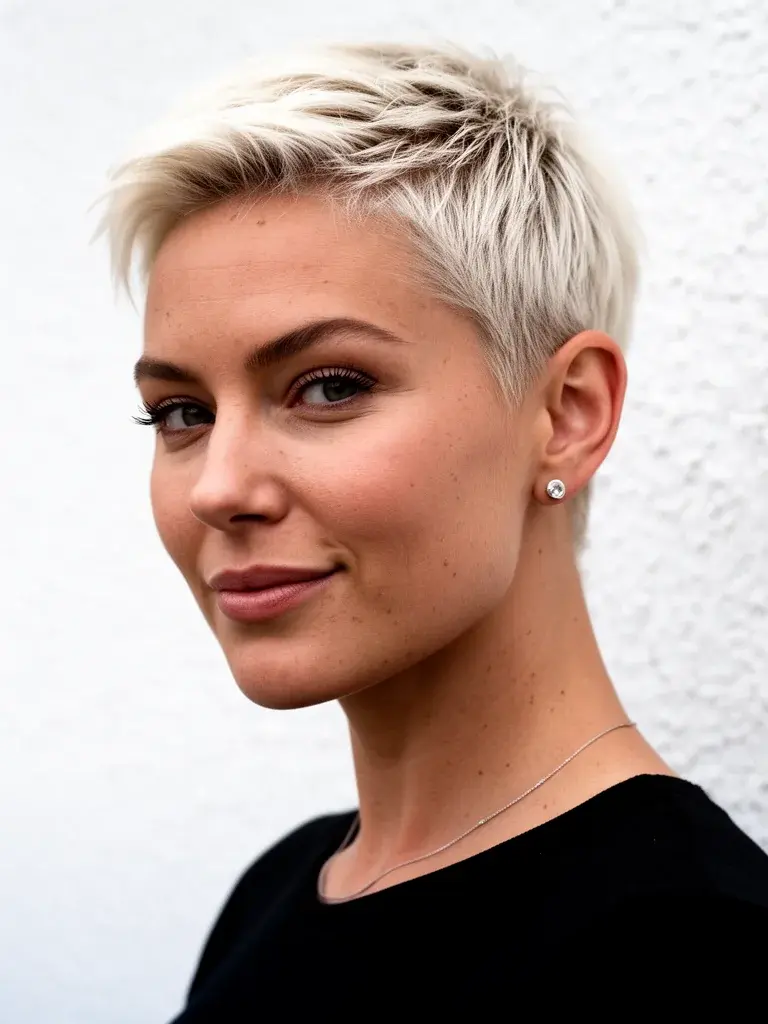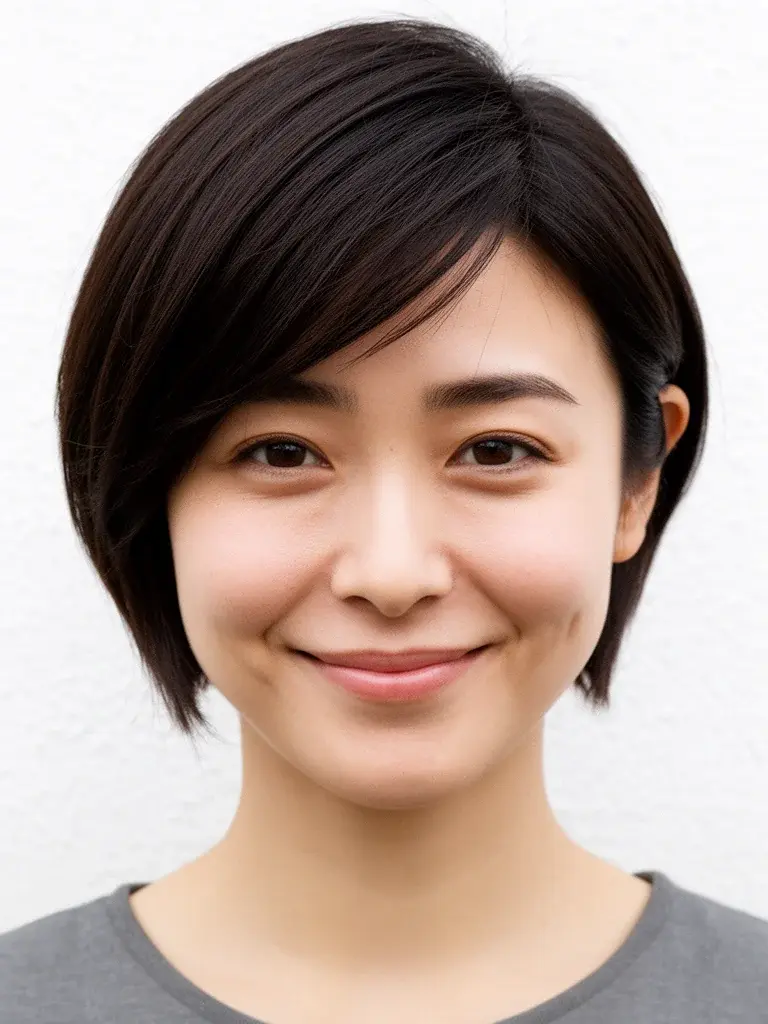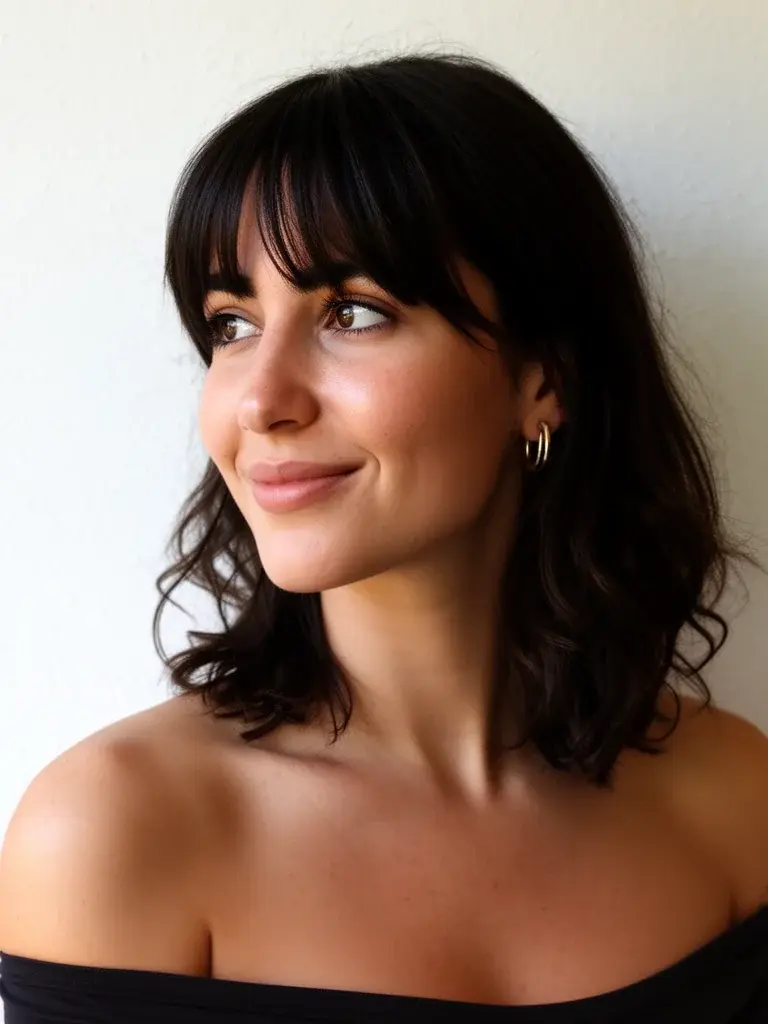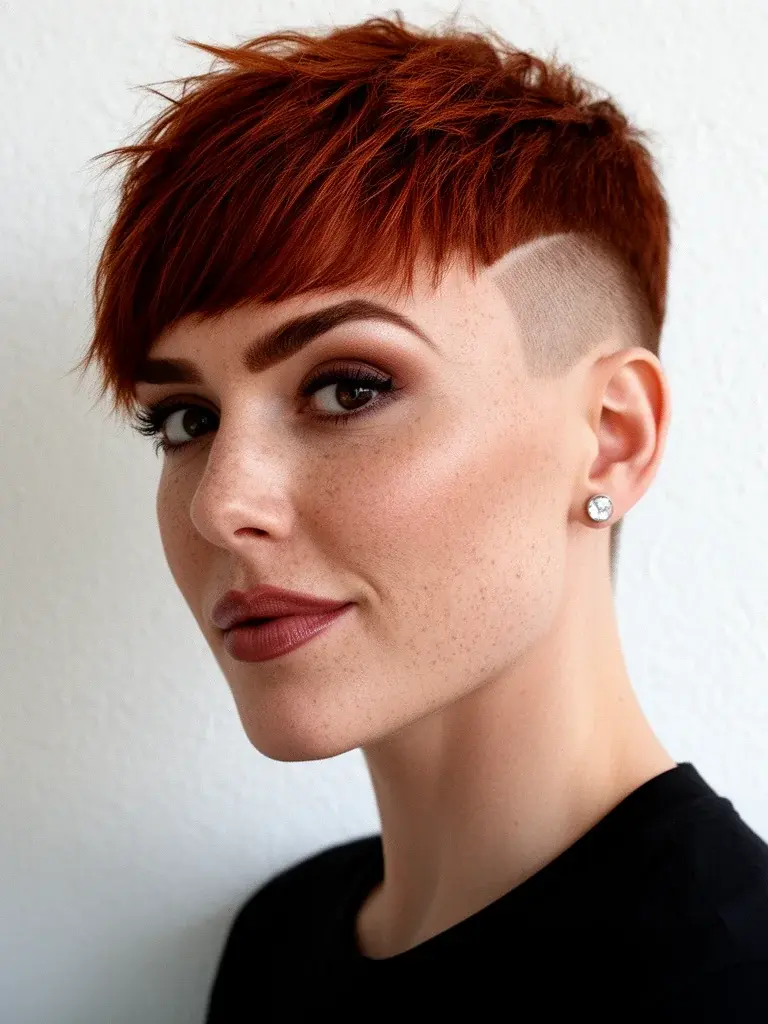
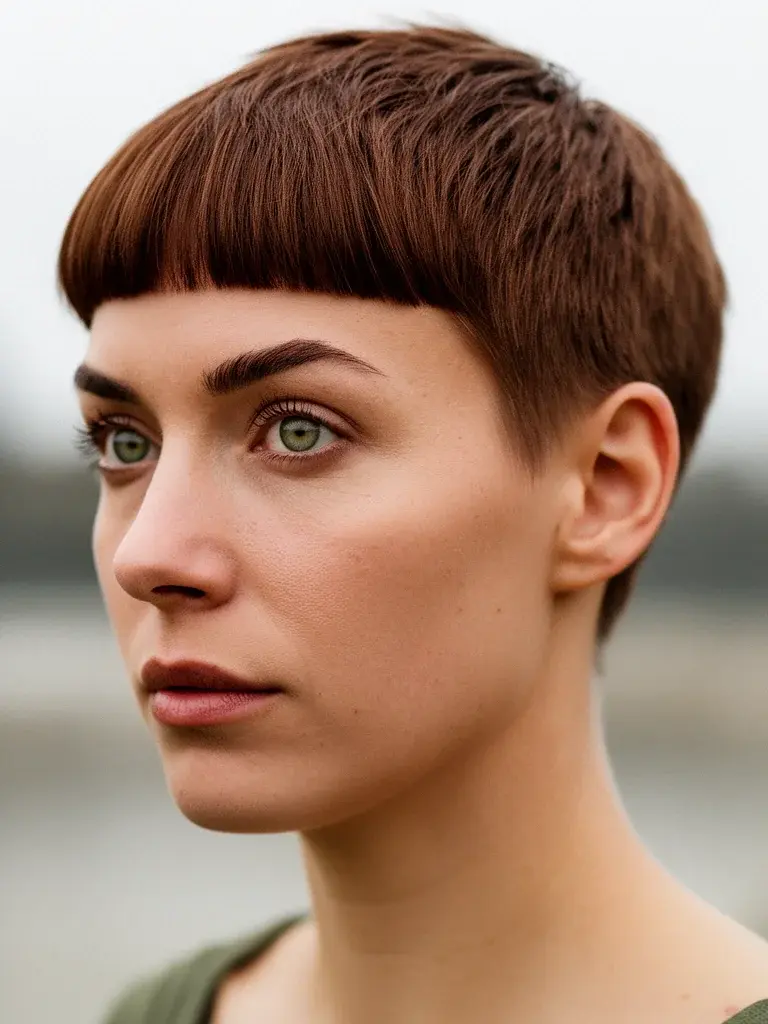
TL;DR
- Best for: Oval and heart faces; fine hair; women who want a pixie with a distinctive visual anchor point
- Avoid if: You have a small or low forehead; you hate bangs that grow into your eyes every 3–4 weeks
- Ask your stylist: "Pixie with short bangs — cut the fringe about 0.5 inches above the eyebrow, straight across. Blunt [or textured] ends. Keep the rest of the top at [X inches]."
- Maintenance: Trim every 4–6 weeks; bang-only trim every 3–4 weeks
Who Does It Suit?
Ideal for:
- Oval and heart faces — the horizontal bang line works with oval's balanced geometry, and on heart faces, adds weight to the forehead zone rather than exposing it
- Fine hair — short bangs on fine hair actually look very clean and precise; fine hair creates a thin, flat bang that's elegant rather than sparse
- Women who want a pixie but aren't ready to expose their forehead completely
- Women drawn to retro-modern aesthetics — short pixie bangs reference 1960s mod style and feel current and editorial in 2025–2026
- Anyone who wants a distinctive visual focal point in their haircut
Hair types:
- Straight: The cleanest bang execution; straight hair allows a precise blunt bang that holds its line from morning to night
- Wavy: Natural wave in the bang creates a slightly less precise, more textured effect — for a cleaner line, straighten the bang with a flat iron; leave it as-is for a softer look
- Fine: Short bangs are particularly elegant on fine hair — the thin, flat quality of fine hair at forehead length creates a delicate, precise fringe rather than a heavy curtain
Avoid If...
- You have a very small or low forehead → short bangs cover vertical forehead space; a very short or low forehead with a short bang leaves almost no forehead visible and can make the face look compact; try a Long Pixie with swept fringe instead
- You dislike frequent salon visits → short bangs grow into the eye line within 3–4 weeks and require more frequent trimming than the rest of the pixie; if you can't manage that frequency, consider a side-swept fringe incorporated into the pixie top instead
- Your hair grows very fast → fast-growing hair means fast-growing bangs; short bangs become eyebrow-length bangs within 2–3 weeks on fast growers, which changes the look entirely
- You want a very casual, undone aesthetic → short bangs require precision; a blunt fringe above the eyebrow line needs daily upkeep to not look unkempt; a Shaggy Bob is the choice for maximum effortlessness
- You rely on styling to keep your bangs out of your face → short bangs can't be pinned back or side-swept easily; they fall forward and stay there
What is a Pixie with Short Bangs?
A pixie with short bangs is a cropped haircut that combines the standard pixie structure — tapered sides, close back, fuller crown — with a short, straight fringe cut above the eyebrows. The bang is not a separate section; it's part of the longer top section of the pixie that's been cut and shaped into a forward-facing panel.
The key characteristic is the bang's position: sitting above the eyebrow rather than at brow level or below. This creates a visible strip of forehead between the bang's bottom edge and the eyebrow. This detail is what separates "short bangs" from "bangs" — and it's what gives the style its distinctive, slightly retro, very deliberate quality.
The reference points for this cut are 1960s mod fashion (Twiggy, Edie Sedgwick, Mia Farrow) filtered through 2020s minimalism. The look has cycled back strongly in 2025–2026 as part of a broader movement toward precise, considered haircuts that reference classic aesthetic eras without being costumey.
Pixie Short Bangs vs Curtain Bangs vs French Crop
| Pixie Short Bangs | Curtain Bangs (on pixie) | French Crop | |
|---|---|---|---|
| Bang style | Blunt horizontal, above brow | Center-parted, swept sides | Short, textured fringe |
| Forehead coverage | Partial (above brow line) | Sides only | Minimal, sits high |
| Aesthetic | Mod, retro-modern | Soft, romantic | Structured, masculine edge |
| Face shapes | Oval, Heart | Any | Oval, Square |
| Maintenance | Every 3–4 weeks | Every 4–6 weeks | Every 3–5 weeks |
| Flexibility | Low (falls forward) | Medium (can pin sides back) | Low (same as short bangs) |
Bottom line: Pixie short bangs = horizontal precision and retro-modern personality. Curtain bangs on pixie = softer, face-framing alternative. French crop = the most stripped-down, least feminine-coded version of a structured fringe.
Cut Specifications
- Bang position: 0.25–1 inch above the eyebrow line; the exact position determines the bang's character (micro = very high, standard short = mid-above-brow)
- Bang width: Varies from full-width (forehead edge to forehead edge) to a narrow center panel; full-width is more graphic; narrow panel is more delicate
- Bang ends: Blunt (precise, graphic) or point-cut (slightly textured, softer) — specify before the cut begins
- Weight line: At the occipital bone for the main cut; the bang defines its own front weight line above the brow
- Trim cycle: Every 3–4 weeks for the bang; every 4–6 weeks for the full cut
Color Pairing
- Single-process bold color that's strongest at the bang: The bang is the focal point; a bold color applied to the full pixie reads most dramatically through the bang section, which catches the most light and attention. Deep red, rich navy, warm copper — the bang carries the color statement.
- Natural base with lightened bang only: A more subtle option — keeping the rest of the pixie at natural color while lightening only the bang section adds a focal point without committing to full-head color. The effect is face-framing and draws the eye to the fringe.
- Dark base, bleached or highlighted bang panel: High contrast between a dark pixie body and a bleached or heavily highlighted bang creates maximum visual interest at the focal point. The graphic quality of a short bang works particularly well with high-contrast color.
Face Shape Tweaks
- Oval: Maximum flexibility with bang length and width. Experiment with different distances above the brow line and different widths.
- Heart: A short bang on a heart face adds visual weight to the forehead, which is already the widest point — this can work if the bang width is narrower rather than full-forehead-width. A very wide, blunt short bang on a heart face can emphasize forehead breadth.
- Round: Keep the bang slightly higher on the forehead (closer to mid-forehead) to reveal more face length. A low short bang on a round face adds horizontal emphasis at the widest point; a higher bang opens up the face vertically.
Hair Type Tweaks
- Straight: Produces the most precise and long-lasting bang definition. A blunt straight bang on straight hair can hold its line all day with minimal styling. If your straight hair is very flat, use a flat iron through the bang to ensure it lies smooth.
- Wavy: Expect the bang to want to wave or lift at the ends. For a clean bang line, straighten the fringe with a flat iron or small round brush while damp. Leaving it natural creates a looser, more textured version of the same look.
- Fine: One of the best textures for short bangs. Fine hair creates thin, precise bangs that look intentionally delicate rather than sparse. The bang lies flat and clean without excessive product.
The Bang Trim: DIY or Salon?
Short bangs grow into the eye line quickly, so the maintenance question matters:
Salon trim (recommended): A professional bang trim takes 10 minutes and costs little to nothing as an add-on to a regular appointment. The precision of a professional cut on a short, blunt bang is hard to replicate at home because the margin for error is very small — a millimeter in the wrong direction changes the look.
DIY trim (possible with care): If your schedule doesn't allow bi-weekly salon visits:
- Use sharp, dedicated hair scissors — never paper scissors or dull shears
- Trim dry, not wet — wet hair appears longer; cut it dry and you'll cut it to its actual dry length
- Comb the bang flat, clip one small section at a time, cut above the desired final line (too short can't be fixed)
- Cut straight across in small snips rather than one continuous pass
What to Tell Your Stylist
"Pixie with short bangs — I want the fringe cut about [half an inch / three-quarters of an inch] above my eyebrows. [Blunt / slightly textured] ends on the bang. Full-width across my forehead [or narrow center panel]. Keep the rest of the top at [X inches] connected to the bang."
Reference photo tips:
- The bang position (how high above the eyebrow) is the most important detail to reference with a photo — words like "short" are relative, but a photo shows the exact line.
- Bring a reference photo of the back and side of the pixie as well, not just the front — the pixie structure affects how the bang reads proportionally.
- Tell your stylist whether you want blunt or textured bang ends before they start. Most stylists default to blunt on short bangs; if you want texture, say so explicitly.
How to Style
Daily (2 minutes):
- Use a flat iron or small round brush to smooth the bang flat while damp
- Direct the bang straight forward and down
- Once dry, apply a very small amount of light hold serum or smoothing cream through just the bang to keep it flat and shiny
- Done — the rest of the pixie needs only texture paste or bare air-dry
Polished (5 minutes):
- Blow-dry the bang downward with a flat-back brush, keeping it flat against the forehead
- Finish with a flat iron pass through the bang to ensure a perfectly straight, precise line
- Apply a tiny amount of smoothing serum to the bang for shine and hold
- Style the rest of the pixie top as usual with paste or pomade
No-Heat Alternative:
- Comb the wet bang flat against the forehead
- Place a clip or use your hand to hold it flat for 5 minutes while the hair starts to set
- Let air-dry completely with the bang directed flat and forward
- Once dry, apply a light smoothing cream through just the bang to tame any lift at the edges
- The rest of the pixie: air-dry with texture paste
Maintenance Schedule
- Week 1: The bang sits precisely above the eyebrow line. This is peak sharpness — the cut looks exactly as intended.
- Week 2: The bang is still above the eyebrow but noticably lower. For those with fast growth, it may already be touching or approaching the eyebrow.
- Week 3: The bang is at the eyebrow line or below. It no longer reads as "short bangs" — it reads as "regular bangs." This is the trim window for most people.
- Week 4: The bang has grown into a standard brow-length bang. If you wanted short bangs, they're gone until the next trim.
If you color your hair:
- Bang panel color: touch up every 3–4 weeks with your bang trim; the bang shows color and regrowth faster than any other section
- Full color: align with your 4–6 week trim schedule
- No-color: still trim the bang every 3–4 weeks independent of whether you do full color
Pro tip: Take a photo of your bang from the front in the first 3 days after the cut, while it's at maximum sharpness. Share it with your stylist at every appointment as the reference for how high the bang should be — without a reference, stylists often leave the bang slightly longer than you want to be safe.
Common Mistakes
-
Cutting the bangs too short at the first appointment Fix: Err on the side of slightly too long on the first cut — if the bang is at the top of your eyebrow and you want it higher, trim again at the next appointment. Too short means your forehead is completely exposed, and that can't be changed without waiting for growth.
-
Cutting the bangs wet and ending up shorter than intended Fix: Always trim or cut short bangs dry. Wet hair can appear 20–30% longer than dry hair. Wet-cut bangs often end up significantly shorter than planned once dry.
-
Neglecting to flat-iron the bang on humid days Fix: Humidity lifts bang ends upward, breaking the horizontal line. A 60-second flat iron pass on the bang in the morning prevents this. Anti-humidity spray applied while the bang is damp also helps.
-
Using heavy serum on the bang that makes it look greasy Fix: Short bangs require very small amounts of product. A drop of light serum between your fingers, pressed lightly through the bang, is enough for shine. More than that makes it look unwashed.
-
Choosing the same bang length as someone with a different forehead length Fix: Reference photos show the bang's position relative to the wearer's specific forehead length. If you have a short forehead, a high-sitting bang becomes micro-bangs faster than on someone with a longer forehead. Adjust the reference photo's bang position based on your own proportions.